
The 7 Core Issues of Adoption in Adults: A Therapist’s Guide for Adoptees
What are the 7 Core Issues of Adoption in Adult Adoptees?
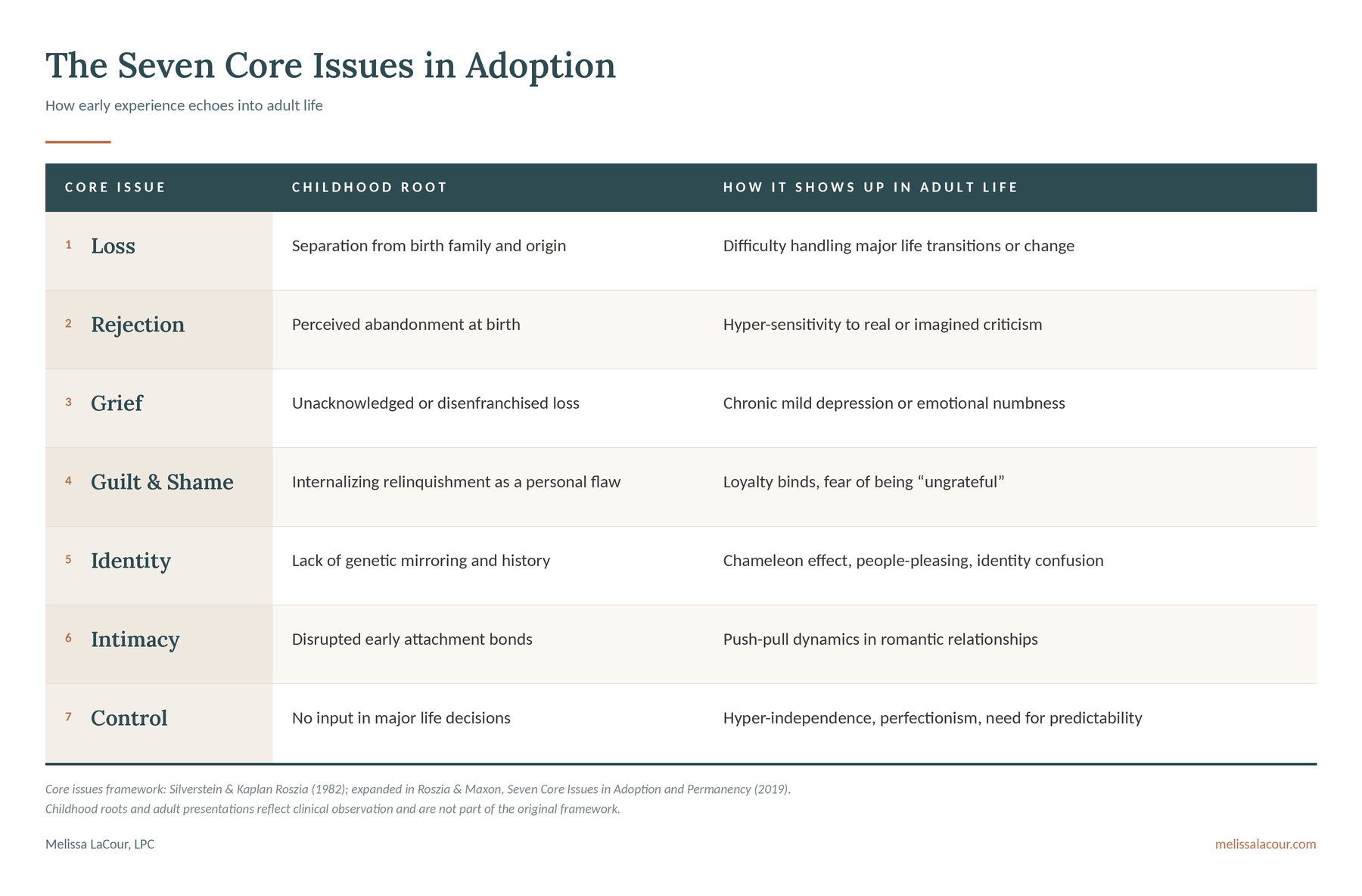
Developed by Sharon Kaplan Roszia and Deborah N. Silverstein, the 7 Core Issues of Adoption framework identifies seven lifelong emotional themes experienced by members of the adoption constellation: Loss, Rejection, Grief, Guilt and Shame, Identity, Intimacy, and Control. In adulthood, these core issues often manifest as fear of abandonment, hyper-independence, chronic people-pleasing, identity confusion, and difficulties with emotional intimacy.
About the Author:
Written by Melissa LaCour, LPC, a licensed therapist, trained in Adoption Competency (TAC) through C.A.S.E. (The Center for Adoption Support and Education), and adult adoptee providing specialized telehealth therapy across Louisiana, Georgia, Indiana, Minnesota, and Ohio.
If you've ever felt like something in you was quietly off — like you were carrying a weight you couldn't name, grieving something you couldn't point to, or struggling in relationships in ways you couldn't fully explain — there's a good chance no one ever gave you language for it.
I know that feeling. I'm an adoptee too.
For a long time, the adoption narrative most of us were handed went something like this: You were chosen. You were loved. You were given a better life. And maybe all of that is true. But it's also incomplete — and that incompleteness is exactly where so much adoptee pain lives. In the gap between the story we were given and the one we actually lived.
The 7 Core Issues of Adoption framework, originally developed by adoption professionals Deborah Silverstein and Sharon Kaplan Roszia, changed a lot of that for me — both personally and in my work as a counselor. Because for the first time, it gave names to things that had always been there but never had words.
This post is my attempt to share that framework with you — not in clinical language, but in the language of someone who has lived it.
What Are the 7 Core Issues of Adoption?
The 7 Core Issues are a set of emotional themes that tend to emerge for people affected by adoption — particularly adoptees, but also birth parents and adoptive families. They were identified as a framework in the early 1980s and have since become foundational in adoption-competent therapy.
Here's the important thing: these aren't stages to get through. They're not a checklist or a diagnosis. They're more like threads — ones that run through the fabric of an adoptee's life, showing up in different forms at different ages, in different relationships, in different seasons.
You may recognize all of them. You may only recognize two or three. Either way, that recognition is the beginning of something.
1. How does Loss manifest in adult adoptees?
Core Definition: Adoption begins with an initial disruption of biological attachment. Even in loving adoptive homes, adoptees experience the loss of biological connection, genetic continuity, culture, or medical history.
In Adulthood: Adult adoptees may experience unexplained anxiety during life transitions, sudden loss, or major milestones (like marriage or parenthood).
Key Signs: Hypervigilance around separation, feeling like a part of you is missing, or waiting for the "other shoe to drop."
2. Why do adult adoptees struggle with a fear of Rejection?
Core Definition: Rejection stems from implicit, non-verbal memory surrounding relinquishment. The early mind interprets separation as an intentional rejection.
In Adulthood: This manifests as rejection sensitivity dysphoria (RSD), chronic people-pleasing, or preemptively pushing loved ones away to avoid being left first.
Key Signs: Over-analyzing tone changes in partners, difficulty accepting criticism, or living in fear of disappointing others.
3. What does Grief look like when it’s disenfranchised?
Core Definition: Adoption grief is often "disenfranchised grief"—a deep loss that society does not acknowledge or validate, frequently dismissed with phrases like "You should be grateful."
In Adulthood: Suppressed grief often turns inward as unexplained sadness, depression, or emotional numbness.
Key Signs: Feeling guilty for feeling sad about adoption, secret mourning during birthdays or holidays, or feeling stuck between two identities.
4. How do Guilt and Shame affect adult adoptee mental health?
Core Definition: Shame is the internal belief that "Something is intrinsically wrong with me for being given away." Guilt arises when an adoptee feels that expressing curiosity about biological family betrays their adoptive parents.
In Adulthood: Creates a severe "loyalty bind" where the adoptee sacrifices their own identity to protect the feelings of others.
Key Signs: Apologizing constantly, hiding search/reunion efforts, or feeling ungrateful for wanting basic medical answers.
5. Why is Identity confusion common among adopted adults?
Core Definition: Identity development requires mirroring—seeing oneself reflected in family traits, temperaments, and genetics. Lacking genetic continuity creates an identity gap.
In Adulthood: Adoptees may describe feeling like a chameleon, shifting personalities depending on who they are with to gain acceptance.
Key Signs: Struggling to answer "Who am I?", feeling disconnected from your reflection, or experiencing an identity crisis when filling out medical forms.
6. How do the core issues impact Intimacy and romantic relationships?
Core Definition: Intimacy requires vulnerability, but vulnerability feels dangerous to a brain conditioned by early attachment loss.
In Adulthood: Adoptees often fluctuate between anxious attachment (fear of being abandoned) and avoidant attachment (fear of getting too close).
Key Signs: Walls up in relationships, difficulty trusting partners completely, or choosing emotionally unavailable partners.
7. Why do adoptees struggle with Control and hyper-independence?
Core Definition: Adoption is a major life decision made completely without the child's consent or control.
In Adulthood: To prevent ever feeling powerless again, adult adoptees often develop hyper-independence, perfectionism, or an intense need to control their environment.
Key Signs: Refusing to ask for help, extreme perfectionism, or intense anxiety when plans change unexpectedly.
-
The 7 Core Issues of Adoption framework was developed in 1989 by adoption specialists Sharon Kaplan Roszia and Deborah N. Silverstein. It was later expanded in their 2019 book, The Seven Core Issues in Adoption and Permanency.
-
Yes. Implicit memory and pre-verbal trauma occur at a cellular and neurological level. Separation from the biological mother disrupts early neurobiological regulation and attachment, even if the adoption occurred at birth and the adoptive home was loving.
-
Look for a licensed mental health professional who holds specialized credentials in adoption competency, such as training from the Center for Adoption Support and Education (C.A.S.E.), or who has lived experience as an adult adoptee.
Need Help Navigating Adoption Complexity as an Adult?
Understanding these seven core issues is often the first step toward healing. If you are an adult adoptee looking for specialized, adoption-competent therapy, you don't have to navigate this alone.
Melissa LaCour, LPC, provides specialized online therapy for adult adoptees across Louisiana, Georgia, Indiana, Minnesota, and Ohio.