

What Happens to Adoptees in Midlife — The Identity Questions That Surface Later
There is a particular kind of adoption story that sounds, on the surface, like a resolved one.
The adoptee who grew up in a loving family, felt mostly fine about being adopted, didn’t spend much time dwelling on it, built a life — career, relationships, children, identity — that felt stable and genuinely their own.
And then, somewhere in their forties or fifties, something shifts.
It might be a parent’s death that raises questions about origins they never pursued. A child who looks nothing like them, prompting a sudden new awareness of biological disconnection. A health scare that puts genetic history on the table. A therapy conversation that leads somewhere they didn’t expect. A midlife quiet that, for the first time, makes room for questions that were always there but never quite audible.
This is not a crisis. It is not regression. It is, in many ways, exactly what is supposed to happen.
There is something I want to say from my own experience: the peace adoptees make with their story in their twenties and thirties is often real — and also incomplete. Not because they have done something wrong, but because the questions midlife asks are different from the ones earlier adulthood asks. When I was younger, the adoption story was something I had resolved. In midlife, I began to understand that resolution was the wrong frame entirely. Some stories don't resolve. They deepen.
Why Midlife Specifically
Midlife has a reputation for crisis, but what is actually happening is better understood as a developmental invitation. It is the period when the scaffolding of early adulthood — the career, the family, the identity built around achieving and becoming — has largely been constructed, and there is suddenly space to ask different questions.
Not “what do I want to become?” but “who have I been?”
Not “what am I building?” but “what is this life actually for?”
For adoptees, this developmental shift intersects with something specific: the adoption narrative that has served as a background story for their entire life is suddenly being reexamined. The story that was adequate — maybe even comfortable — in their twenties and thirties no longer fits the questions midlife is asking.
The Questions That Surface
The specific questions vary, but certain themes recur across the adoptees I work with who are navigating this period:
Who are my people, genetically and historically? This question often intensifies in midlife, particularly with the arrival of DNA testing technology that makes biological family findable in ways that were never previously possible. For adoptees who spent decades not pursuing this question, the sudden accessibility of an answer changes something.
What health information don’t I have? Midlife health concerns make genetic history newly relevant for many adoptees. The absence of a medical family history — which may have felt abstract in their twenties — can feel more concrete when they are filling out forms in a cardiologist’s office.
What parts of me are nature and what are nurture? This question can feel more pressing in midlife, particularly for adoptees who have watched their own children develop. Seeing traits they recognize as their own in a child who shares their genetics — or noticing traits in themselves that do not match their adoptive family — reopens the question of origin in new ways.
Have I made peace with my story, or have I just avoided it? This may be the most important question midlife surfaces for adoptees. The coping strategies of early adulthood — staying busy, focusing forward, not dwelling — become less effective as the internal landscape gets quieter. What was managed, rather than processed, tends to surface.
What do I owe to my adoptive family, and what do I owe to myself? For adoptees who sense that exploring their biological origins might feel like a betrayal to their adoptive family, midlife often brings a reckoning with this conflict. The question of loyalty versus self-knowledge tends to become harder to defer.
The Grief That Comes With It
One of the things that surprises adoptees in midlife is the grief.
Grief for biological family members who may have died before being found. Grief for the relationship with a birth parent that might have been if circumstances had been different. Grief for the years spent not asking the questions, or not having language for the answers.
There is also, often, a complicated grief around the adoptive family. Parents who are aging, ill, or gone. The recognition that certain questions can no longer be asked because the people who might have answered them are no longer here. The realization that the family story that was accepted at face value for decades has gaps that cannot now be filled.
This grief is real and it deserves to be named as such. It is not ingratitude toward the adoptive family. It is the normal response to loss — loss that was always present but may only now have enough space to be felt.
When Search and Reunion Becomes the Question
Midlife is one of the most common times for adoptees to begin thinking seriously about searching for biological family. Sometimes because a triggering event makes the question urgent. Sometimes because the motivations that kept them from searching — a sense that searching would hurt their adoptive parents, or that they should be content with what they have — feel less compelling now.
Search and reunion is a topic that deserves its own careful conversation, and a therapist who understands adoption is an invaluable guide through it. What I want to say here is that there is no right answer about whether to search — only the answer that is right for you, arrived at through honest self-examination rather than guilt in either direction.
What motivates the search matters. What you are hoping to find or resolve matters. And preparing, as much as preparation is possible, for the range of possible outcomes matters enormously.
What Midlife Adoptee Work Looks Like in Therapy
Therapy with adoptees navigating midlife identity questions tends to cover several overlapping areas:
Revisiting and expanding the adoption narrative — looking at the story that has been carried and asking what is accurate, what is incomplete, and what needs to be grieved
Working through the specific grief and loss that surfaces in this period — grief for biological connections, for the family of origin relationship, for the years spent not asking certain questions
Navigating the search and reunion question — if it arises — with care and preparation
Addressing the identity questions that midlife opens up for everyone, with the specific adoption lens applied
Building a more integrated sense of self that can hold all of the complexity — adoptive family, biological origins, chosen identity — without requiring any part to be denied
The goal is not to arrive at a tidy narrative. Adoption stories are rarely tidy. The goal is to develop the capacity to hold the complexity with less weight.
A Word to the Adoptee Who Thought They Were Done With This
If you spent your twenties and thirties feeling mostly fine about being adopted — and now, in your forties or fifties, something is stirring that you thought was settled — I want you to know that this is normal. It is not a sign that you did something wrong by not dealing with it sooner. It is a sign that you are at a developmental moment that invites a deeper reckoning.
The adoption story doesn’t resolve itself once and for all. It is revisited at different stages of life with different questions. Midlife is one of the most significant revisiting points.
What is surfacing is not a problem. It is an invitation.
Melissa LaCour is a Licensed Professional Counselor and adoptee based in Lafayette, Louisiana. She specializes in adoption-informed therapy for adult adoptees at all life stages. In-person in Lafayette and telehealth across Louisiana, Ohio, Minnesota, Georgia, and Indiana.
If midlife is bringing up questions you haven’t had space to look at before, therapy can help. Free 15-minute consultation. The Belonging workbook offers a guided framework for this work.

Why Adoptees Struggle With Intimacy (And What To Do About It)
Intimacy is supposed to be one of the things we want most.
And for many adoptees, it is. The longing for genuine closeness — for a relationship where you are fully known and genuinely chosen — can be intense. Sometimes it feels like the thing you have been looking for your entire life.
And yet when closeness actually arrives, something often happens. A pull in the opposite direction. A sudden need for space. A picking of fights that didn’t need to be picked. A leaving before you can be left.
If this is familiar, I want to explain why it makes complete sense — and what you can actually do about it.
I'll be honest with you: I understand this from the inside. As an adoptee, I have spent time on both sides of this — wanting connection and making it harder than it needed to be. I didn't always have language for what I was doing or why. That's part of what drew me to this work.
The Root of the Problem: Love and Loss Arrived Together
For adoptees, the very first experience of love came packaged with loss.
Whatever the circumstances of the adoption — however loving the adoptive family, however thoughtful the placement decision — there was a loss at the beginning. A connection that existed and then didn’t. A person or people who were there and then were not.
The developing nervous system draws conclusions from early experience. And when the earliest experience of love includes separation, the nervous system learns something important: closeness is dangerous. People you love leave. Connection leads to loss.
This is not a conscious belief. Most adoptees who carry it cannot articulate it as a thought. It lives in the body, in the reflexes, in the patterns of behavior that show up in relationships without a clear explanation.
The result is what attachment researchers call an insecure attachment style — a set of strategies the nervous system has developed to manage the threat of intimacy. Those strategies look different depending on the person, but they share a common function: they keep people at a manageable distance.
How It Shows Up: The Common Patterns
Intimacy struggles in adoptees don’t always look the same. Here are the most common patterns I see in clinical work:
The avoidant pattern. This looks like independence, self-sufficiency, and a general preference for not needing people. Avoidant adults are often described by partners as emotionally unavailable, difficult to get close to, or dismissive of emotional needs. Underneath the self-sufficiency is a deep wariness of depending on someone who might leave.
The anxious pattern. This looks like intensity, preoccupation with the relationship, and a heightened sensitivity to any sign of withdrawal. Anxious adults often describe feeling like they want more closeness than their partner can give. Underneath the intensity is a terror of abandonment that makes even small distances feel catastrophic.
The disorganized pattern. This is the most complex, and it is more common in adoptees who experienced significant early trauma or multiple placements. It looks like wanting closeness and being afraid of it simultaneously — approaching and withdrawing, sometimes in the same conversation. The person who is the source of comfort is also experienced, at some level, as a potential source of danger.
The high-functioning isolation pattern. Some adoptees are genuinely warm, connected, and well-liked — and still maintain a private inner world that no one fully accesses. They can be present in relationships without being truly vulnerable. They give generously and receive poorly. They are, in a particular and lonely way, always slightly behind glass.
Why Relationships Can Feel Like the Highest-Stakes Arena
For adoptees, romantic relationships often carry an unusually heavy weight.
The longing to be chosen — genuinely chosen, by someone who stays — connects directly to the wound at the center of the adoption experience. When a romantic partner chooses you, something in you recognizes that this is what you have been waiting for. And when that relationship feels threatened, or when you sense — accurately or not — that the choosing might be revoked, the response is not proportionate to the situation. It is proportionate to the original wound.
This is why adoptees sometimes describe a level of anxiety or reactivity in relationships that doesn’t match what is actually happening. The current relationship is not the only relationship being processed. The original loss is always, in some sense, present in the room.
The Specific Challenges of Vulnerability
Genuine intimacy requires vulnerability — the willingness to be seen fully, including the parts you are not sure are acceptable.
For adoptees who carry shame about their origins, their identity, or the complexity of their feelings about adoption, vulnerability in a relationship can feel genuinely dangerous. What if the person sees those parts and decides, as someone once seemed to decide, that you are not worth staying for?
This fear can operate completely beneath conscious awareness. An adoptee may not consciously think: “I am afraid you will leave if you really know me.” But the behavior that prevents real knowing — the deflection, the humor that keeps things light, the sudden emotional unavailability exactly when things get most intimate — tells the story.
The fear underneath the wall — the one that says if you really see me, you might leave — is something I wrote about at length in Belonging: A Guided Journey Through Adoption Wounds & Wisdom. The identity and intimacy chapters go deeper into this territory than a single blog post can. If you are doing this work and want something to guide you through it, that is what the workbook is for.
What Partners Need to Understand
If you are in a relationship with an adoptee and reading this, a few things are worth knowing:
The withdrawal is not about you. When your partner pulls away exactly when you feel closest, it is almost never a rejection of you specifically. It is the nervous system doing what it learned to do when closeness arrived.
Pressure makes it worse. The instinct when someone withdraws is often to pursue — to ask more questions, to need more reassurance that the relationship is okay. For a partner with avoidant patterns, this pursuit typically triggers more withdrawal. The counterintuitive move is to give space while remaining clearly available.
Consistency is the medicine. What slowly, over time, changes insecure attachment patterns is consistent, predictable presence. Not grand gestures. Not perfect attunement. Just the steady accumulation of being there, again and again, in a way that does not demand that the person perform their security before they feel it.
What Actually Helps: For Adoptees Working on This
The good news about attachment is that it is not fixed. The patterns formed in early experience are not permanent — they can change, with the right conditions and the right support. Here is what that looks like in practice:
Name the pattern. The first step is simply recognizing which pattern is yours. Not as a diagnosis or a life sentence, but as information. “I tend to pull away when things get close” or “I tend to panic when I sense distance” is enormously useful self-knowledge.
Slow the automatic response. Attachment patterns operate faster than conscious thought. The goal is not to eliminate the response but to create a small gap between the trigger and the behavior. That gap is where choice lives.
Practice tolerating closeness in low-stakes contexts. Intimacy is a skill that builds. Starting with smaller vulnerabilities — saying something true about how you feel in a moment where the stakes are relatively low — builds the nervous system’s capacity for bigger ones.
Work with a therapist who understands adoption. Attachment work is most effective in the context of a therapeutic relationship. The therapy relationship itself is a place to practice — to notice the patterns as they arise, and to have a different experience of closeness than the one that formed the original blueprint.
Be patient with the timeline. Attachment patterns that took years to form take time to change. The measure of progress is not whether the patterns disappear but whether they have less power — whether the gap between trigger and response grows, and whether you make different choices more often than you used to.
A Word to the Adoptee Who Is Tired of This
If you have been in multiple relationships that ended the same way. If you have watched yourself do the thing again, knowing what you were doing, unable to stop it. If you are exhausted by the gap between how much you want closeness and how hard you make it for closeness to arrive —
I want you to know this is not a character flaw. It is not evidence that you are incapable of love or undeserving of it.
It is evidence that your nervous system learned something very early and very powerfully, and that it has been trying to protect you ever since.
That learning can be updated. It takes work. It takes the right support. But it is not permanent — and you are not stuck.
Melissa LaCour is a Licensed Professional Counselor and adoptee based in Lafayette, Louisiana, specializing in adoption-informed therapy for adult adoptees and adoptive families. In-person in Lafayette and telehealth across Louisiana, Ohio, Minnesota, Georgia, and Indiana.
If intimacy is the thing you keep circling, therapy is a good place to start. Book a free 15-minute consultation. The Belonging workbook includes a full chapter on intimacy for adoptees.

Adoption Trauma in Adulthood — What It Is and Why It Still Shows Up
There's a particular kind of confusion that a lot of adult adoptees carry — and it goes something like this:
I had a good life. I was loved. So why does it still feel like something is wrong?
If that question has lived in you — quietly, persistently, sometimes surfacing at the most inconvenient moments — I want to offer you something: not a diagnosis, not a label, but a framework that might finally make some sense of it.
It's called adoption trauma. And it doesn't always look the way we expect trauma to look.
What Is Adoption Trauma?
When most people think of trauma, they think of a single, dramatic event — an accident, an assault, a disaster. Something with a clear before and after.
Adoption trauma rarely works that way.
Adoption trauma refers to the psychological and emotional impact of early separation from a birth parent — and the ripple effects of that separation across a lifetime. It can begin before a child has any conscious memory, before they have language, before they can form a narrative about what happened. And yet the body remembers. The nervous system remembers.
Researchers describe early separation from a caregiver as one of the most significant stressors an infant can experience. Even in cases where the adoptive home is warm, stable, and loving — the separation itself carries weight. It doesn't mean the adoption was wrong or that your adoptive family failed you. It means that loss, even early and pre-verbal loss, leaves a mark.
This is sometimes called developmental trauma or early relational trauma — trauma that is less about a single event and more about a disruption to the foundational experience of safety, connection, and continuity.
Why It Shows Up in Adulthood
Here's what's true about trauma that happened very early in life: it doesn't necessarily show up as a memory. It shows up as a pattern.
You may not remember being placed. You may not have a clear narrative around your earliest separation. But if your nervous system learned, in those first days or months or years, that connection is precarious — that the people you love might disappear — that lesson gets encoded somewhere deep. And it tends to drive behavior from that place, long after the conscious mind has moved on.
For many adult adoptees, adoption trauma surfaces not as flashbacks or nightmares but as:
A persistent, low-level anxiety about being left — in relationships, in friendships, even in professional settings
Difficulty trusting that love is stable, even when there's evidence it is
Patterns of pushing people away before they can leave first
An exquisite sensitivity to criticism, rejection, or feeling unwanted
A sense of not quite belonging — anywhere, to anyone, including yourself
Emotional responses that feel disproportionate to the situation, as if the reaction is older than the moment
A body that is often tense, vigilant, or difficult to settle
None of these are character flaws. They are the logical output of a nervous system that learned early that the world was uncertain.
"But I Had a Happy Childhood"
This is one of the most common things I hear — and one of the most important to address.
Having a loving adoptive family and experiencing adoption trauma are not mutually exclusive. In fact, many adoptees who had genuinely wonderful childhoods still carry this — because the trauma didn't happen in the adoptive family. It happened before it. It happened in the original separation.
Gratitude and grief are not opposites. You can be deeply grateful for the family that raised you and still carry a wound from the one you were separated from. Those two things do not cancel each other out. They simply coexist — and that coexistence is one of the most disorienting parts of the adoptee experience.
The pressure to choose — to be either grateful or wounded, either fine or struggling — is one of the cruelest things the adoption narrative imposes on adoptees. You don't have to choose. Both are true. Both are allowed.
How Adoption Trauma Lives in the Body
Dr. Bessel van der Kolk's landmark work established something that trauma-informed therapists know well: the body keeps the score. Trauma that isn't processed cognitively doesn't disappear — it relocates. It lives in the nervous system, in patterns of tension and activation, in the ways the body responds to perceived threat long after the actual threat is gone.
For adoptees, this can look like:
Hypervigilance — a baseline alertness, always scanning for signs that connection is about to be withdrawn. Feeling exhausted by relationships in a way others don't seem to understand.
Emotional dysregulation — big responses to things that others find minor, because underneath the current moment is the original one. The body doesn't distinguish clearly between then and now.
Shutdown or numbing — the opposite of hyperarousal, but coming from the same place. Some nervous systems respond to chronic stress by going quiet, flat, unreachable. This can look like depression, disconnection, or what one of my clients once described as "watching my life from behind glass."
Somatic symptoms — chronic tension, digestive issues, fatigue, headaches — the body's way of holding what the mind hasn't processed.
None of this makes you broken. It makes you human — and it makes you someone whose early experience was more complex than the simple story you may have been given.
Adoption Trauma Looks Different for Different Adoptees
It's worth saying clearly: adoption trauma is not universal or uniform. Every adoptee's experience is shaped by a complex combination of factors — the circumstances of their placement, the quality of their adoptive home, their temperament, whether they experienced additional adverse experiences before or after adoption, whether their adoption was domestic or international, same-race or transracial.
Some adoptees carry significant, identifiable trauma. Others carry something quieter and more diffuse. Some don't identify with the word "trauma" at all — and that's valid too.
What matters is not whether your experience fits a particular label. What matters is whether naming it — in whatever form it takes — helps you understand yourself more clearly and move through the world with more freedom.
The Particular Complexity of Transracial Adoption
For adoptees raised in families that didn't share their racial or cultural background, adoption trauma can carry additional layers.
When your physical appearance, cultural heritage, or racial identity differs from your adoptive family's, you may have navigated questions of identity without anyone who could mirror that experience back to you. You may have received messages — overt or subtle — about which parts of yourself were acceptable and which were awkward or inconvenient. You may have felt caught between communities, belonging fully to neither.
This isn't a criticism of transracial adoptive families. It's an acknowledgment that the work of navigating racial and cultural identity is real, it matters, and it deserves space in any honest conversation about adoption and healing.
What Healing Actually Looks Like
Healing from adoption trauma is not a linear process, and it is rarely a destination you arrive at once and stay. It is more like a relationship you develop — with your own history, with the parts of yourself that adapted to survive, with the grief that may not have had anywhere to land until now.
A few things that genuinely help:
Adoption-competent therapy. Not every therapist is equipped to work with adoption trauma. Look for someone who is adoption-informed, has training in attachment and trauma, and doesn't minimize the complexity of your experience. Approaches like internal family systems (IFS) can be particularly effective for early developmental trauma.
Language. One of the most consistently healing things I see in my work is the moment a client finds language for something they've been living wordlessly. Frameworks like the 7 Core Issues of Adoption don't diagnose you — they name what's already there. And naming it changes your relationship to it.
Community. There is something irreplaceable about being witnessed by people who understand from the inside. The adoptee community — through podcasts, support groups, online spaces — offers a kind of belonging that even the best therapy can't fully replicate.
Structured self-reflection. For adoptees who are ready to do deeper work but aren't yet in therapy — or who want to supplement the work they're already doing — guided reflection can be a powerful tool. My workbook, Belonging: A Guided Journey Through Adoption Wounds & Wisdom, was written specifically for adult adoptees and covers these themes chapter by chapter, with space to write, reflect, and integrate.
Somatic practices. Because adoption trauma often lives in the body, healing often has to happen there too. Breathwork, yoga, movement, body-based therapy — these aren't luxuries. For many adoptees, they're essential.
A Word About Resilience
I want to be careful here, because resilience is a word that gets weaponized against adoptees.
You're so resilient. It's often meant as a compliment — but it can function as a way of closing the conversation. Of saying: you survived, so you're fine, so let's move on.
Resilience is real. Many adoptees have developed extraordinary capacity for adaptation, empathy, insight, and strength — in part because of what they've navigated. That is worth honoring.
But resilience and healing are not the same thing. You can be highly functional and still be carrying something unresolved. You can be strong and still be hurting. You can have survived beautifully and still deserve more than just survival.
The goal isn't to be resilient in spite of your adoption story. The goal is to understand it, integrate it, and build a life that is genuinely yours — not just one that looks okay from the outside.
You Don't Have to Have It All Figured Out
If this post has surfaced things that feel tender or confusing — that's not a sign that something is wrong with you. That's a sign that something in you is ready to be looked at.
You don't have to resolve it today. You don't have to have the right words for it yet. You don't have to decide whether "trauma" is the right word for your experience before you're allowed to take it seriously.
You're allowed to start wherever you are.
And wherever you are — with whatever you're carrying — there is a path forward. It isn't always easy, and it isn't linear, and it doesn't end with a ceremony or a certificate. But it is real. And you are not alone on it.
Melissa LaCour is a Licensed Professional Counselor based in Louisiana, specializing in adoption, relationships, and life transitions. She is also an adoptee. Learn more at melissalacour.com.
If you're ready to go deeper into your adoption story, the Belonging workbook was written for exactly this moment.
Further reading: Van der Kolk, B. (2014). The body keeps the score. Viking. Boss, P. (1999). Ambiguous loss. Harvard University Press. Verrier, N. N. (1993). The primal wound. Gateway Press. Brodzinsky, D., Schechter, M., & Henig, R. M. (1992). Being adopted: The lifelong search for self. Doubleday.
The 7 Core Issues of Adoption in Adults: A Therapist’s Guide for Adoptees
What are the 7 Core Issues of Adoption in Adult Adoptees?
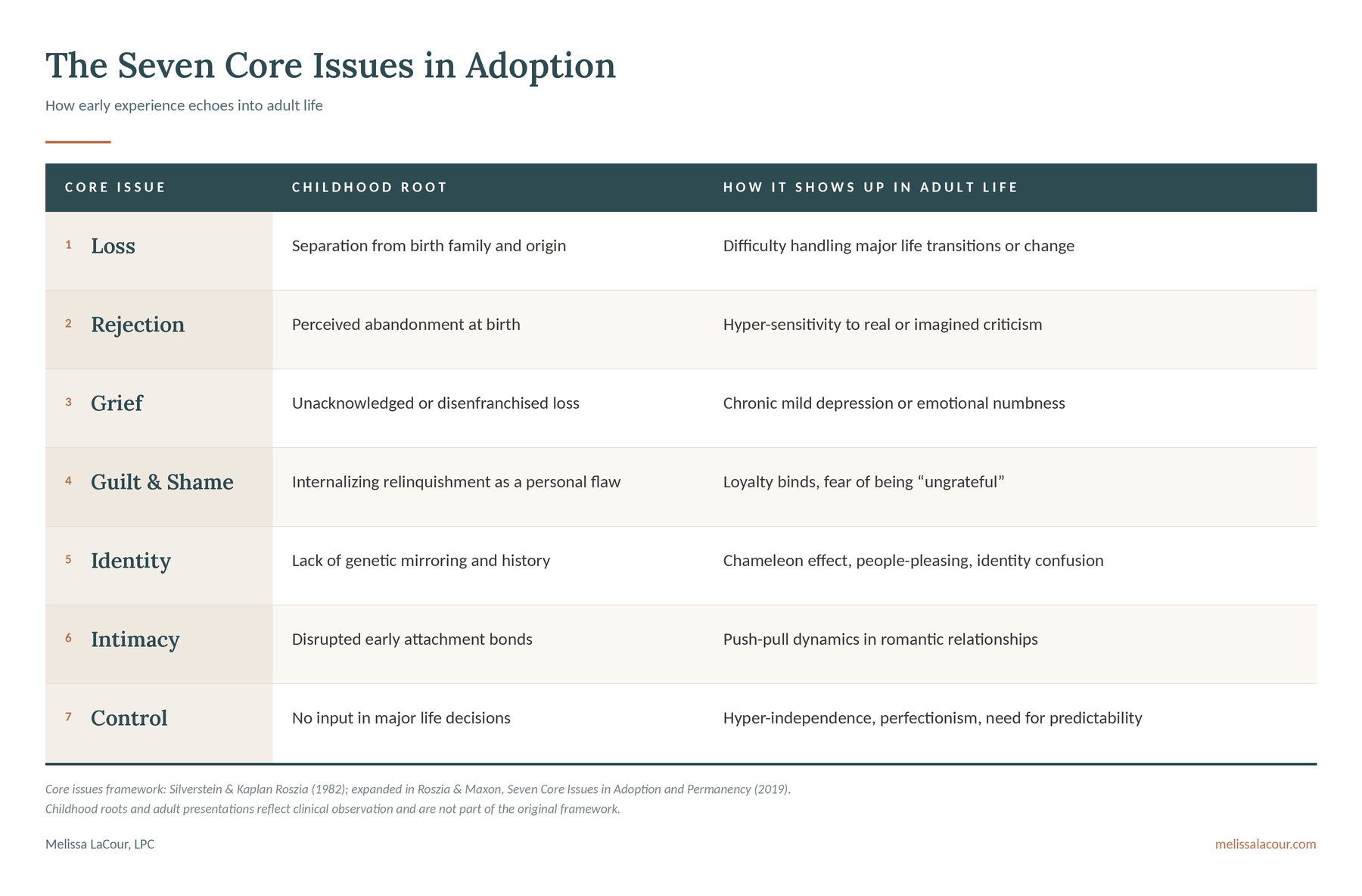
Developed by Sharon Kaplan Roszia and Deborah N. Silverstein, the 7 Core Issues of Adoption framework identifies seven lifelong emotional themes experienced by members of the adoption constellation: Loss, Rejection, Grief, Guilt and Shame, Identity, Intimacy, and Control. In adulthood, these core issues often manifest as fear of abandonment, hyper-independence, chronic people-pleasing, identity confusion, and difficulties with emotional intimacy.
About the Author:
Written by Melissa LaCour, LPC, a licensed therapist, trained in Adoption Competency (TAC) through C.A.S.E. (The Center for Adoption Support and Education), and adult adoptee providing specialized telehealth therapy across Louisiana, Georgia, Indiana, Minnesota, and Ohio.
If you've ever felt like something in you was quietly off — like you were carrying a weight you couldn't name, grieving something you couldn't point to, or struggling in relationships in ways you couldn't fully explain — there's a good chance no one ever gave you language for it.
I know that feeling. I'm an adoptee too.
For a long time, the adoption narrative most of us were handed went something like this: You were chosen. You were loved. You were given a better life. And maybe all of that is true. But it's also incomplete — and that incompleteness is exactly where so much adoptee pain lives. In the gap between the story we were given and the one we actually lived.
The 7 Core Issues of Adoption framework, originally developed by adoption professionals Deborah Silverstein and Sharon Kaplan Roszia, changed a lot of that for me — both personally and in my work as a counselor. Because for the first time, it gave names to things that had always been there but never had words.
This post is my attempt to share that framework with you — not in clinical language, but in the language of someone who has lived it.
What Are the 7 Core Issues of Adoption?
The 7 Core Issues are a set of emotional themes that tend to emerge for people affected by adoption — particularly adoptees, but also birth parents and adoptive families. They were identified as a framework in the early 1980s and have since become foundational in adoption-competent therapy.
Here's the important thing: these aren't stages to get through. They're not a checklist or a diagnosis. They're more like threads — ones that run through the fabric of an adoptee's life, showing up in different forms at different ages, in different relationships, in different seasons.
You may recognize all of them. You may only recognize two or three. Either way, that recognition is the beginning of something.
1. How does Loss manifest in adult adoptees?
Core Definition: Adoption begins with an initial disruption of biological attachment. Even in loving adoptive homes, adoptees experience the loss of biological connection, genetic continuity, culture, or medical history.
In Adulthood: Adult adoptees may experience unexplained anxiety during life transitions, sudden loss, or major milestones (like marriage or parenthood).
Key Signs: Hypervigilance around separation, feeling like a part of you is missing, or waiting for the "other shoe to drop."
2. Why do adult adoptees struggle with a fear of Rejection?
Core Definition: Rejection stems from implicit, non-verbal memory surrounding relinquishment. The early mind interprets separation as an intentional rejection.
In Adulthood: This manifests as rejection sensitivity dysphoria (RSD), chronic people-pleasing, or preemptively pushing loved ones away to avoid being left first.
Key Signs: Over-analyzing tone changes in partners, difficulty accepting criticism, or living in fear of disappointing others.
3. What does Grief look like when it’s disenfranchised?
Core Definition: Adoption grief is often "disenfranchised grief"—a deep loss that society does not acknowledge or validate, frequently dismissed with phrases like "You should be grateful."
In Adulthood: Suppressed grief often turns inward as unexplained sadness, depression, or emotional numbness.
Key Signs: Feeling guilty for feeling sad about adoption, secret mourning during birthdays or holidays, or feeling stuck between two identities.
4. How do Guilt and Shame affect adult adoptee mental health?
Core Definition: Shame is the internal belief that "Something is intrinsically wrong with me for being given away." Guilt arises when an adoptee feels that expressing curiosity about biological family betrays their adoptive parents.
In Adulthood: Creates a severe "loyalty bind" where the adoptee sacrifices their own identity to protect the feelings of others.
Key Signs: Apologizing constantly, hiding search/reunion efforts, or feeling ungrateful for wanting basic medical answers.
5. Why is Identity confusion common among adopted adults?
Core Definition: Identity development requires mirroring—seeing oneself reflected in family traits, temperaments, and genetics. Lacking genetic continuity creates an identity gap.
In Adulthood: Adoptees may describe feeling like a chameleon, shifting personalities depending on who they are with to gain acceptance.
Key Signs: Struggling to answer "Who am I?", feeling disconnected from your reflection, or experiencing an identity crisis when filling out medical forms.
6. How do the core issues impact Intimacy and romantic relationships?
Core Definition: Intimacy requires vulnerability, but vulnerability feels dangerous to a brain conditioned by early attachment loss.
In Adulthood: Adoptees often fluctuate between anxious attachment (fear of being abandoned) and avoidant attachment (fear of getting too close).
Key Signs: Walls up in relationships, difficulty trusting partners completely, or choosing emotionally unavailable partners.
7. Why do adoptees struggle with Control and hyper-independence?
Core Definition: Adoption is a major life decision made completely without the child's consent or control.
In Adulthood: To prevent ever feeling powerless again, adult adoptees often develop hyper-independence, perfectionism, or an intense need to control their environment.
Key Signs: Refusing to ask for help, extreme perfectionism, or intense anxiety when plans change unexpectedly.
-
The 7 Core Issues of Adoption framework was developed in 1989 by adoption specialists Sharon Kaplan Roszia and Deborah N. Silverstein. It was later expanded in their 2019 book, The Seven Core Issues in Adoption and Permanency.
-
Yes. Implicit memory and pre-verbal trauma occur at a cellular and neurological level. Separation from the biological mother disrupts early neurobiological regulation and attachment, even if the adoption occurred at birth and the adoptive home was loving.
-
Look for a licensed mental health professional who holds specialized credentials in adoption competency, such as training from the Center for Adoption Support and Education (C.A.S.E.), or who has lived experience as an adult adoptee.
Need Help Navigating Adoption Complexity as an Adult?
Understanding these seven core issues is often the first step toward healing. If you are an adult adoptee looking for specialized, adoption-competent therapy, you don't have to navigate this alone.
Melissa LaCour, LPC, provides specialized online therapy for adult adoptees across Louisiana, Georgia, Indiana, Minnesota, and Ohio.