
How Childhood Attachment Wounds Show Up In Adult Relationships
Most people go into adult relationships with the best intentions. They want to love well, be loved well, and build something that lasts.
And most people find, at some point, that something keeps getting in the way. A pattern that repeats. A wall that goes up exactly when things get good. A pull toward people who are not quite available. A tendency to disappear or to cling, neither of which produces the connection they actually want.
The origin of these patterns is almost always the same place: early childhood.
What Attachment Theory Actually Says
Attachment theory, developed by British psychiatrist John Bowlby and expanded by developmental psychologist Mary Ainsworth, proposes that the quality of early caregiving relationships creates an internal working model — a set of expectations about how relationships work, how available people are, and how safe it is to need someone.
This model operates largely below conscious awareness. You don’t decide what your attachment style is. It was shaped by thousands of interactions before you had language for them — by whether the person who was supposed to come when you cried actually came, whether comfort was available when you were scared, whether the people you needed were reliably present or unpredictably absent.
Four primary attachment styles have been identified in the research: secure, anxious, avoidant, and disorganized. Only the secure style — developed when early caregiving was consistently warm, responsive, and available — supports easy, relaxed adult intimacy. The other three are adaptations to early environments that were, in various ways, insufficient for the child’s attachment needs.
The Three Insecure Patterns and What They Look Like Now
Anxious attachment develops when caregiving was inconsistent — sometimes present and warm, sometimes absent or preoccupied. The child learns that connection is possible but unreliable, and develops a strategy of heightened vigilance and emotional intensity to maximize caregiver availability. In adulthood this looks like: preoccupation with the relationship, sensitivity to any hint of withdrawal, difficulty tolerating distance, and a tendency to interpret ambiguous signals as rejection.
Avoidant attachment develops when caregiving was consistently emotionally unavailable — present in a functional sense but not attuned to the child’s emotional needs. The child learns that emotional needs won’t be met and develops a strategy of self-reliance and emotional suppression. In adulthood this looks like: discomfort with closeness, difficulty asking for or accepting support, a preference for independence, and a tendency to withdraw when relationships become emotionally demanding.
Disorganized attachment develops when caregiving was frightening, unpredictable, or traumatizing — when the very person who was supposed to be the source of safety was also a source of fear. The child is caught in an impossible bind: approach the caregiver (terrifying) or don’t (also terrifying). In adulthood this looks like: simultaneous craving for and fear of closeness, volatile relationships, difficulty regulating emotional responses to relationship stress, and patterns that feel out of control.
The Specific Ways Wounds Show Up
Attachment wounds don’t show up as abstract patterns. They show up in specific, concrete moments in your relationships. Here are some of the most common:
Choosing unavailable partners — people who are emotionally closed, physically absent, or otherwise unable to offer the consistent closeness the attachment system is seeking
Pushing away people who are actually available — finding something wrong with them, creating conflict, or losing interest exactly when they show up consistently
Extreme reactions to perceived rejection — responses that feel disproportionate to the situation because they are drawing on the emotional weight of the original wound, not just the current moment
Difficulty trusting even when there is no evidence of untrustworthiness
Self-sabotage at moments of genuine connection and vulnerability
Tolerance of treatment in relationships that replicates the early wound — because it is familiar, because familiarity registers as safety even when it isn’t
I see this pattern consistently in my work with adoptees, and I understand why. Adoption, whatever else it is, begins with a loss of connection. The nervous system of a newborn or infant does not know the reasons. It only knows that the person it was connected to is no longer there. That early registration — love is here and then it isn't — has a way of shaping every attachment that comes after. It doesn't doom anyone. But it does mean that adoptees often arrive at adult relationships carrying a blueprint that was written before they had any say in it.
What Healing Actually Looks Like
Here is the most important thing to understand about attachment wounds: they were formed in relationship, and they heal in relationship.
Not through insight alone. Not through understanding the theory of your attachment style, as useful as that understanding is. But through repeated, embodied experience of relationships that work differently than the ones that formed the wound.
This can happen in a few contexts:
A therapeutic relationship. Therapy offers a particular kind of relational experience — consistent, boundaried, attuned, and focused on the client’s inner world. For people with insecure attachment, the therapy relationship itself is often the first place they experience being consistently met. That experience changes something.
An earned secure attachment relationship. Researchers use the term “learned security” to describe what happens when someone with an insecure attachment style develops a secure relationship — typically with a romantic partner, a close friend, or a therapist — that provides enough corrective experience to update the internal working model. It is possible. It takes time.
Personal development work. Reflective practices that build self-awareness — therapy, journaling, mindfulness, honest conversations with people you trust — support the gradual process of knowing yourself well enough to recognize the pattern when it activates, and to make different choices.
The goal is not to eliminate the attachment style. It is to develop enough awareness and flexibility that the pattern no longer runs your relationships without your knowledge.
Melissa LaCour is a Licensed Professional Counselor based in Lafayette, Louisiana, specializing in relationships, adoption, and life transitions. In-person in Lafayette and telehealth across Louisiana, Ohio, Minnesota, Georgia, and Indiana.
If you recognize your patterns here and are ready to do something about them, start with a free 15-minute consultation.

What Birth Parents Experience That No One Talks About
In most adoption narratives, birth parents appear briefly and then disappear.
They make a decision — one of the most consequential decisions a human being can make — and then the story moves on. The adoptive family takes center stage. The adoptee grows up. The birth parent becomes a background character in someone else’s story.
But birth parents don’t disappear. They go on living. And what they carry — in the months and years and decades after placement — is one of the least discussed and most inadequately supported experiences in the adoption world.
This post is for birth parents. It is also for the therapists, social workers, adoptive parents, and adoptees who love them and want to understand what they are actually carrying.
As an adoptee with an open adoption, I spent much of my childhood deeply curious about my birthmother — wondering who I looked like, where my talents came from, what parts of me were hers. That curiosity was quiet but constant, the kind that doesn't make noise but never really goes away either.
When I finally developed a relationship with her at sixteen, I understood something I couldn't have put into words before: she had been carrying questions too. Not just about whether I was okay, but about who I had become — and whether the decision she made had been the right one.
That experience shaped how I sit with birth parents in my clinical work. What I've witnessed is a wide spectrum — some who have built walls so high around the experience that they can barely access it, and others who are still grieving just as actively as they were the day of placement, years or decades later. What both have in common is that they rarely have a space where any of it is welcome. This post is an attempt to create that space — even just in words.
The Decision That Never Really Ends
Birth parents are often asked, at various points in their lives, whether they regret their decision. It is the wrong question.
Placement is not a decision that gets made once and then filed away. For most birth parents, it is a decision that continues to live in the body, resurface in the mind, and shape behavior in relationships for years — sometimes for a lifetime. It is not a past event. It is an ongoing presence.
This is one of the most important things for anyone supporting a birth parent to understand: the work of processing a placement decision is not something that gets done in the weeks or months following. It is something many birth parents return to at every developmental milestone, every anniversary, every moment that reminds them of what they chose and what it cost.
Grief Without a Map
The grief birth parents experience is among the most complex and least socially supported forms of grief there is.
Pauline Boss, the researcher who developed the concept of ambiguous loss, describes grief that lacks the social acknowledgment and ritual that helps people mourn as “disenfranchised grief.” Birth parents experience this in an acute form. There is no funeral. There is no bereavement leave. There is no socially recognized moment of mourning. In many cases, the people in a birth parent’s life — friends, family, colleagues — don’t know about the placement at all.
What this means is that birth parents are often grieving in complete silence. Grieving a child who is alive. Grieving a relationship that technically exists somewhere but is not accessible. Grieving a self — a version of their life — that will not be.
Researchers who study birth parents consistently find elevated rates of grief, depression, anxiety, and complicated mourning — often lasting for decades. The silence doesn’t protect birth parents from the grief. It just makes it harder to process.
What Birth Parents Are Often Told — And What Gets Left Out
There is a particular kind of cruelty in the messages birth parents often receive, even from well-meaning people:
“You made a brave decision.” (Which doesn’t leave room for the possibility that they feel broken by it.)
“You did what was best for your child.” (Which doesn’t acknowledge that best for the child and painless for the parent are not the same thing.)
“You should be proud.” (Which can feel profoundly disconnected from what they are actually feeling.)
“At least you know they’re in a good home.” (Which treats placement as a completed transaction rather than an ongoing relational reality.)
These responses are usually offered in good faith. But they have the effect of foreclosing the conversation rather than opening it. They communicate, implicitly, that grief and ambivalence are not welcome. That the birth parent is supposed to have arrived, by now, at peace.
Most birth parents have not arrived at peace. And the expectation that they should have is one of the loneliest parts of the experience.
Shame: The Hidden Layer
Underneath the grief, for many birth parents, is shame.
Shame about the circumstances that led to the placement. Shame about the decision itself. Shame about the grief — because if you gave your child a better life, shouldn’t you be okay? Shame about searching for information about your child. Shame about not searching. Shame about the complexity of what you feel.
Brene Brown’s research on shame is relevant here: shame grows in silence and needs secrecy to survive. It is metabolized through connection — through being seen and not condemned, through finding that the thing you are most ashamed of does not drive people away.
For birth parents, this kind of connection is difficult to find. There are few spaces where the full complexity of the birth parent experience is welcomed. Therapy, when it is adoption-informed and judgment-free, can be one of those spaces. Support groups for birth parents can be another.
The Relational Impact
Placement doesn’t affect only the birth parent’s relationship with the child who was placed. It often affects their relationships with everyone.
Many birth parents describe a changed relationship with subsequent children — anxiety about losing them, hypervigilance about their wellbeing, or conversely, emotional distance that they can’t fully explain. They describe partnerships strained by grief that couldn’t be shared. They describe friendships that became shallower once there was a significant part of their history they felt they couldn’t disclose.
The placement decision doesn’t just shape the birth parent’s inner life. It shapes the contours of every relationship they have afterward.
Search, Contact, and Reunion
Many birth parents think about searching for the child they placed. Some do. Some don’t. Some search and find what they hoped for. Some search and find something far more complicated.
What matters most is this: there is no right answer. The decision to search or not search is a deeply personal one, shaped by the specifics of the adoption, the emotional readiness of everyone involved, and factors no one outside the situation can fully evaluate.
What birth parents often need is not guidance toward a particular decision but a space to think through what they actually want, what they fear, and what they can handle — without pressure from any direction.
If reunion does happen, it rarely looks the way birth parents imagined. It tends to be complicated, emotionally layered, and different for everyone involved. Support before, during, and after this process is not a luxury. It is a clinical necessity.
Reunion is rarely the resolution people imagine it will be — and I've come to understand that from both sides.
In my own life, reunion didn't arrive through a deliberate search. It came quietly, through grief — a loss in my birthmother's life that seemed to crack open what had been held closed. What followed was slow. It took years before we found a rhythm that honored what we were to each other without trying to name it something it wasn't. She carried what I imagine was a great deal of shame, and a deep fear of overstepping. That kind of careful, tender navigation doesn't show up in the reunion stories people tell at dinner parties.
Clinically, I've sat with birth parents who have reconnected with the children they placed — and what strikes me most is how reunion doesn't always bring the emotional release they expected. Some remain strangely distant even after contact is made, as though the years of compartmentalization have become structural. The grief is still there. It has just learned to live behind glass.
What Actually Helps
For birth parents who are struggling, a few things consistently make a difference:
Adoption-informed therapy. Not every therapist is equipped to support birth parents. Look for someone who understands the adoption constellation, doesn’t minimize the complexity of the placement decision, and can hold grief and ambivalence without moving too quickly toward resolution.
Peer support. There is something irreplaceable about being in a room — or a Zoom call — with other birth parents. Organizations like Concerned United Birthparents (CUB) offer support specifically for this population. The specificity matters.
Permission to grieve without a timeline. One of the most healing things anyone can offer a birth parent is the simple acknowledgment that there is no point at which they are supposed to be over this. Grief of this kind doesn’t follow a schedule.
A judgment-free space for ambivalence. Many birth parents have never had a space where they could say the complicated, contradictory, imperfect things they actually feel — without worrying about being judged or having their love for their child questioned. That space changes things.
A Word to Everyone Else
If you are an adoptive parent, an adoptee, a social worker, or a clinician reading this — the best thing you can offer a birth parent is not an answer. It is a willingness to sit with the complexity.
Not rushing them toward gratitude or peace. Not minimizing the grief by highlighting the good. Not treating their experience as a background detail in someone else’s story.
Birth parents are full members of the adoption constellation. Their experience matters — not as context for someone else’s story, but as its own story, deserving its own attention and its own care.
Melissa LaCour is a Licensed Professional Counselor and adoptee based in Lafayette, Louisiana, specializing in adoption-informed therapy for adoptees, adoptive families, and birth parents. She offers in-person sessions in Lafayette and telehealth across Louisiana, Georgia, Indiana Minnesota, and Ohio.
If you’re a birth parent looking for support, or a professional looking for adoption-informed referrals, reach out here.
The 7 Core Issues of Adoption in Adults: A Therapist’s Guide for Adoptees
What are the 7 Core Issues of Adoption in Adult Adoptees?
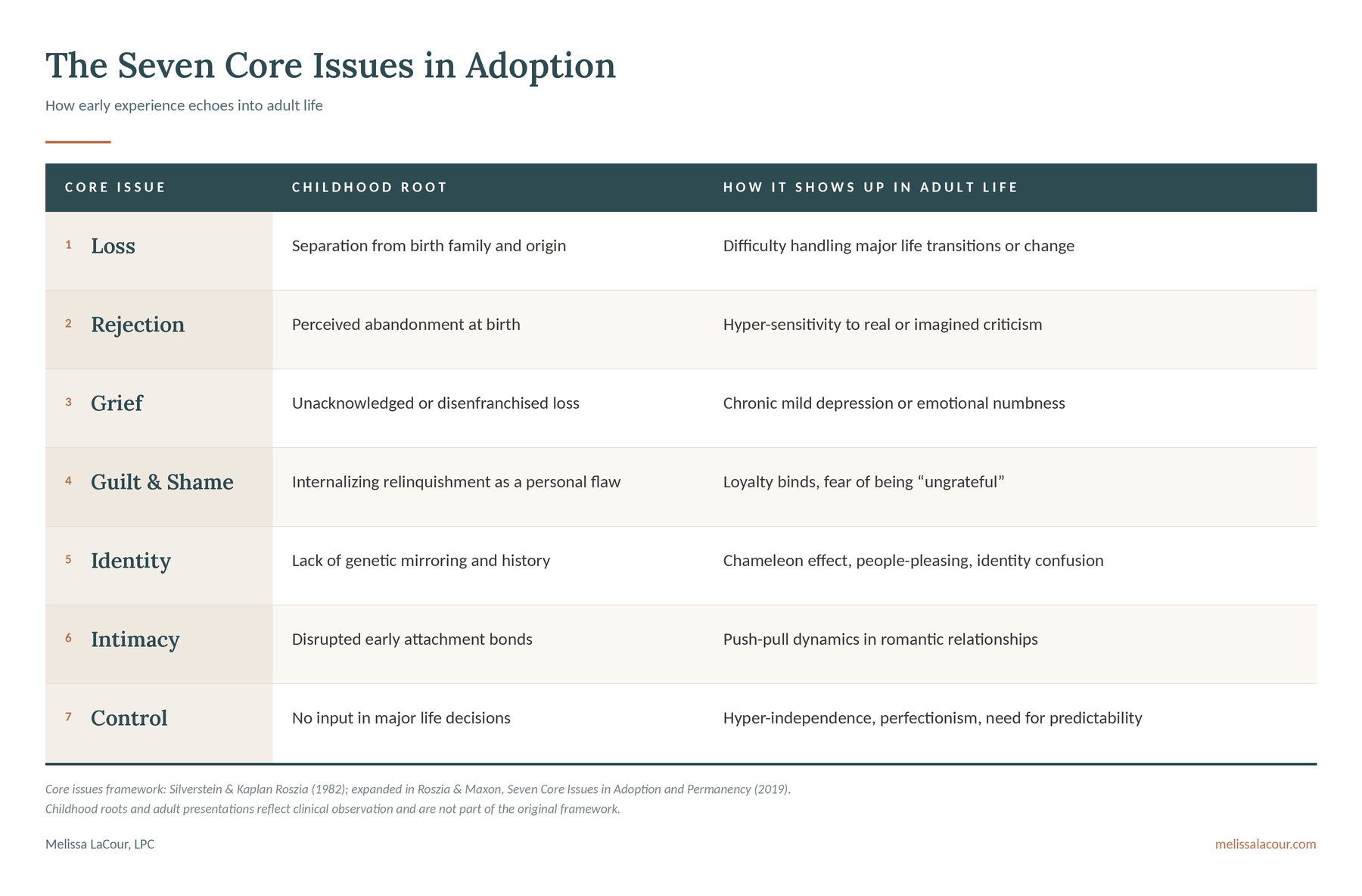
Developed by Sharon Kaplan Roszia and Deborah N. Silverstein, the 7 Core Issues of Adoption framework identifies seven lifelong emotional themes experienced by members of the adoption constellation: Loss, Rejection, Grief, Guilt and Shame, Identity, Intimacy, and Control. In adulthood, these core issues often manifest as fear of abandonment, hyper-independence, chronic people-pleasing, identity confusion, and difficulties with emotional intimacy.
About the Author:
Written by Melissa LaCour, LPC, a licensed therapist, trained in Adoption Competency (TAC) through C.A.S.E. (The Center for Adoption Support and Education), and adult adoptee providing specialized telehealth therapy across Louisiana, Georgia, Indiana, Minnesota, and Ohio.
If you've ever felt like something in you was quietly off — like you were carrying a weight you couldn't name, grieving something you couldn't point to, or struggling in relationships in ways you couldn't fully explain — there's a good chance no one ever gave you language for it.
I know that feeling. I'm an adoptee too.
For a long time, the adoption narrative most of us were handed went something like this: You were chosen. You were loved. You were given a better life. And maybe all of that is true. But it's also incomplete — and that incompleteness is exactly where so much adoptee pain lives. In the gap between the story we were given and the one we actually lived.
The 7 Core Issues of Adoption framework, originally developed by adoption professionals Deborah Silverstein and Sharon Kaplan Roszia, changed a lot of that for me — both personally and in my work as a counselor. Because for the first time, it gave names to things that had always been there but never had words.
This post is my attempt to share that framework with you — not in clinical language, but in the language of someone who has lived it.
What Are the 7 Core Issues of Adoption?
The 7 Core Issues are a set of emotional themes that tend to emerge for people affected by adoption — particularly adoptees, but also birth parents and adoptive families. They were identified as a framework in the early 1980s and have since become foundational in adoption-competent therapy.
Here's the important thing: these aren't stages to get through. They're not a checklist or a diagnosis. They're more like threads — ones that run through the fabric of an adoptee's life, showing up in different forms at different ages, in different relationships, in different seasons.
You may recognize all of them. You may only recognize two or three. Either way, that recognition is the beginning of something.
1. How does Loss manifest in adult adoptees?
Core Definition: Adoption begins with an initial disruption of biological attachment. Even in loving adoptive homes, adoptees experience the loss of biological connection, genetic continuity, culture, or medical history.
In Adulthood: Adult adoptees may experience unexplained anxiety during life transitions, sudden loss, or major milestones (like marriage or parenthood).
Key Signs: Hypervigilance around separation, feeling like a part of you is missing, or waiting for the "other shoe to drop."
2. Why do adult adoptees struggle with a fear of Rejection?
Core Definition: Rejection stems from implicit, non-verbal memory surrounding relinquishment. The early mind interprets separation as an intentional rejection.
In Adulthood: This manifests as rejection sensitivity dysphoria (RSD), chronic people-pleasing, or preemptively pushing loved ones away to avoid being left first.
Key Signs: Over-analyzing tone changes in partners, difficulty accepting criticism, or living in fear of disappointing others.
3. What does Grief look like when it’s disenfranchised?
Core Definition: Adoption grief is often "disenfranchised grief"—a deep loss that society does not acknowledge or validate, frequently dismissed with phrases like "You should be grateful."
In Adulthood: Suppressed grief often turns inward as unexplained sadness, depression, or emotional numbness.
Key Signs: Feeling guilty for feeling sad about adoption, secret mourning during birthdays or holidays, or feeling stuck between two identities.
4. How do Guilt and Shame affect adult adoptee mental health?
Core Definition: Shame is the internal belief that "Something is intrinsically wrong with me for being given away." Guilt arises when an adoptee feels that expressing curiosity about biological family betrays their adoptive parents.
In Adulthood: Creates a severe "loyalty bind" where the adoptee sacrifices their own identity to protect the feelings of others.
Key Signs: Apologizing constantly, hiding search/reunion efforts, or feeling ungrateful for wanting basic medical answers.
5. Why is Identity confusion common among adopted adults?
Core Definition: Identity development requires mirroring—seeing oneself reflected in family traits, temperaments, and genetics. Lacking genetic continuity creates an identity gap.
In Adulthood: Adoptees may describe feeling like a chameleon, shifting personalities depending on who they are with to gain acceptance.
Key Signs: Struggling to answer "Who am I?", feeling disconnected from your reflection, or experiencing an identity crisis when filling out medical forms.
6. How do the core issues impact Intimacy and romantic relationships?
Core Definition: Intimacy requires vulnerability, but vulnerability feels dangerous to a brain conditioned by early attachment loss.
In Adulthood: Adoptees often fluctuate between anxious attachment (fear of being abandoned) and avoidant attachment (fear of getting too close).
Key Signs: Walls up in relationships, difficulty trusting partners completely, or choosing emotionally unavailable partners.
7. Why do adoptees struggle with Control and hyper-independence?
Core Definition: Adoption is a major life decision made completely without the child's consent or control.
In Adulthood: To prevent ever feeling powerless again, adult adoptees often develop hyper-independence, perfectionism, or an intense need to control their environment.
Key Signs: Refusing to ask for help, extreme perfectionism, or intense anxiety when plans change unexpectedly.
-
The 7 Core Issues of Adoption framework was developed in 1989 by adoption specialists Sharon Kaplan Roszia and Deborah N. Silverstein. It was later expanded in their 2019 book, The Seven Core Issues in Adoption and Permanency.
-
Yes. Implicit memory and pre-verbal trauma occur at a cellular and neurological level. Separation from the biological mother disrupts early neurobiological regulation and attachment, even if the adoption occurred at birth and the adoptive home was loving.
-
Look for a licensed mental health professional who holds specialized credentials in adoption competency, such as training from the Center for Adoption Support and Education (C.A.S.E.), or who has lived experience as an adult adoptee.
Need Help Navigating Adoption Complexity as an Adult?
Understanding these seven core issues is often the first step toward healing. If you are an adult adoptee looking for specialized, adoption-competent therapy, you don't have to navigate this alone.
Melissa LaCour, LPC, provides specialized online therapy for adult adoptees across Louisiana, Georgia, Indiana, Minnesota, and Ohio.