


What Happens to Adoptees in Midlife — The Identity Questions That Surface Later
There is a particular kind of adoption story that sounds, on the surface, like a resolved one.
The adoptee who grew up in a loving family, felt mostly fine about being adopted, didn’t spend much time dwelling on it, built a life — career, relationships, children, identity — that felt stable and genuinely their own.
And then, somewhere in their forties or fifties, something shifts.
It might be a parent’s death that raises questions about origins they never pursued. A child who looks nothing like them, prompting a sudden new awareness of biological disconnection. A health scare that puts genetic history on the table. A therapy conversation that leads somewhere they didn’t expect. A midlife quiet that, for the first time, makes room for questions that were always there but never quite audible.
This is not a crisis. It is not regression. It is, in many ways, exactly what is supposed to happen.
There is something I want to say from my own experience: the peace adoptees make with their story in their twenties and thirties is often real — and also incomplete. Not because they have done something wrong, but because the questions midlife asks are different from the ones earlier adulthood asks. When I was younger, the adoption story was something I had resolved. In midlife, I began to understand that resolution was the wrong frame entirely. Some stories don't resolve. They deepen.
Why Midlife Specifically
Midlife has a reputation for crisis, but what is actually happening is better understood as a developmental invitation. It is the period when the scaffolding of early adulthood — the career, the family, the identity built around achieving and becoming — has largely been constructed, and there is suddenly space to ask different questions.
Not “what do I want to become?” but “who have I been?”
Not “what am I building?” but “what is this life actually for?”
For adoptees, this developmental shift intersects with something specific: the adoption narrative that has served as a background story for their entire life is suddenly being reexamined. The story that was adequate — maybe even comfortable — in their twenties and thirties no longer fits the questions midlife is asking.
The Questions That Surface
The specific questions vary, but certain themes recur across the adoptees I work with who are navigating this period:
Who are my people, genetically and historically? This question often intensifies in midlife, particularly with the arrival of DNA testing technology that makes biological family findable in ways that were never previously possible. For adoptees who spent decades not pursuing this question, the sudden accessibility of an answer changes something.
What health information don’t I have? Midlife health concerns make genetic history newly relevant for many adoptees. The absence of a medical family history — which may have felt abstract in their twenties — can feel more concrete when they are filling out forms in a cardiologist’s office.
What parts of me are nature and what are nurture? This question can feel more pressing in midlife, particularly for adoptees who have watched their own children develop. Seeing traits they recognize as their own in a child who shares their genetics — or noticing traits in themselves that do not match their adoptive family — reopens the question of origin in new ways.
Have I made peace with my story, or have I just avoided it? This may be the most important question midlife surfaces for adoptees. The coping strategies of early adulthood — staying busy, focusing forward, not dwelling — become less effective as the internal landscape gets quieter. What was managed, rather than processed, tends to surface.
What do I owe to my adoptive family, and what do I owe to myself? For adoptees who sense that exploring their biological origins might feel like a betrayal to their adoptive family, midlife often brings a reckoning with this conflict. The question of loyalty versus self-knowledge tends to become harder to defer.
The Grief That Comes With It
One of the things that surprises adoptees in midlife is the grief.
Grief for biological family members who may have died before being found. Grief for the relationship with a birth parent that might have been if circumstances had been different. Grief for the years spent not asking the questions, or not having language for the answers.
There is also, often, a complicated grief around the adoptive family. Parents who are aging, ill, or gone. The recognition that certain questions can no longer be asked because the people who might have answered them are no longer here. The realization that the family story that was accepted at face value for decades has gaps that cannot now be filled.
This grief is real and it deserves to be named as such. It is not ingratitude toward the adoptive family. It is the normal response to loss — loss that was always present but may only now have enough space to be felt.
When Search and Reunion Becomes the Question
Midlife is one of the most common times for adoptees to begin thinking seriously about searching for biological family. Sometimes because a triggering event makes the question urgent. Sometimes because the motivations that kept them from searching — a sense that searching would hurt their adoptive parents, or that they should be content with what they have — feel less compelling now.
Search and reunion is a topic that deserves its own careful conversation, and a therapist who understands adoption is an invaluable guide through it. What I want to say here is that there is no right answer about whether to search — only the answer that is right for you, arrived at through honest self-examination rather than guilt in either direction.
What motivates the search matters. What you are hoping to find or resolve matters. And preparing, as much as preparation is possible, for the range of possible outcomes matters enormously.
What Midlife Adoptee Work Looks Like in Therapy
Therapy with adoptees navigating midlife identity questions tends to cover several overlapping areas:
Revisiting and expanding the adoption narrative — looking at the story that has been carried and asking what is accurate, what is incomplete, and what needs to be grieved
Working through the specific grief and loss that surfaces in this period — grief for biological connections, for the family of origin relationship, for the years spent not asking certain questions
Navigating the search and reunion question — if it arises — with care and preparation
Addressing the identity questions that midlife opens up for everyone, with the specific adoption lens applied
Building a more integrated sense of self that can hold all of the complexity — adoptive family, biological origins, chosen identity — without requiring any part to be denied
The goal is not to arrive at a tidy narrative. Adoption stories are rarely tidy. The goal is to develop the capacity to hold the complexity with less weight.
A Word to the Adoptee Who Thought They Were Done With This
If you spent your twenties and thirties feeling mostly fine about being adopted — and now, in your forties or fifties, something is stirring that you thought was settled — I want you to know that this is normal. It is not a sign that you did something wrong by not dealing with it sooner. It is a sign that you are at a developmental moment that invites a deeper reckoning.
The adoption story doesn’t resolve itself once and for all. It is revisited at different stages of life with different questions. Midlife is one of the most significant revisiting points.
What is surfacing is not a problem. It is an invitation.
Melissa LaCour is a Licensed Professional Counselor and adoptee based in Lafayette, Louisiana. She specializes in adoption-informed therapy for adult adoptees at all life stages. In-person in Lafayette and telehealth across Louisiana, Ohio, Minnesota, Georgia, and Indiana.
If midlife is bringing up questions you haven’t had space to look at before, therapy can help. Free 15-minute consultation. The Belonging workbook offers a guided framework for this work.

When Your Adoptee Identity Affects Your Marriage or Partnership
Most adoptees don’t walk into a relationship and announce: “By the way, I was adopted, and here is a list of ways that might create complexity between us.”
It doesn’t work like that. The adoption doesn’t announce itself. It just shows up — in the way you fight, in the way you repair, in the things that trigger you that seem disproportionate, in the distance you keep even when you don’t want to.
For many adoptees, it takes years of relationship — and often a significant crisis — before they connect the dots between their adoption history and the patterns their partner has been trying to name.
This post is for the adoptees who are starting to make those connections, and for their partners who are trying to understand.
If I am honest, this particular topic took me longer to understand about myself than I realized. As an adoptee, I could see the patterns in clients because I had learned to fully see them in myself. There is something humbling about that — and something that I think makes this work more honest. I am not describing this from a comfortable distance. I am describing it from the inside.
The Ways Adoption Shows Up in Partnership
Adoption doesn’t affect every adoptee’s relationships in the same way. But certain themes come up consistently in my work with adoptee clients and couples:
Hypervigilance about abandonment. When a spouse or partner is late, distant, angry, or simply having a bad day, the adoptee’s nervous system may read it as a threat to the relationship itself. The response — anxiety, clinginess, withdrawal, or conflict — is proportionate to an existential threat, not to the actual situation.
Difficulty with conflict. For adoptees who carry the belief that they can be left, conflict feels particularly dangerous. Some respond by avoiding conflict entirely — becoming the agreeable, easy-to-be-with partner who never says what they actually need. Others respond to conflict by escalating it, testing whether the partner will stay. Both strategies create the same problem: the conflict doesn’t get resolved because the real issue never gets named.
Withdrawal at moments of closeness. Intimacy can trigger the attachment system’s alarm. For adoptees who learned early that love and loss arrive together, genuine closeness can feel unsafe. They may pull away, pick a fight, or create emotional distance exactly when the relationship is at its warmest.
Difficulty receiving care. Many adoptees have developed a high degree of self-sufficiency as a protection against depending on people who might leave. Being genuinely cared for in a relationship — having someone notice what you need and provide it — can feel uncomfortable, suspicious, or even threatening.
The hidden inner world. Some adoptees are warm, generous, and deeply engaged in their relationships while simultaneously keeping a private interior that their partner never fully accesses. They are present without being fully known. Their partner may describe feeling like there is always a door that doesn’t open.
What Partners Often Experience
Partners of adoptees often describe a particular frustration: the sense that they cannot win. When they are warm and close, the adoptee withdraws. When they give space, the adoptee becomes anxious. When they try to address a problem directly, the conversation goes sideways in ways that don’t make sense.
What is happening is that the partner is not dealing with a personality quirk. They are dealing with a nervous system that is running an old program — one written before the current relationship existed, in response to circumstances the partner had nothing to do with.
This is not an excuse for behavior. Partners deserve to have their needs met, to have conflict handled constructively, and to be genuinely known by the person they love. But it is an explanation. And explanations matter because they change the meaning of the behavior, which changes how a partner can respond to it.
The Conversation That Changes Things
Most adoptees have never had a full conversation with their partner about how their adoption history shows up in their relationship. Not because they are hiding it, but because they haven’t had the language for it. Or they haven’t made the connection themselves. Or they worry that naming it will make it seem like an excuse.
That conversation — however imperfect and partial — is often the thing that changes the dynamic.
It doesn’t have to be a comprehensive disclosure. It might be as simple as: “I’ve realized that when you seem distant, I react more strongly than the situation probably calls for, and I think it connects to some things from my history. I’m working on it, and I wanted you to know.”
This does several things at once. It names the pattern without blaming the partner. It offers context without using context as justification. It signals that the adoptee is taking responsibility. And it invites the partner into the work rather than leaving them on the outside of something they could feel but not understand.
When Couples Therapy Is the Right Next Step
If the patterns described in this post are causing significant distress in your relationship — if the same fights keep happening without resolution, if your partner feels chronically shut out, if you feel chronically misunderstood — couples therapy with a therapist who understands adoption is worth considering.
The qualifier matters. A couples therapist who doesn’t understand adoption may help with communication skills and conflict resolution while missing the deeper dynamic entirely. The adoption history is not a side note. In many cases it is the central context for everything else.
Individual therapy for the adoptee is often equally valuable — not instead of couples work but alongside it. Understanding your own patterns, their origins, and what changes them creates a foundation that couples work can build on.
Melissa LaCour is a Licensed Professional Counselor and adoptee based in Lafayette, Louisiana. She specializes in adoption-informed therapy and works with individual adoptees and couples navigating the relational impacts of adoption history. In-person in Lafayette and telehealth across Louisiana, Ohio, Minnesota, Georgia, and Indiana.
If this resonated, a free 15-minute consultation is a good starting point. The Belonging workbook includes dedicated chapters on identity and intimacy for adult adoptees.

Why Adoptees Struggle With Intimacy (And What To Do About It)
Intimacy is supposed to be one of the things we want most.
And for many adoptees, it is. The longing for genuine closeness — for a relationship where you are fully known and genuinely chosen — can be intense. Sometimes it feels like the thing you have been looking for your entire life.
And yet when closeness actually arrives, something often happens. A pull in the opposite direction. A sudden need for space. A picking of fights that didn’t need to be picked. A leaving before you can be left.
If this is familiar, I want to explain why it makes complete sense — and what you can actually do about it.
I'll be honest with you: I understand this from the inside. As an adoptee, I have spent time on both sides of this — wanting connection and making it harder than it needed to be. I didn't always have language for what I was doing or why. That's part of what drew me to this work.
The Root of the Problem: Love and Loss Arrived Together
For adoptees, the very first experience of love came packaged with loss.
Whatever the circumstances of the adoption — however loving the adoptive family, however thoughtful the placement decision — there was a loss at the beginning. A connection that existed and then didn’t. A person or people who were there and then were not.
The developing nervous system draws conclusions from early experience. And when the earliest experience of love includes separation, the nervous system learns something important: closeness is dangerous. People you love leave. Connection leads to loss.
This is not a conscious belief. Most adoptees who carry it cannot articulate it as a thought. It lives in the body, in the reflexes, in the patterns of behavior that show up in relationships without a clear explanation.
The result is what attachment researchers call an insecure attachment style — a set of strategies the nervous system has developed to manage the threat of intimacy. Those strategies look different depending on the person, but they share a common function: they keep people at a manageable distance.
How It Shows Up: The Common Patterns
Intimacy struggles in adoptees don’t always look the same. Here are the most common patterns I see in clinical work:
The avoidant pattern. This looks like independence, self-sufficiency, and a general preference for not needing people. Avoidant adults are often described by partners as emotionally unavailable, difficult to get close to, or dismissive of emotional needs. Underneath the self-sufficiency is a deep wariness of depending on someone who might leave.
The anxious pattern. This looks like intensity, preoccupation with the relationship, and a heightened sensitivity to any sign of withdrawal. Anxious adults often describe feeling like they want more closeness than their partner can give. Underneath the intensity is a terror of abandonment that makes even small distances feel catastrophic.
The disorganized pattern. This is the most complex, and it is more common in adoptees who experienced significant early trauma or multiple placements. It looks like wanting closeness and being afraid of it simultaneously — approaching and withdrawing, sometimes in the same conversation. The person who is the source of comfort is also experienced, at some level, as a potential source of danger.
The high-functioning isolation pattern. Some adoptees are genuinely warm, connected, and well-liked — and still maintain a private inner world that no one fully accesses. They can be present in relationships without being truly vulnerable. They give generously and receive poorly. They are, in a particular and lonely way, always slightly behind glass.
Why Relationships Can Feel Like the Highest-Stakes Arena
For adoptees, romantic relationships often carry an unusually heavy weight.
The longing to be chosen — genuinely chosen, by someone who stays — connects directly to the wound at the center of the adoption experience. When a romantic partner chooses you, something in you recognizes that this is what you have been waiting for. And when that relationship feels threatened, or when you sense — accurately or not — that the choosing might be revoked, the response is not proportionate to the situation. It is proportionate to the original wound.
This is why adoptees sometimes describe a level of anxiety or reactivity in relationships that doesn’t match what is actually happening. The current relationship is not the only relationship being processed. The original loss is always, in some sense, present in the room.
The Specific Challenges of Vulnerability
Genuine intimacy requires vulnerability — the willingness to be seen fully, including the parts you are not sure are acceptable.
For adoptees who carry shame about their origins, their identity, or the complexity of their feelings about adoption, vulnerability in a relationship can feel genuinely dangerous. What if the person sees those parts and decides, as someone once seemed to decide, that you are not worth staying for?
This fear can operate completely beneath conscious awareness. An adoptee may not consciously think: “I am afraid you will leave if you really know me.” But the behavior that prevents real knowing — the deflection, the humor that keeps things light, the sudden emotional unavailability exactly when things get most intimate — tells the story.
The fear underneath the wall — the one that says if you really see me, you might leave — is something I wrote about at length in Belonging: A Guided Journey Through Adoption Wounds & Wisdom. The identity and intimacy chapters go deeper into this territory than a single blog post can. If you are doing this work and want something to guide you through it, that is what the workbook is for.
What Partners Need to Understand
If you are in a relationship with an adoptee and reading this, a few things are worth knowing:
The withdrawal is not about you. When your partner pulls away exactly when you feel closest, it is almost never a rejection of you specifically. It is the nervous system doing what it learned to do when closeness arrived.
Pressure makes it worse. The instinct when someone withdraws is often to pursue — to ask more questions, to need more reassurance that the relationship is okay. For a partner with avoidant patterns, this pursuit typically triggers more withdrawal. The counterintuitive move is to give space while remaining clearly available.
Consistency is the medicine. What slowly, over time, changes insecure attachment patterns is consistent, predictable presence. Not grand gestures. Not perfect attunement. Just the steady accumulation of being there, again and again, in a way that does not demand that the person perform their security before they feel it.
What Actually Helps: For Adoptees Working on This
The good news about attachment is that it is not fixed. The patterns formed in early experience are not permanent — they can change, with the right conditions and the right support. Here is what that looks like in practice:
Name the pattern. The first step is simply recognizing which pattern is yours. Not as a diagnosis or a life sentence, but as information. “I tend to pull away when things get close” or “I tend to panic when I sense distance” is enormously useful self-knowledge.
Slow the automatic response. Attachment patterns operate faster than conscious thought. The goal is not to eliminate the response but to create a small gap between the trigger and the behavior. That gap is where choice lives.
Practice tolerating closeness in low-stakes contexts. Intimacy is a skill that builds. Starting with smaller vulnerabilities — saying something true about how you feel in a moment where the stakes are relatively low — builds the nervous system’s capacity for bigger ones.
Work with a therapist who understands adoption. Attachment work is most effective in the context of a therapeutic relationship. The therapy relationship itself is a place to practice — to notice the patterns as they arise, and to have a different experience of closeness than the one that formed the original blueprint.
Be patient with the timeline. Attachment patterns that took years to form take time to change. The measure of progress is not whether the patterns disappear but whether they have less power — whether the gap between trigger and response grows, and whether you make different choices more often than you used to.
A Word to the Adoptee Who Is Tired of This
If you have been in multiple relationships that ended the same way. If you have watched yourself do the thing again, knowing what you were doing, unable to stop it. If you are exhausted by the gap between how much you want closeness and how hard you make it for closeness to arrive —
I want you to know this is not a character flaw. It is not evidence that you are incapable of love or undeserving of it.
It is evidence that your nervous system learned something very early and very powerfully, and that it has been trying to protect you ever since.
That learning can be updated. It takes work. It takes the right support. But it is not permanent — and you are not stuck.
Melissa LaCour is a Licensed Professional Counselor and adoptee based in Lafayette, Louisiana, specializing in adoption-informed therapy for adult adoptees and adoptive families. In-person in Lafayette and telehealth across Louisiana, Ohio, Minnesota, Georgia, and Indiana.
If intimacy is the thing you keep circling, therapy is a good place to start. Book a free 15-minute consultation. The Belonging workbook includes a full chapter on intimacy for adoptees.

Grief That Doesn’t Have a Name — Understanding Ambiguous Loss
Most of what we know about grief — culturally, clinically, personally — is organized around a clear loss. Someone dies. A relationship ends with a definitive event. A job concludes. A chapter closes.
These losses are devastating. But they have something that makes them, in a specific sense, navigable: they have an ending. A moment you can point to. A before and after.
Not all grief works this way.
Some of the hardest grief we carry is grief without a clear object, without a recognized ending, without social support or ritual or even language. Grief for something that is lost but not entirely gone. Grief for something that might come back but probably won’t. Grief for something that never fully existed in the first place.
This is what psychologist Pauline Boss named “ambiguous loss” — and it may be the most common and least addressed form of grief there is.
What Ambiguous Loss Is
Boss identified two primary forms of ambiguous loss:
Physical absence with psychological presence. The person is physically gone but remains psychologically present. A missing person. A soldier listed as missing in action. An estranged family member. A child who was placed for adoption. The loss is real, but the person is still out there somewhere, which means the grief cannot fully close.
Physical presence with psychological absence. The person is physically present but psychologically gone. A parent with Alzheimer’s who is no longer quite themselves. A partner who has checked out of the relationship emotionally but is still in the house. A child who has changed in ways that feel like a stranger is living in the body of someone you knew. The person is there. The person you knew is not.
Both forms share a defining characteristic: the loss cannot be confirmed, cannot be closed, and therefore cannot be mourned in the way that socially recognized losses can be mourned. The grief has no container.
Why Ambiguous Loss Is So Hard to Process
Grief needs acknowledgment to move. It needs witnesses. It needs the social recognition that something has been lost and that the loss matters.
Ambiguous loss is, by definition, resistant to acknowledgment. The loss isn’t clear. There’s nothing to hold a funeral for. The people around you may not understand what you’re grieving, or may actively discourage the grief — “They’re still out there somewhere” or “At least they’re still here” — because the loss makes them uncomfortable too.
This creates what Boss calls a “frozen grief” — a grief that cannot complete its cycle because the loss itself remains unresolved. People with ambiguous loss often describe feeling stuck. Unable to fully mourn. Unable to move forward because moving forward feels like abandonment.
Where Ambiguous Loss Shows Up
Ambiguous loss is far more common than most people recognize. It shows up in:
Adoption — for adoptees grieving biological connections, for birth parents grieving placed children, for adoptive parents grieving the child they imagined before meeting the one who arrived
Estrangement — from parents, siblings, or children who are alive but no longer in relationship
Dementia and progressive illness — grieving someone who is present in body but receding in mind
Divorce and relationship endings that don’t feel complete — especially when there are children, shared history, or ongoing contact
Infertility and pregnancy loss — grief for children who were hoped for or briefly real
Immigration and cultural displacement — grief for a home, a language, a community that can be returned to but never quite reclaimed
Addiction in a loved one — grief for who they were before, who they might have been, who they sometimes still seem to be
Ambiguous loss shows up in my clinical work with adoptees more than almost any other grief presentation — and it takes both forms that Pauline Boss, who coined the term, describes. There's the loss of what was never known: origins, birth family, the life that might have been. And there's the loss of something that once existed and then became unclear — an open adoption that quietly closed, a reunion that didn't hold the shape either person hoped for. Both are real. Both are largely unnamed in the world outside a therapy room.
I've come to understand ambiguous loss personally as well. My birth father died when I was ten. At the time, I had no particular desire for that relationship — I was a child, and he was an abstraction. But now, in my late thirties, I find myself sitting with a quiet wonder about what that might have looked like. Not acute grief. Not a crisis. Just the gentle, persistent kind of loss that ambiguous grief specializes in — the kind that waits until you're old enough to understand what you're mourning.
That experience is part of why I wrote Belonging. So much of what adoptees carry doesn't have a name yet. The workbook is an attempt to give some of that experience language — because naming a loss, even an ambiguous one, is often the first step toward being able to grieve it.
What Doesn’t Help — And What Does
The standard grief advice — allow yourself to grieve, give it time, find closure — doesn’t map cleanly onto ambiguous loss. Closure is often not available. Time alone doesn’t help grief that has nowhere to go.
What Boss’s research suggests actually helps:
Naming it. Calling it what it is — ambiguous loss, grief without an ending — can itself be relieving. It validates the experience. It explains why the normal grief roadmap hasn’t worked. It removes the shame of “still not being over it” when there is no “it” to be over.
Finding meaning without resolution. In traditional grief, meaning-making often comes after resolution. In ambiguous loss, resolution may never come. The task becomes finding ways to carry the loss with meaning rather than waiting for the loss to end before you can begin.
Holding contradictions. Ambiguous loss often requires holding two things at once that feel like they shouldn’t coexist: hope and acceptance, love and anger, presence and absence. The capacity to hold contradiction without resolving it prematurely is a learnable skill and one that therapy can support.
Community. Being witnessed by people who understand the specific texture of your loss — other adoptees, other bereaved parents, other adult children of parents with dementia — provides a form of acknowledgment that general support cannot always reach.
A Final Word
If you are carrying something that doesn’t have a clear name — something that others don’t quite understand or that you’ve been told you should be over by now — I want to offer you a different frame.
Your grief is not a sign of weakness or inability to cope. It may be a sign that what you’ve lost genuinely resists the clean endings that conventional grief requires.
That is not a problem to be fixed. It is a reality to be witnessed, held, and carried with as much support as you can find.
That support exists. You deserve it.
Melissa LaCour is a Licensed Professional Counselor based in Lafayette, Louisiana, specializing in adoption, relationships, life transitions, and sports counseling. She offers in-person sessions in Lafayette and telehealth across Louisiana, Ohio, Minnesota, Georgia, and Indiana.
If any of this resonated — whether it’s adoption grief, relational loss, or something that doesn’t quite have a name yet — a free 10-minute consultation is a good place to start.
For adoptees doing deeper work on loss and identity, the Belonging workbook was written for exactly this.

What Birth Parents Experience That No One Talks About
In most adoption narratives, birth parents appear briefly and then disappear.
They make a decision — one of the most consequential decisions a human being can make — and then the story moves on. The adoptive family takes center stage. The adoptee grows up. The birth parent becomes a background character in someone else’s story.
But birth parents don’t disappear. They go on living. And what they carry — in the months and years and decades after placement — is one of the least discussed and most inadequately supported experiences in the adoption world.
This post is for birth parents. It is also for the therapists, social workers, adoptive parents, and adoptees who love them and want to understand what they are actually carrying.
As an adoptee with an open adoption, I spent much of my childhood deeply curious about my birthmother — wondering who I looked like, where my talents came from, what parts of me were hers. That curiosity was quiet but constant, the kind that doesn't make noise but never really goes away either.
When I finally developed a relationship with her at sixteen, I understood something I couldn't have put into words before: she had been carrying questions too. Not just about whether I was okay, but about who I had become — and whether the decision she made had been the right one.
That experience shaped how I sit with birth parents in my clinical work. What I've witnessed is a wide spectrum — some who have built walls so high around the experience that they can barely access it, and others who are still grieving just as actively as they were the day of placement, years or decades later. What both have in common is that they rarely have a space where any of it is welcome. This post is an attempt to create that space — even just in words.
The Decision That Never Really Ends
Birth parents are often asked, at various points in their lives, whether they regret their decision. It is the wrong question.
Placement is not a decision that gets made once and then filed away. For most birth parents, it is a decision that continues to live in the body, resurface in the mind, and shape behavior in relationships for years — sometimes for a lifetime. It is not a past event. It is an ongoing presence.
This is one of the most important things for anyone supporting a birth parent to understand: the work of processing a placement decision is not something that gets done in the weeks or months following. It is something many birth parents return to at every developmental milestone, every anniversary, every moment that reminds them of what they chose and what it cost.
Grief Without a Map
The grief birth parents experience is among the most complex and least socially supported forms of grief there is.
Pauline Boss, the researcher who developed the concept of ambiguous loss, describes grief that lacks the social acknowledgment and ritual that helps people mourn as “disenfranchised grief.” Birth parents experience this in an acute form. There is no funeral. There is no bereavement leave. There is no socially recognized moment of mourning. In many cases, the people in a birth parent’s life — friends, family, colleagues — don’t know about the placement at all.
What this means is that birth parents are often grieving in complete silence. Grieving a child who is alive. Grieving a relationship that technically exists somewhere but is not accessible. Grieving a self — a version of their life — that will not be.
Researchers who study birth parents consistently find elevated rates of grief, depression, anxiety, and complicated mourning — often lasting for decades. The silence doesn’t protect birth parents from the grief. It just makes it harder to process.
What Birth Parents Are Often Told — And What Gets Left Out
There is a particular kind of cruelty in the messages birth parents often receive, even from well-meaning people:
“You made a brave decision.” (Which doesn’t leave room for the possibility that they feel broken by it.)
“You did what was best for your child.” (Which doesn’t acknowledge that best for the child and painless for the parent are not the same thing.)
“You should be proud.” (Which can feel profoundly disconnected from what they are actually feeling.)
“At least you know they’re in a good home.” (Which treats placement as a completed transaction rather than an ongoing relational reality.)
These responses are usually offered in good faith. But they have the effect of foreclosing the conversation rather than opening it. They communicate, implicitly, that grief and ambivalence are not welcome. That the birth parent is supposed to have arrived, by now, at peace.
Most birth parents have not arrived at peace. And the expectation that they should have is one of the loneliest parts of the experience.
Shame: The Hidden Layer
Underneath the grief, for many birth parents, is shame.
Shame about the circumstances that led to the placement. Shame about the decision itself. Shame about the grief — because if you gave your child a better life, shouldn’t you be okay? Shame about searching for information about your child. Shame about not searching. Shame about the complexity of what you feel.
Brene Brown’s research on shame is relevant here: shame grows in silence and needs secrecy to survive. It is metabolized through connection — through being seen and not condemned, through finding that the thing you are most ashamed of does not drive people away.
For birth parents, this kind of connection is difficult to find. There are few spaces where the full complexity of the birth parent experience is welcomed. Therapy, when it is adoption-informed and judgment-free, can be one of those spaces. Support groups for birth parents can be another.
The Relational Impact
Placement doesn’t affect only the birth parent’s relationship with the child who was placed. It often affects their relationships with everyone.
Many birth parents describe a changed relationship with subsequent children — anxiety about losing them, hypervigilance about their wellbeing, or conversely, emotional distance that they can’t fully explain. They describe partnerships strained by grief that couldn’t be shared. They describe friendships that became shallower once there was a significant part of their history they felt they couldn’t disclose.
The placement decision doesn’t just shape the birth parent’s inner life. It shapes the contours of every relationship they have afterward.
Search, Contact, and Reunion
Many birth parents think about searching for the child they placed. Some do. Some don’t. Some search and find what they hoped for. Some search and find something far more complicated.
What matters most is this: there is no right answer. The decision to search or not search is a deeply personal one, shaped by the specifics of the adoption, the emotional readiness of everyone involved, and factors no one outside the situation can fully evaluate.
What birth parents often need is not guidance toward a particular decision but a space to think through what they actually want, what they fear, and what they can handle — without pressure from any direction.
If reunion does happen, it rarely looks the way birth parents imagined. It tends to be complicated, emotionally layered, and different for everyone involved. Support before, during, and after this process is not a luxury. It is a clinical necessity.
Reunion is rarely the resolution people imagine it will be — and I've come to understand that from both sides.
In my own life, reunion didn't arrive through a deliberate search. It came quietly, through grief — a loss in my birthmother's life that seemed to crack open what had been held closed. What followed was slow. It took years before we found a rhythm that honored what we were to each other without trying to name it something it wasn't. She carried what I imagine was a great deal of shame, and a deep fear of overstepping. That kind of careful, tender navigation doesn't show up in the reunion stories people tell at dinner parties.
Clinically, I've sat with birth parents who have reconnected with the children they placed — and what strikes me most is how reunion doesn't always bring the emotional release they expected. Some remain strangely distant even after contact is made, as though the years of compartmentalization have become structural. The grief is still there. It has just learned to live behind glass.
What Actually Helps
For birth parents who are struggling, a few things consistently make a difference:
Adoption-informed therapy. Not every therapist is equipped to support birth parents. Look for someone who understands the adoption constellation, doesn’t minimize the complexity of the placement decision, and can hold grief and ambivalence without moving too quickly toward resolution.
Peer support. There is something irreplaceable about being in a room — or a Zoom call — with other birth parents. Organizations like Concerned United Birthparents (CUB) offer support specifically for this population. The specificity matters.
Permission to grieve without a timeline. One of the most healing things anyone can offer a birth parent is the simple acknowledgment that there is no point at which they are supposed to be over this. Grief of this kind doesn’t follow a schedule.
A judgment-free space for ambivalence. Many birth parents have never had a space where they could say the complicated, contradictory, imperfect things they actually feel — without worrying about being judged or having their love for their child questioned. That space changes things.
A Word to Everyone Else
If you are an adoptive parent, an adoptee, a social worker, or a clinician reading this — the best thing you can offer a birth parent is not an answer. It is a willingness to sit with the complexity.
Not rushing them toward gratitude or peace. Not minimizing the grief by highlighting the good. Not treating their experience as a background detail in someone else’s story.
Birth parents are full members of the adoption constellation. Their experience matters — not as context for someone else’s story, but as its own story, deserving its own attention and its own care.
Melissa LaCour is a Licensed Professional Counselor and adoptee based in Lafayette, Louisiana, specializing in adoption-informed therapy for adoptees, adoptive families, and birth parents. She offers in-person sessions in Lafayette and telehealth across Louisiana, Georgia, Indiana Minnesota, and Ohio.
If you’re a birth parent looking for support, or a professional looking for adoption-informed referrals, reach out here.

What Adoptive Parents Need to Know About Attachment — And Why It’s Never Too Late
You love your child completely. You have from the beginning.
And yet — sometimes it feels like that love can’t quite break through. Like your child is behind a wall you didn’t build and can’t find the door to. Like the closer you get, the harder they push away. Like you’re doing everything right and still something isn’t landing.
If this sounds familiar, I want to offer you something that isn’t judgment and isn’t a parenting checklist. It’s a framework. One that might finally help some of what you’re experiencing make sense.
It’s called attachment — and understanding it changed how I work with adoptive families. It might change how you parent.
What Is Attachment, Really?
Attachment is the term researchers use to describe the bond between a child and their primary caregivers — and more specifically, the internal working model that bond creates. In other words: the blueprint a child develops for how relationships work, whether love is safe, and whether people can be trusted to stay.
This blueprint is formed early. In the first weeks, months, and years of life, a child’s nervous system is learning from repeated experience: When I cry, does someone come? When I’m scared, am I held? When I need something, is it met?
When the answer to those questions is consistently “yes,” a child develops what researchers call secure attachment. They learn that the world is mostly safe, that relationships are trustworthy, and that they can venture out and explore because there’s a safe base to return to.
When the answer is inconsistent, absent, or frightening — because of early trauma, neglect, loss, or disrupted caregiving — a different kind of blueprint forms. One that says: connection isn’t reliable. People leave. Love has to be earned, or earned back, or isn’t safe to want at all.
For children who have experienced adoption — who have, by definition, experienced a significant early disruption in caregiving, regardless of the love and intention in their adoptive home — insecure attachment patterns are common. Not universal, not inevitable, but common enough that every adoptive parent deserves to understand them.
What Insecure Attachment Actually Looks Like
Attachment patterns don’t always look like what you’d expect. They don’t necessarily look like clinging or crying. Sometimes they look like:
Pushing away the people they love most, especially when things get emotional
Difficulty accepting comfort — stiffening when held, rejecting soothing when distressed
Extreme responses to transitions, goodbyes, or separations that seem disproportionate
Testing behavior — doing things that seem designed to see if you will leave
Controlling behavior — needing to manage everything because losing control feels catastrophic
Charming everyone except you — presenting beautifully to the outside world while the most difficult behavior is reserved for home
Difficulty with cause and effect — not connecting their behavior to consequences in the way their age might suggest they should
None of this means your child doesn’t love you. Often it means exactly the opposite. The people we push hardest are the ones we most want to stay.
Not only is insecure attachment something I struggled with in childhood (but didn’t know until adulthood), but I see this daily with children, teens, and even adults in their own relationships with their loved ones. I see the inability to transition or say goodbye in childhood, adults who can’t relinquish control in relationships, and teens who reject those closest to them when they are emotionally heightened. All of these things are directly related to attachment, but often get labeled simply as “bad behavior.”
The Myth of the Fresh Start
One of the most persistent and well-intentioned myths in adoption is the idea that love is enough. That if you just love your child deeply enough, consistently enough, for long enough — the early disruption won’t matter. The slate will be wiped clean.
I say this gently, because I know it comes from a place of pure love: the research doesn’t support it.
Early attachment experiences live in the body and the nervous system, not just the conscious mind. A child who learned in their first months of life that caregivers are unreliable doesn’t unlearn that through good intentions alone. They need something more specific: consistent, attuned, attachment-informed parenting — and often, for more significantly impacted children, professional support.
This is not a criticism of adoptive parents. It’s an acknowledgment that the work of building secure attachment with a child who has experienced early disruption is genuinely harder than parenting a child without that history — and that harder means you might need more tools, more support, and more grace for yourself.
The Good News: Attachment Is Not Fixed
Here is what the research also tells us, and this matters enormously: attachment patterns are not permanent.
The brain is more plastic than we once believed, particularly in childhood. Children who have experienced early attachment disruption can and do develop more secure attachment patterns — when they have consistently attuned, responsive, safe caregivers over time. It takes longer. It looks different. It requires patience measured in years, not weeks.
But it is possible.
The work of researchers like Dr. Daniel Siegel on interpersonal neurobiology, and the Trust-Based Relational Intervention (TBRI) framework developed at TCU, has given adoptive parents and therapists specific, evidence-based tools for this work. It’s not guesswork. It’s not just waiting and hoping. There are approaches that work.
I’ve done training in TBRI — and while it isn’t a therapeutic model, it gives so much context to adults and caregivers on working with children who come from “hard places” such as foster care and adoption.
What Helps: Practical Principles for Adoptive Parents
Every child is different, and what works for one family may not work for another. That said, here are principles that consistently show up in the research and in my clinical work with adoptive families:
Stay regulated yourself. Your nervous system is the most powerful co-regulator your child has. When you can stay calm, warm, and present — especially when they are at their most dysregulated — you are literally teaching their nervous system to calm down. This is harder than it sounds and requires your own support.
Understand the behavior, not just address it. Most difficult behavior in children with attachment histories is communication, not defiance. When you can ask “what is this behavior telling me about what my child needs?” instead of “why is my child doing this to me?” — everything shifts.
Build in connection rituals. Small, consistent moments of connection — a specific greeting, a special routine at bedtime, a predictable pattern of physical closeness — build felt safety over time. The accumulation of thousands of small moments is what changes attachment.
Reduce shame-based discipline. Children with attachment trauma are often already carrying enormous amounts of shame. Discipline approaches that increase shame — isolation, public criticism, withdrawal of love as a consequence — typically make attachment-related behavior worse, not better.
Seek support for yourself. Parenting a child with significant attachment needs is emotionally demanding in ways that most of your friends and family will not fully understand. Adoptive parent support groups, adoption-competent therapists, and communities of parents walking the same road are not a luxury. They are a necessity.
When to Seek Professional Help
If your child’s behavior is significantly disrupting family life, if you find yourself consistently at the end of your rope, if you notice that your relationship with your child feels more like a battle than a bond — please don’t wait.
Adoption-informed therapy can be genuinely transformative — both for your child and for your family system. Look for a therapist who has specific training in attachment and trauma, who is familiar with the adoption experience, and who works with the whole family rather than just treating your child as the identified patient.
I work with adoptive parents both individually and alongside their children. If any of this is resonating, I’d love to talk.
A Final Word to the Parent Who Is Tired
If you are in the thick of it right now — if you are questioning yourself, if you are more exhausted than you knew was possible, if you sometimes lie awake wondering if you are doing this right — I want you to hear this:
The fact that you are reading articles like this one tells me something important about you. You are trying. You are curious about your child’s inner world. You are committed to understanding them, not just managing them.
That is not nothing. That is everything.
Secure attachment is built in exactly the moments you stay when the easier thing would be to pull away. It is built in the rupture and the repair. It is built in the ten thousand small moments of being chosen, again and again, even when it’s hard.
You’re building it. Even on the hard days.
Melissa LaCour is a Licensed Professional Counselor based in Lafayette, Louisiana, specializing in adoption, relationships, life transitions, and sports counseling. She is also an adoptee. If you’re an adoptive parent looking for support, learn more at melissalacour.com.
If you’re working through your own adoption story, the Belonging workbook was written for you (coming August 2026).

Adoption Trauma in Adulthood — What It Is and Why It Still Shows Up
There's a particular kind of confusion that a lot of adult adoptees carry — and it goes something like this:
I had a good life. I was loved. So why does it still feel like something is wrong?
If that question has lived in you — quietly, persistently, sometimes surfacing at the most inconvenient moments — I want to offer you something: not a diagnosis, not a label, but a framework that might finally make some sense of it.
It's called adoption trauma. And it doesn't always look the way we expect trauma to look.
What Is Adoption Trauma?
When most people think of trauma, they think of a single, dramatic event — an accident, an assault, a disaster. Something with a clear before and after.
Adoption trauma rarely works that way.
Adoption trauma refers to the psychological and emotional impact of early separation from a birth parent — and the ripple effects of that separation across a lifetime. It can begin before a child has any conscious memory, before they have language, before they can form a narrative about what happened. And yet the body remembers. The nervous system remembers.
Researchers describe early separation from a caregiver as one of the most significant stressors an infant can experience. Even in cases where the adoptive home is warm, stable, and loving — the separation itself carries weight. It doesn't mean the adoption was wrong or that your adoptive family failed you. It means that loss, even early and pre-verbal loss, leaves a mark.
This is sometimes called developmental trauma or early relational trauma — trauma that is less about a single event and more about a disruption to the foundational experience of safety, connection, and continuity.
Why It Shows Up in Adulthood
Here's what's true about trauma that happened very early in life: it doesn't necessarily show up as a memory. It shows up as a pattern.
You may not remember being placed. You may not have a clear narrative around your earliest separation. But if your nervous system learned, in those first days or months or years, that connection is precarious — that the people you love might disappear — that lesson gets encoded somewhere deep. And it tends to drive behavior from that place, long after the conscious mind has moved on.
For many adult adoptees, adoption trauma surfaces not as flashbacks or nightmares but as:
A persistent, low-level anxiety about being left — in relationships, in friendships, even in professional settings
Difficulty trusting that love is stable, even when there's evidence it is
Patterns of pushing people away before they can leave first
An exquisite sensitivity to criticism, rejection, or feeling unwanted
A sense of not quite belonging — anywhere, to anyone, including yourself
Emotional responses that feel disproportionate to the situation, as if the reaction is older than the moment
A body that is often tense, vigilant, or difficult to settle
None of these are character flaws. They are the logical output of a nervous system that learned early that the world was uncertain.
"But I Had a Happy Childhood"
This is one of the most common things I hear — and one of the most important to address.
Having a loving adoptive family and experiencing adoption trauma are not mutually exclusive. In fact, many adoptees who had genuinely wonderful childhoods still carry this — because the trauma didn't happen in the adoptive family. It happened before it. It happened in the original separation.
Gratitude and grief are not opposites. You can be deeply grateful for the family that raised you and still carry a wound from the one you were separated from. Those two things do not cancel each other out. They simply coexist — and that coexistence is one of the most disorienting parts of the adoptee experience.
The pressure to choose — to be either grateful or wounded, either fine or struggling — is one of the cruelest things the adoption narrative imposes on adoptees. You don't have to choose. Both are true. Both are allowed.
How Adoption Trauma Lives in the Body
Dr. Bessel van der Kolk's landmark work established something that trauma-informed therapists know well: the body keeps the score. Trauma that isn't processed cognitively doesn't disappear — it relocates. It lives in the nervous system, in patterns of tension and activation, in the ways the body responds to perceived threat long after the actual threat is gone.
For adoptees, this can look like:
Hypervigilance — a baseline alertness, always scanning for signs that connection is about to be withdrawn. Feeling exhausted by relationships in a way others don't seem to understand.
Emotional dysregulation — big responses to things that others find minor, because underneath the current moment is the original one. The body doesn't distinguish clearly between then and now.
Shutdown or numbing — the opposite of hyperarousal, but coming from the same place. Some nervous systems respond to chronic stress by going quiet, flat, unreachable. This can look like depression, disconnection, or what one of my clients once described as "watching my life from behind glass."
Somatic symptoms — chronic tension, digestive issues, fatigue, headaches — the body's way of holding what the mind hasn't processed.
None of this makes you broken. It makes you human — and it makes you someone whose early experience was more complex than the simple story you may have been given.
Adoption Trauma Looks Different for Different Adoptees
It's worth saying clearly: adoption trauma is not universal or uniform. Every adoptee's experience is shaped by a complex combination of factors — the circumstances of their placement, the quality of their adoptive home, their temperament, whether they experienced additional adverse experiences before or after adoption, whether their adoption was domestic or international, same-race or transracial.
Some adoptees carry significant, identifiable trauma. Others carry something quieter and more diffuse. Some don't identify with the word "trauma" at all — and that's valid too.
What matters is not whether your experience fits a particular label. What matters is whether naming it — in whatever form it takes — helps you understand yourself more clearly and move through the world with more freedom.
The Particular Complexity of Transracial Adoption
For adoptees raised in families that didn't share their racial or cultural background, adoption trauma can carry additional layers.
When your physical appearance, cultural heritage, or racial identity differs from your adoptive family's, you may have navigated questions of identity without anyone who could mirror that experience back to you. You may have received messages — overt or subtle — about which parts of yourself were acceptable and which were awkward or inconvenient. You may have felt caught between communities, belonging fully to neither.
This isn't a criticism of transracial adoptive families. It's an acknowledgment that the work of navigating racial and cultural identity is real, it matters, and it deserves space in any honest conversation about adoption and healing.
What Healing Actually Looks Like
Healing from adoption trauma is not a linear process, and it is rarely a destination you arrive at once and stay. It is more like a relationship you develop — with your own history, with the parts of yourself that adapted to survive, with the grief that may not have had anywhere to land until now.
A few things that genuinely help:
Adoption-competent therapy. Not every therapist is equipped to work with adoption trauma. Look for someone who is adoption-informed, has training in attachment and trauma, and doesn't minimize the complexity of your experience. Approaches like internal family systems (IFS) can be particularly effective for early developmental trauma.
Language. One of the most consistently healing things I see in my work is the moment a client finds language for something they've been living wordlessly. Frameworks like the 7 Core Issues of Adoption don't diagnose you — they name what's already there. And naming it changes your relationship to it.
Community. There is something irreplaceable about being witnessed by people who understand from the inside. The adoptee community — through podcasts, support groups, online spaces — offers a kind of belonging that even the best therapy can't fully replicate.
Structured self-reflection. For adoptees who are ready to do deeper work but aren't yet in therapy — or who want to supplement the work they're already doing — guided reflection can be a powerful tool. My workbook, Belonging: A Guided Journey Through Adoption Wounds & Wisdom, was written specifically for adult adoptees and covers these themes chapter by chapter, with space to write, reflect, and integrate.
Somatic practices. Because adoption trauma often lives in the body, healing often has to happen there too. Breathwork, yoga, movement, body-based therapy — these aren't luxuries. For many adoptees, they're essential.
A Word About Resilience
I want to be careful here, because resilience is a word that gets weaponized against adoptees.
You're so resilient. It's often meant as a compliment — but it can function as a way of closing the conversation. Of saying: you survived, so you're fine, so let's move on.
Resilience is real. Many adoptees have developed extraordinary capacity for adaptation, empathy, insight, and strength — in part because of what they've navigated. That is worth honoring.
But resilience and healing are not the same thing. You can be highly functional and still be carrying something unresolved. You can be strong and still be hurting. You can have survived beautifully and still deserve more than just survival.
The goal isn't to be resilient in spite of your adoption story. The goal is to understand it, integrate it, and build a life that is genuinely yours — not just one that looks okay from the outside.
You Don't Have to Have It All Figured Out
If this post has surfaced things that feel tender or confusing — that's not a sign that something is wrong with you. That's a sign that something in you is ready to be looked at.
You don't have to resolve it today. You don't have to have the right words for it yet. You don't have to decide whether "trauma" is the right word for your experience before you're allowed to take it seriously.
You're allowed to start wherever you are.
And wherever you are — with whatever you're carrying — there is a path forward. It isn't always easy, and it isn't linear, and it doesn't end with a ceremony or a certificate. But it is real. And you are not alone on it.
Melissa LaCour is a Licensed Professional Counselor based in Louisiana, specializing in adoption, relationships, and life transitions. She is also an adoptee. Learn more at melissalacour.com.
If you're ready to go deeper into your adoption story, the Belonging workbook was written for exactly this moment.
Further reading: Van der Kolk, B. (2014). The body keeps the score. Viking. Boss, P. (1999). Ambiguous loss. Harvard University Press. Verrier, N. N. (1993). The primal wound. Gateway Press. Brodzinsky, D., Schechter, M., & Henig, R. M. (1992). Being adopted: The lifelong search for self. Doubleday.
The 7 Core Issues of Adoption in Adults: A Therapist’s Guide for Adoptees
What are the 7 Core Issues of Adoption in Adult Adoptees?
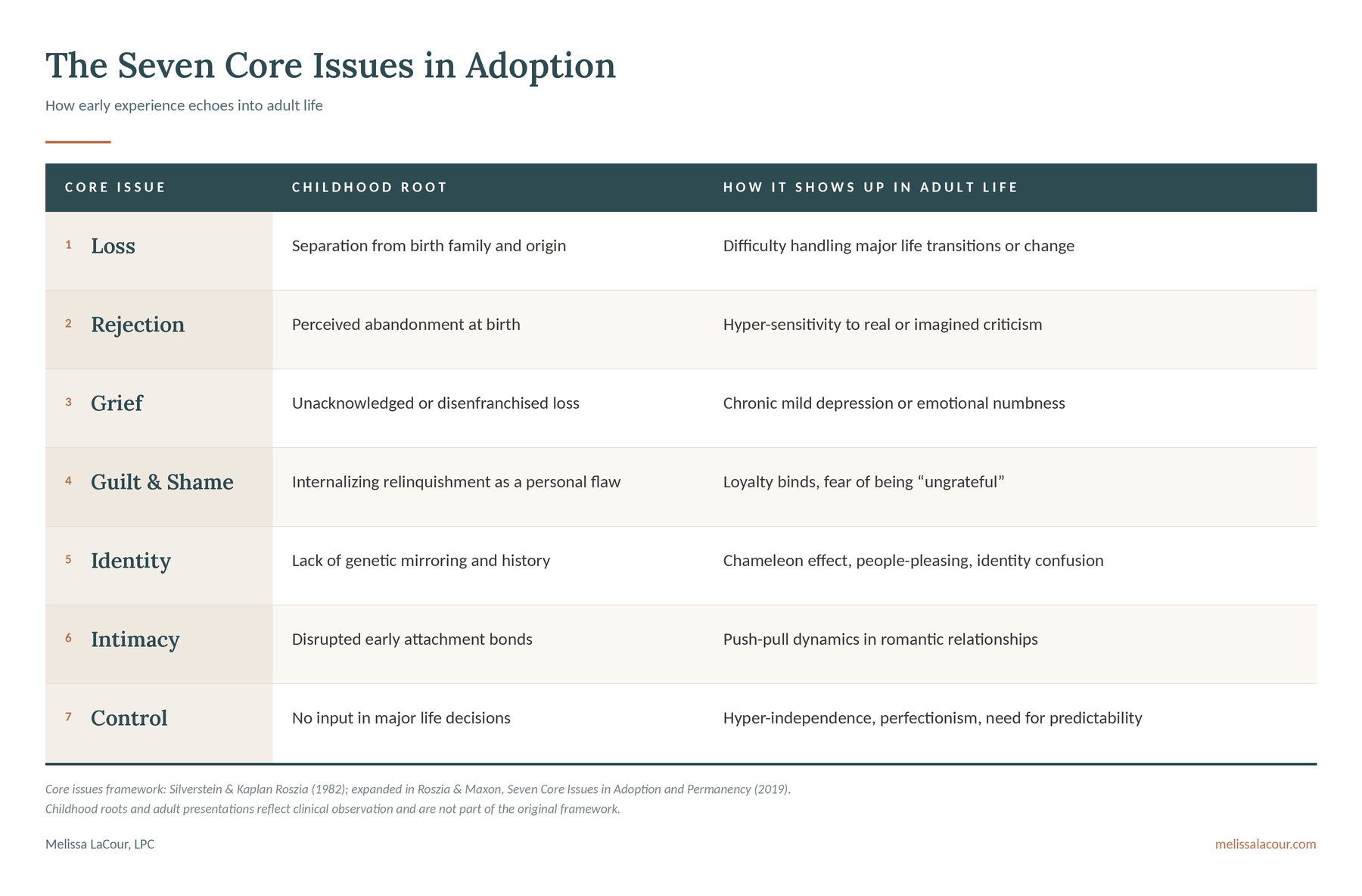
Developed by Sharon Kaplan Roszia and Deborah N. Silverstein, the 7 Core Issues of Adoption framework identifies seven lifelong emotional themes experienced by members of the adoption constellation: Loss, Rejection, Grief, Guilt and Shame, Identity, Intimacy, and Control. In adulthood, these core issues often manifest as fear of abandonment, hyper-independence, chronic people-pleasing, identity confusion, and difficulties with emotional intimacy.
About the Author:
Written by Melissa LaCour, LPC, a licensed therapist, trained in Adoption Competency (TAC) through C.A.S.E. (The Center for Adoption Support and Education), and adult adoptee providing specialized telehealth therapy across Louisiana, Georgia, Indiana, Minnesota, and Ohio.
If you've ever felt like something in you was quietly off — like you were carrying a weight you couldn't name, grieving something you couldn't point to, or struggling in relationships in ways you couldn't fully explain — there's a good chance no one ever gave you language for it.
I know that feeling. I'm an adoptee too.
For a long time, the adoption narrative most of us were handed went something like this: You were chosen. You were loved. You were given a better life. And maybe all of that is true. But it's also incomplete — and that incompleteness is exactly where so much adoptee pain lives. In the gap between the story we were given and the one we actually lived.
The 7 Core Issues of Adoption framework, originally developed by adoption professionals Deborah Silverstein and Sharon Kaplan Roszia, changed a lot of that for me — both personally and in my work as a counselor. Because for the first time, it gave names to things that had always been there but never had words.
This post is my attempt to share that framework with you — not in clinical language, but in the language of someone who has lived it.
What Are the 7 Core Issues of Adoption?
The 7 Core Issues are a set of emotional themes that tend to emerge for people affected by adoption — particularly adoptees, but also birth parents and adoptive families. They were identified as a framework in the early 1980s and have since become foundational in adoption-competent therapy.
Here's the important thing: these aren't stages to get through. They're not a checklist or a diagnosis. They're more like threads — ones that run through the fabric of an adoptee's life, showing up in different forms at different ages, in different relationships, in different seasons.
You may recognize all of them. You may only recognize two or three. Either way, that recognition is the beginning of something.
1. How does Loss manifest in adult adoptees?
Core Definition: Adoption begins with an initial disruption of biological attachment. Even in loving adoptive homes, adoptees experience the loss of biological connection, genetic continuity, culture, or medical history.
In Adulthood: Adult adoptees may experience unexplained anxiety during life transitions, sudden loss, or major milestones (like marriage or parenthood).
Key Signs: Hypervigilance around separation, feeling like a part of you is missing, or waiting for the "other shoe to drop."
2. Why do adult adoptees struggle with a fear of Rejection?
Core Definition: Rejection stems from implicit, non-verbal memory surrounding relinquishment. The early mind interprets separation as an intentional rejection.
In Adulthood: This manifests as rejection sensitivity dysphoria (RSD), chronic people-pleasing, or preemptively pushing loved ones away to avoid being left first.
Key Signs: Over-analyzing tone changes in partners, difficulty accepting criticism, or living in fear of disappointing others.
3. What does Grief look like when it’s disenfranchised?
Core Definition: Adoption grief is often "disenfranchised grief"—a deep loss that society does not acknowledge or validate, frequently dismissed with phrases like "You should be grateful."
In Adulthood: Suppressed grief often turns inward as unexplained sadness, depression, or emotional numbness.
Key Signs: Feeling guilty for feeling sad about adoption, secret mourning during birthdays or holidays, or feeling stuck between two identities.
4. How do Guilt and Shame affect adult adoptee mental health?
Core Definition: Shame is the internal belief that "Something is intrinsically wrong with me for being given away." Guilt arises when an adoptee feels that expressing curiosity about biological family betrays their adoptive parents.
In Adulthood: Creates a severe "loyalty bind" where the adoptee sacrifices their own identity to protect the feelings of others.
Key Signs: Apologizing constantly, hiding search/reunion efforts, or feeling ungrateful for wanting basic medical answers.
5. Why is Identity confusion common among adopted adults?
Core Definition: Identity development requires mirroring—seeing oneself reflected in family traits, temperaments, and genetics. Lacking genetic continuity creates an identity gap.
In Adulthood: Adoptees may describe feeling like a chameleon, shifting personalities depending on who they are with to gain acceptance.
Key Signs: Struggling to answer "Who am I?", feeling disconnected from your reflection, or experiencing an identity crisis when filling out medical forms.
6. How do the core issues impact Intimacy and romantic relationships?
Core Definition: Intimacy requires vulnerability, but vulnerability feels dangerous to a brain conditioned by early attachment loss.
In Adulthood: Adoptees often fluctuate between anxious attachment (fear of being abandoned) and avoidant attachment (fear of getting too close).
Key Signs: Walls up in relationships, difficulty trusting partners completely, or choosing emotionally unavailable partners.
7. Why do adoptees struggle with Control and hyper-independence?
Core Definition: Adoption is a major life decision made completely without the child's consent or control.
In Adulthood: To prevent ever feeling powerless again, adult adoptees often develop hyper-independence, perfectionism, or an intense need to control their environment.
Key Signs: Refusing to ask for help, extreme perfectionism, or intense anxiety when plans change unexpectedly.
-
The 7 Core Issues of Adoption framework was developed in 1989 by adoption specialists Sharon Kaplan Roszia and Deborah N. Silverstein. It was later expanded in their 2019 book, The Seven Core Issues in Adoption and Permanency.
-
Yes. Implicit memory and pre-verbal trauma occur at a cellular and neurological level. Separation from the biological mother disrupts early neurobiological regulation and attachment, even if the adoption occurred at birth and the adoptive home was loving.
-
Look for a licensed mental health professional who holds specialized credentials in adoption competency, such as training from the Center for Adoption Support and Education (C.A.S.E.), or who has lived experience as an adult adoptee.
Need Help Navigating Adoption Complexity as an Adult?
Understanding these seven core issues is often the first step toward healing. If you are an adult adoptee looking for specialized, adoption-competent therapy, you don't have to navigate this alone.
Melissa LaCour, LPC, provides specialized online therapy for adult adoptees across Louisiana, Georgia, Indiana, Minnesota, and Ohio.

What Minnesota Adoptees Should Know About Finding an Adoption-Competent Therapist
It all begins with an idea.
If you've ever searched for a therapist as an adoptee — or as an adoptive parent trying to find support for your child — you already know the frustration. The directory is full of names. The profiles all sound reasonable. But somewhere in the first few sessions, you realize this person doesn't quite get it. They're applying a framework that doesn't fit your story. They treat adoption as background information rather than a lens that shapes everything.
You leave feeling more alone than when you started.
This happens more often than it should, and in Minnesota — a state with one of the highest adoption rates in the country — it's a problem worth talking about openly.
Why Minnesota Has a Unique Adoption Landscape
Minnesota has a long and significant history with adoption. The state has been home to large populations of internationally adopted individuals, particularly from South Korea, as well as a substantial number of transracial and domestic adoptions. Organizations like Lutheran Social Service of Minnesota have facilitated thousands of adoptions over decades, and the Twin Cities in particular have developed tight-knit adoptee communities that have become nationally recognized for advocacy and support.
What this means practically is that Minnesota has a high concentration of people whose lives have been shaped by adoption — adoptees now in adulthood, adoptive families raising children across a range of backgrounds, birth parents navigating grief and contact decisions, and adult adoptees revisiting questions they shelved for years.
And yet, despite this concentration, adoption-competent therapists remain genuinely rare. Most mental health training programs dedicate little to no time to adoption-specific clinical content. A therapist can be fully licensed, highly skilled, and still completely unprepared for the nuances of adoptee identity work, attachment in adoptive families, or the particular grief that doesn't have a clean name.
What "Adoption-Competent" Actually Means
Adoption competency isn't a personality trait or a general sensitivity to family complexity. It's a specific clinical framework — one that recognizes adoption as a lifelong experience with distinct psychological dimensions that don't resolve in childhood and don't disappear when life is otherwise going well.
A therapist trained in adoption competency understands several things that a general therapist may not:
The seven core struggles of adoption. Researchers and clinicians who specialize in adoption have identified seven themes that show up repeatedly across the lifespan for adoptees: loss, rejection, grief, guilt and shame, identity, intimacy, and control. These aren't stages to move through — they're threads that resurface in relationships, career, parenting, and sense of self, often in ways that don't feel obviously connected to adoption at all.
Adoption is not a single event. Many adoptees describe their adoption as something they are still living, not something that happened to them once. An adoption-competent therapist doesn't treat the placement as the whole story — they understand that questions of belonging, identity, and family loyalty are ongoing and evolving.
The adoption constellation. Adoption involves more than the adoptee. Birth parents, adoptive parents, siblings, and extended family members all carry pieces of the adoption story. A competent therapist can work with any member of this constellation and understands how the experience differs for each of them.
Transracial and international adoption carry additional layers. For adoptees raised in families of a different race or culture, identity questions are compounded by the experience of navigating two worlds — the family they were raised in and the heritage they were separated from. This requires cultural humility and specific clinical attention that goes beyond general multicultural training.
Questions to Ask a Therapist Before Your First Session
Finding the right therapist starts before you ever sit down together. Here are questions worth asking during a consultation — and what to listen for in the answers.
"What training or experience do you have specifically with adoption?" You're listening for specifics. General answers like "I've worked with a variety of family structures" are not the same as training in adoption competency, experience with adoptee identity work, or familiarity with the research on adoptee outcomes. It's completely reasonable to ask directly.
"Are you familiar with the seven core struggles of adoption?" This is a useful signal. A therapist grounded in adoption-competent practice will recognize this framework immediately. Someone without adoption-specific training may not.
"Have you worked with adult adoptees, not just adoptive families?" There's a meaningful difference. Adoption is often framed as a children's issue or a parenting issue. Adult adoptees have distinct needs — and finding a therapist who has worked specifically with adults navigating adoption-related identity, grief, and relational patterns is worth asking about.
"Do you have any personal connection to adoption?" This isn't a requirement, but it can be relevant context. Therapists who are adoptees themselves, have adopted children, or have close relationships with adoption often bring a depth of lived understanding that complements their clinical training.
"How do you think about adoption in relation to the other issues I'm bringing to therapy?" You want a therapist who integrates adoption as a lens — not one who compartmentalizes it as a separate topic or, conversely, reduces everything to adoption when that's not what's happening.
Why Telehealth Has Changed the Equation for Minnesota Adoptees
One of the most significant shifts in mental health care in recent years is that geography is no longer the limiting factor it once was. For Minnesota adoptees — whether you're in Minneapolis, Duluth, Rochester, or a small town hours from the nearest city — telehealth means you are no longer restricted to whichever therapists happen to be within driving distance.
This matters enormously for a specialty as specific as adoption-competent therapy. Instead of choosing between a convenient therapist who doesn't understand adoption and a long drive to one who does, you can now search for the right clinical fit regardless of location — and meet with that therapist from your home, your car, or wherever is private and comfortable for you.
For adoptees who may have complicated feelings about institutional or clinical settings, the ability to do this work in a familiar environment can itself be meaningful.
A Note From Melissa
I'm a Licensed Professional Counselor with a privilege to practice in Minnesota and offering telehealth therapy to Minnesota residents across the state. I'm also an adoptee.
That second part isn't a footnote. It's foundational to how I work.
I came to adoption-competent therapy through lived experience before I ever came to it clinically. I know what it feels like to carry questions about identity and belonging that don't have easy answers. I know what it's like to sit across from a therapist who is well-meaning but clearly working from a framework that doesn't quite fit your story.
My clinical training includes Adoption Competency training. I approach adoption through the lens of the seven core struggles and work with adoptees, adoptive families, and birth parents navigating every stage of the adoption experience.
I am currently accepting new Minnesota clients via telehealth. If you've been looking for a therapist who genuinely understands the adoption experience — not just professionally, but personally — I'd be glad to talk.
Schedule a free 10-minute consultation here.
There's no commitment and no pressure. Just a conversation to see if we're the right fit.
Melissa LaCour is a Licensed Professional Counselor licensed in Louisiana (#7708), with privilege to practice in Ohio and Minnesota, providing telehealth mental health services to clients across all three states. She specializes in adoption, relationships, life transitions, and sports counseling.