Adoption Trauma Symptoms in Adults Who "Turned Out Fine"
You were the easy one. Good grades, good job, rarely in trouble. When adoption comes up, people say some version of, "Well, you turned out great," and you agree—because it is true, and because disagreeing would require explaining something you have never been able to put into words.
And still, there is the thing you do not say: The exhaustion that does not match your life. The way a small mistake at work can ruin four days. The fact that you would rather do anything than ask someone for help.
As a Licensed Professional Counselor trained in adoption competency and an adult adoptee myself, I want to be careful here. The last thing adoptees need is another outsider telling them what their experience means. So take this as an offer rather than a diagnosis: if any of the following sounds familiar, there may be a reason for it that has nothing to do with you being broken.
What Is the "Fine" Adoptee Myth?
High achievement is frequently an adaptive survival strategy rather than evidence of internal peace.
In clinical settings, we are trained to look for distress that announces itself: the person who cannot hold a job, the visible spiral, the obvious crisis. Nobody screens the woman who shows up early, over-prepares, and apologizes for taking up space.
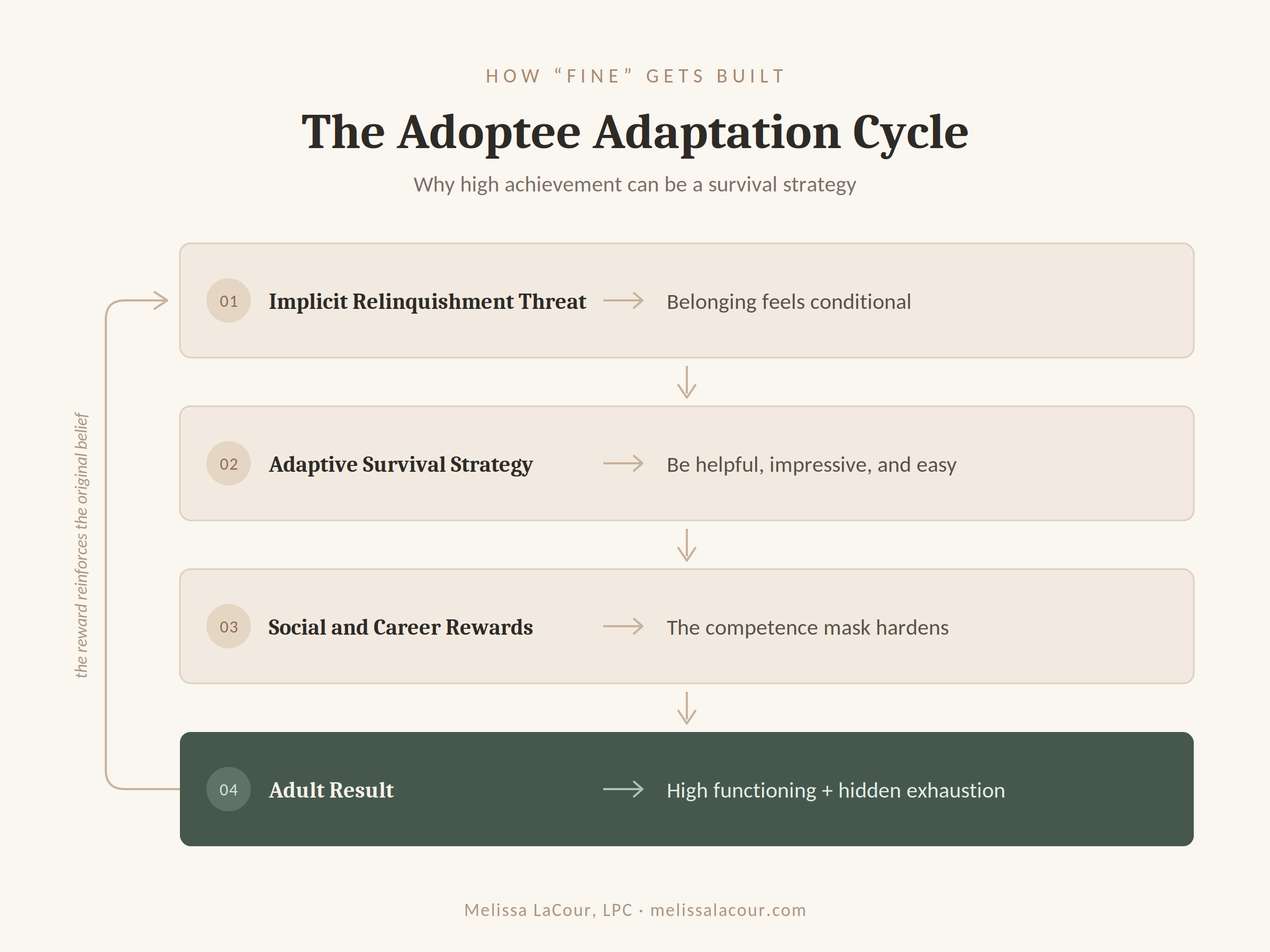
A child who arrives in a family through adoption absorbs, very early and without anyone explicitly saying it, that belonging is arranged. Adults made decisions about where she would live. Whatever the circumstances and whatever the love in the home, the child holds a piece of information most children never have to process: placement is a thing that happens to people like me.
What does a child do with that realization? She gets good at being wanted.
It is not a conscious plan; it is the nervous system running a script that produces safety: Be helpful. Be impressive. Be easy. Do not be a burden. Do not need too much. That strategy works. It yields scholarships, promotions, and a reputation for dependability. Nobody looks at a competent adult and asks what the competence is protecting.
Can You Have Adoption Trauma If Nothing Bad Happened?
A common objection—and adoptees raise it more than anyone—is: "I don't have trauma. My adoption was good. Nothing bad happened to me."
Trauma is not only about events you can consciously remember. A separation occurring in the first weeks or months of life happens before the brain has language to encode a narrative, but well after the body is capable of registering physiological stress. Infants recognize a birth mother's voice, smell, and heartbeat. The transition to a new caregiver, however loving and swift, is a real neurobiological event for the infant.
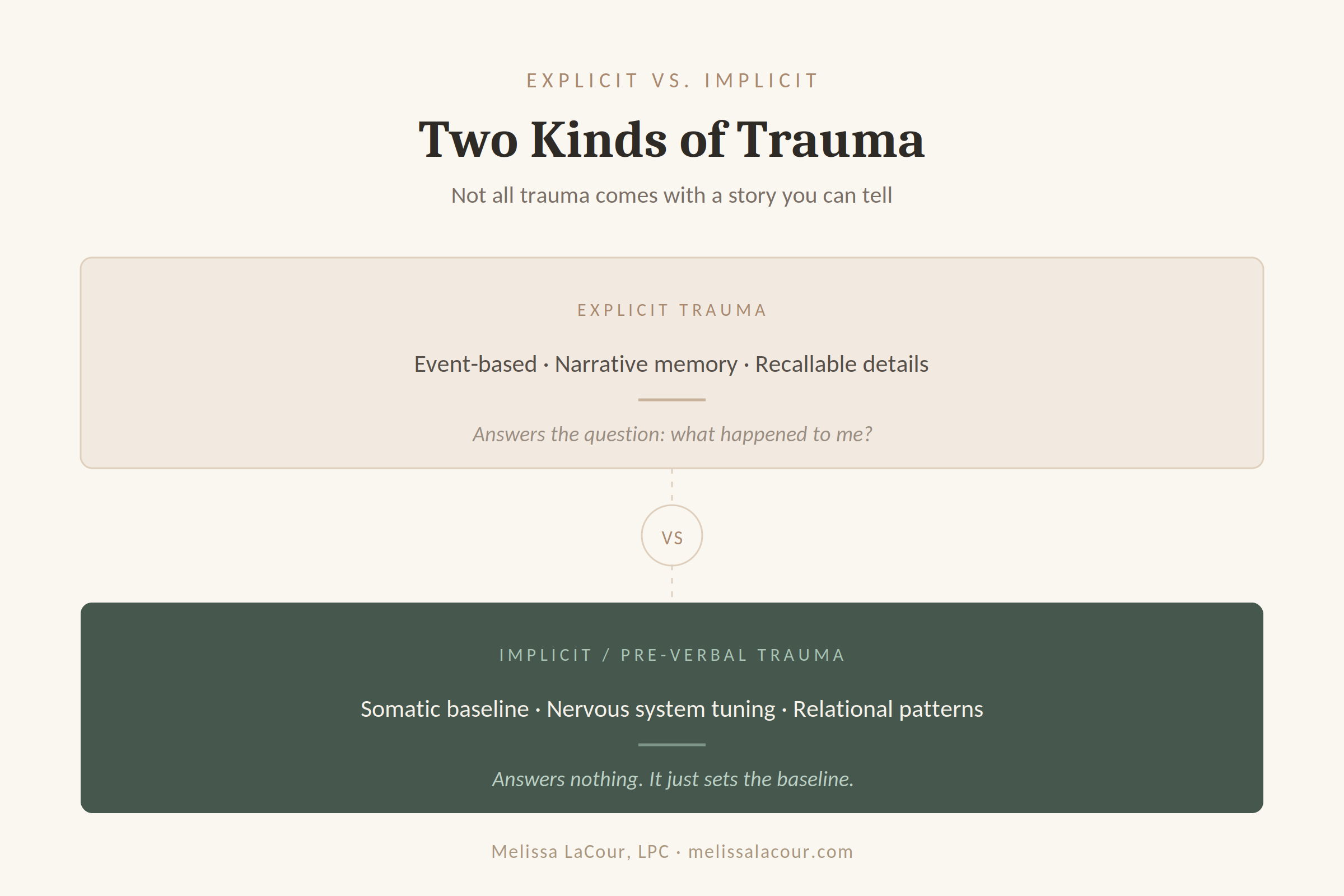
This is implicit or pre-verbal experience. It does not produce a memory you can recall and examine; it produces patterning: a baseline setting for how safe closeness feels, how much vigilance the world requires, and how quickly your nervous system relaxes.
An adoptee can have a genuinely warm, stable childhood and still carry a body that runs hot. Those two facts are not in conflict.
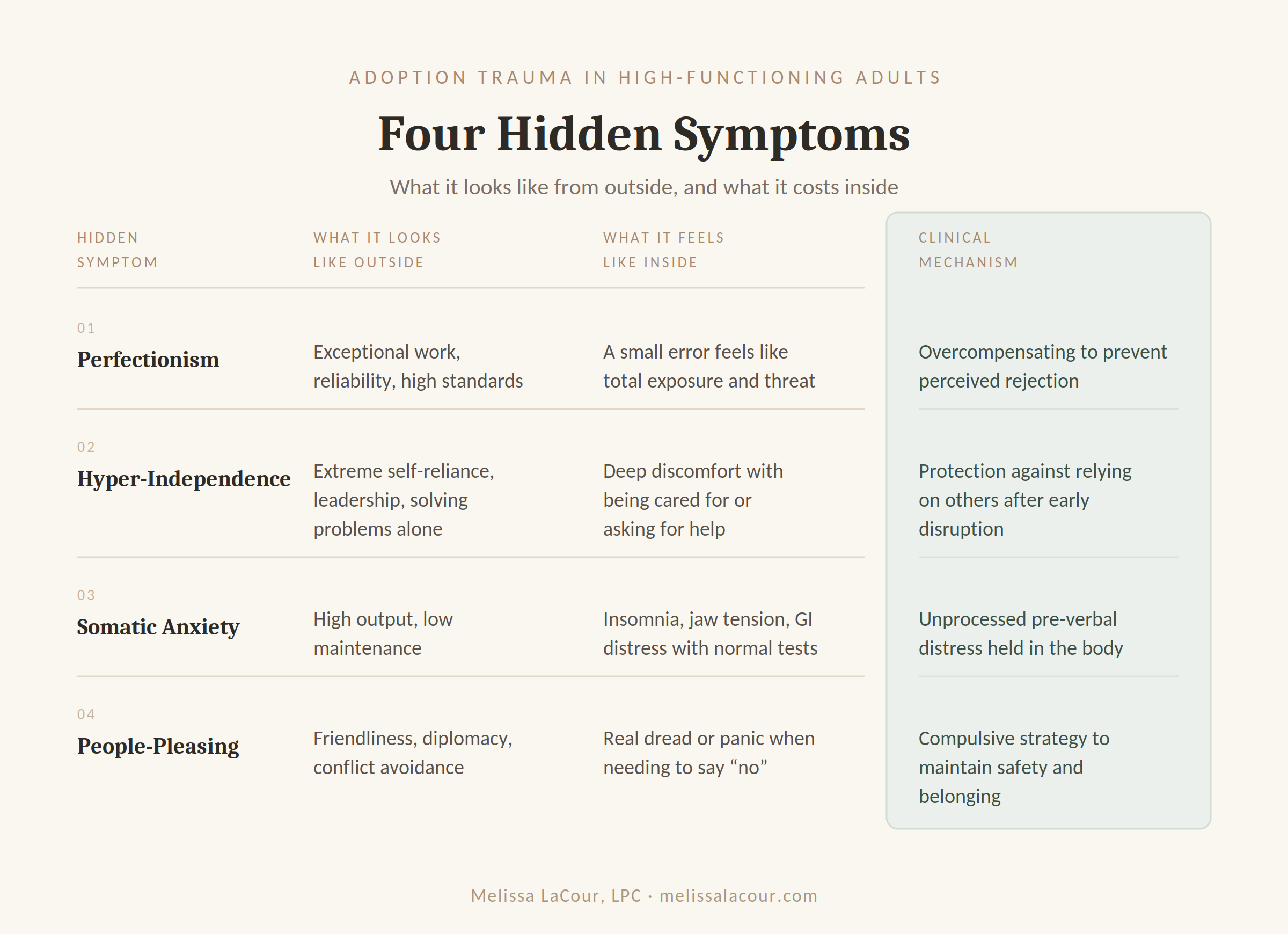
1. Perfectionism: Overcompensating to Prevent Rejection
For high-functioning adoptees, perfectionism is not about high standards; it is about the catastrophic consequence attached to falling short. A mistake does not register as a simple error—it registers as structural exposure. Related signs include difficulty accepting praise, rehearsing conversations endlessly, and feeling that your standing with loved ones is conditional on your latest performance.
2. Hyper-Independence: Refusing Help Because Needing Feels Dangerous
Hyper-independence is often praised as a strength, but it is a reliable marker of early relational disruption. The implicit logic runs: depending on someone is a risk because the one time I fully depended on someone, my arrangement changed. In adulthood, this shows up as doing everything yourself, feeling deep discomfort when sick, and keeping one foot out of relationships.
3. Somatic Anxiety: Stress With No Story Attached
When distress has no words, it settles in the body. Common presentations include trouble falling asleep while exhausted, jaw and shoulder tension, gastrointestinal problems that return clear test results, a heightened startle response, and chronic low-grade alertness with no identifiable threat.
4. Relational Hypervigilance & Compulsory People-Pleasing
High-functioning adoptees often experience "people-pleasing" as compulsory, where setting a boundary produces panic rather than mild awkwardness. Additional signs include relationship hypervigilance (scanning a partner's voice for subtle shifts) and a specific, tiring loneliness in a crowd.
How Does Therapy Help Without Taking Away Your Drive?
A frequent concern among high-achieving adoptees is: "If my drive came from this coping mechanism, will I lose my ambition in therapy?"
Therapy does not remove your competence; it changes what powers it.
Currently, achievement for many high-functioning adoptees runs on fear ("If I stop performing, I become disposable"). Adoption-competent therapy shifts that engine from fear to genuine agency:
Naming the Pattern: Realizing that a dozen separate personality quirks are actually one coherent, adaptive strategy.
Somatic Nervous System Regulation: Using body-centered approaches like EMDR and somatic work to process pre-verbal stress that talk therapy cannot reach.
Building Tolerance for Being Cared For: Practicing micro-steps of vulnerability and receiving help without losing control.
Separating Grief from Ingratitude: Acknowledging early attachment loss without invalidating the love of your adoptive family.
Do I Need an Adoption-Competent Therapist?
You do not have to be in a crisis to deserve therapeutic support. Functioning well is not the threshold for needing care.
Working with an adoption-competent clinician ensures you do not have to spend your first six sessions explaining why adoption is clinically relevant or defending the reality that a positive adoption can still involve profound loss.
Specialized Training: C.A.S.E. Training for Adoption Competency (TAC)
Dual Perspective: Adult Adoptee & Licensed Professional Counselor (LPC)
Telehealth Service Footprint: Online adoption therapy across Louisiana, Georgia, Indiana, Minnesota, and Ohio.
Schedule a Free Consultation →
Frequently Asked Questions
Can you have adoption trauma if your adoption was happy?
Yes. Adoption trauma relates to early separation and the loss of biological connection, not the quality of the adoptive home. A loving, stable adoptive family does not erase the physiological experience of original separation, which occurs before an infant develops language.
What are common signs of adoption trauma in high-functioning adults?
Common signs include perfectionism, extreme self-reliance, people-pleasing, chronic low-grade anxiety, difficulty accepting help or praise, relational hypervigilance, and unexplained somatic symptoms like insomnia or digestive issues.
Is adoption trauma the same as PTSD?
Not usually. Adoption-related trauma is primarily developmental and relational rather than single-event trauma. It tends to present as patterns in attachment, self-concept, and nervous system regulation rather than classic PTSD flashbacks, though some adoptees may experience both.
Why do adult adoptees struggle with asking for help?
Early separation can establish an implicit association between relying on others and existential risk. Because this forms pre-verbally, it operates as an automatic reflex, making hyper-independence feel necessary even when an adult intellectually knows help is safe.
Do I need adoption-specific therapy, or is a general therapist enough?
An adoption-competent therapist saves you from having to educate your clinician on adoption dynamics. They are trained to recognize loss within positive adoption narratives and understand pre-verbal attachment disruption.
Can therapy help without taking away my motivation?
Yes. The goal of adoption-competent therapy is to change what fuels your performance. Most high-functioning adoptees retain their standards and competence while eliminating the underlying fear that was funding them.