How to Find a Good Counselor as an Adult Adoptee
Most adult adoptees I meet have been to therapy before. That is not the problem. The problem is what happened there.
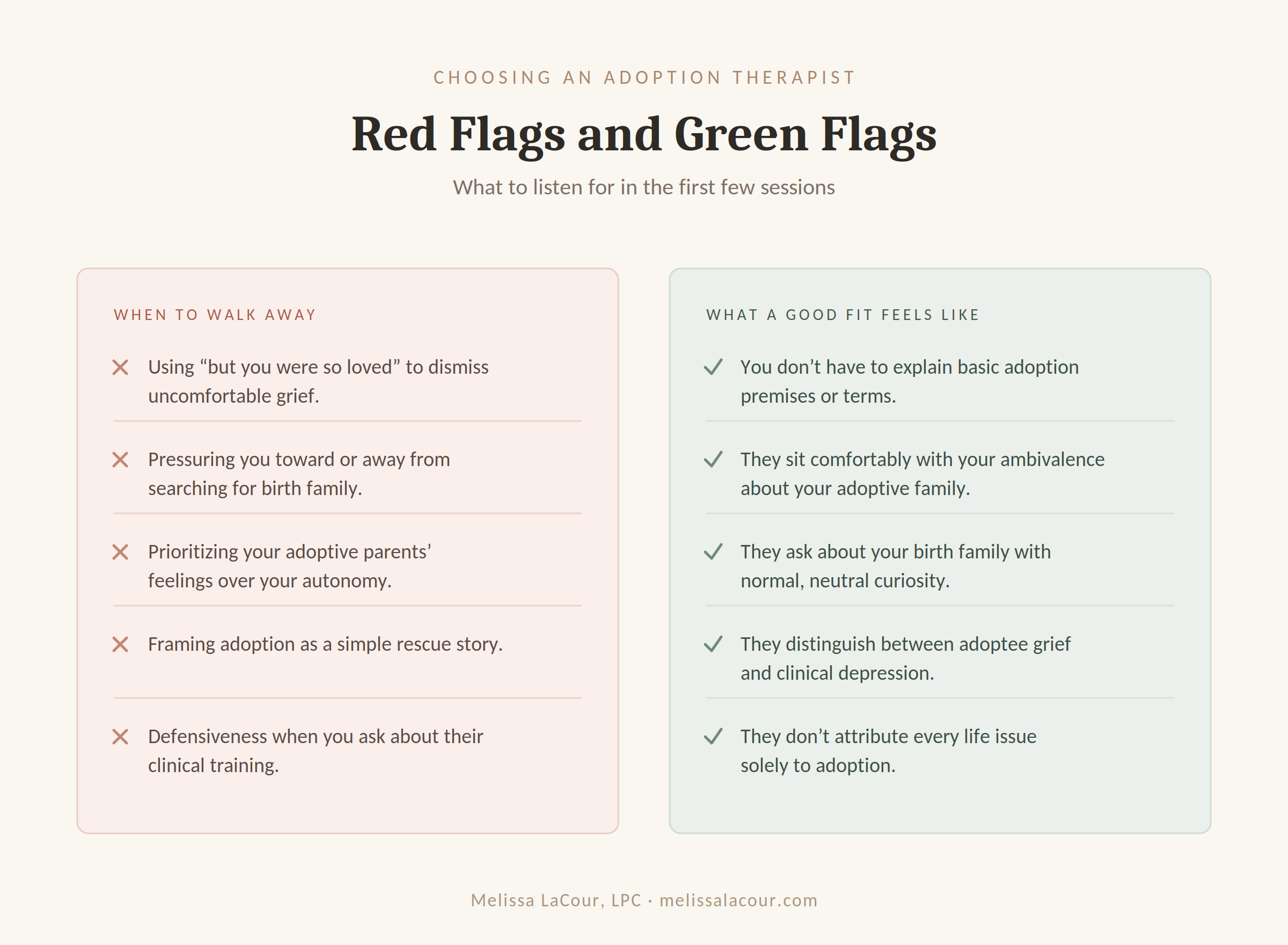
They tell me about the therapist who kept steering toward the adoptive parents. The one who said, "But it sounds like they really loved you," as though that settled it. The one who treated adoption as a single line on an intake form rather than an organizing fact. The one who was kind, competent, and completely unequipped, so the adoptee spent months teaching a class she was paying to attend.
If you have had that experience, you are not difficult and your expectations are not too high. You were looking for a specialty in a place that does not automatically stock it.
As a Licensed Professional Counselor trained in adoption competency and an adult adoptee myself, here is how to find a clinician who actually understands your experience.
Why General Therapy Often Falls Short for Adoptees
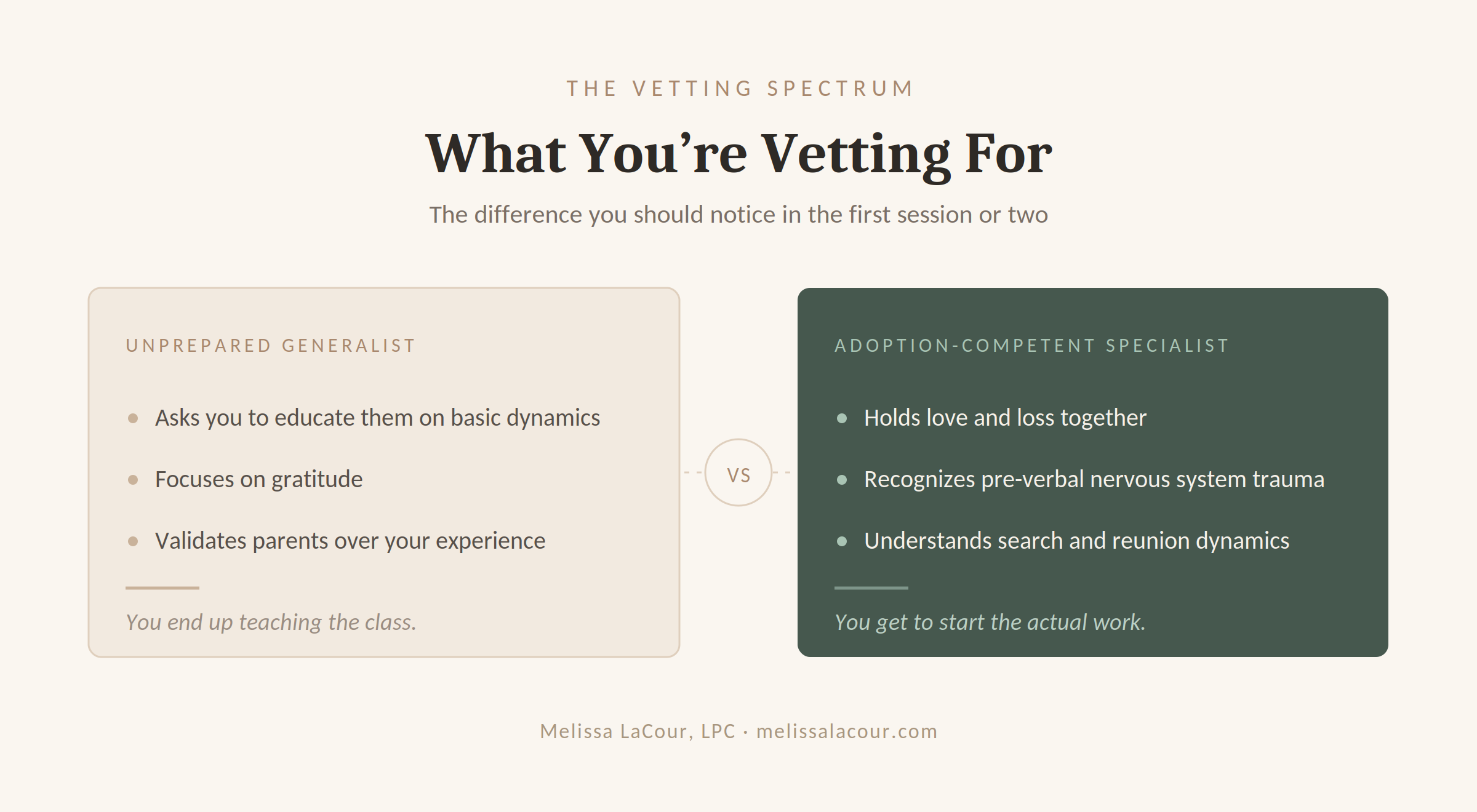
Most therapists receive minimal adoption-specific training in graduate school—often limited to a brief overview in a child development course. A clinician can be highly skilled in general trauma and still carry significant clinical blind spots regarding adoption:
Equating a Good Home with No Loss: Treating a loving adoptive family as proof that no wound exists, which invalidates the foundational loss of origin.
Defaulting to the Adoptive Parent Lens: Most graduate literature focuses on adoptive parenting rather than the lifelong internal experience of the adoptee.
Missing Pre-Verbal Attachment Material: Searching for a single, conscious memory of trauma rather than recognizing somatic and implicit nervous system patterning.
Pathologizing Normal Adoptee Experiences: Misinterpreting search curiosity as relational avoidance, or viewing reunion grief as a sudden mood disorder.
What "Adoption Competent" Actually Means
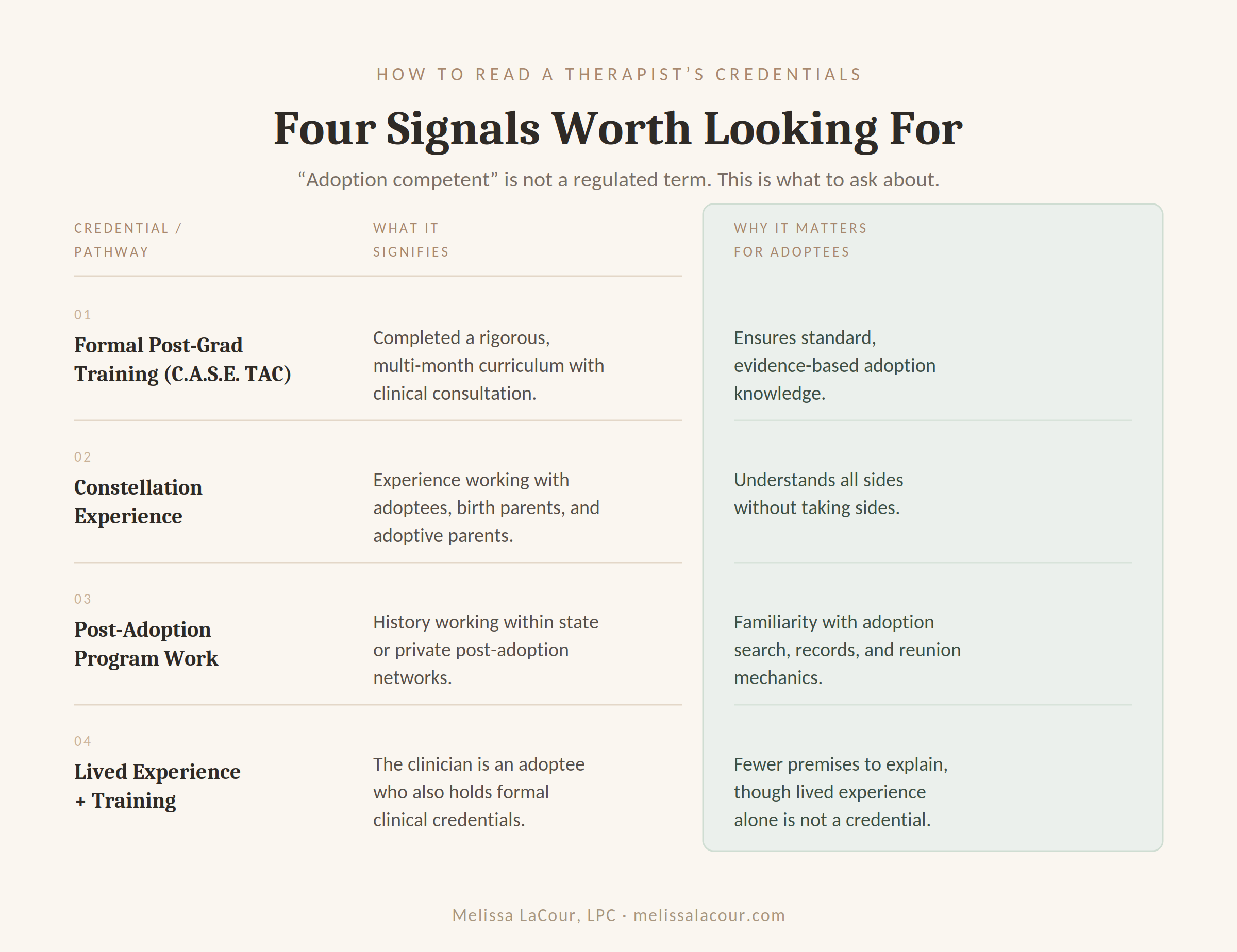
"Adoption competent" is not a protected or regulated term. Any clinician can list it on a directory profile based solely on having worked with a few adoptive families.
True adoption competency usually stems from specific, verifiable clinical experience:
Where to Look for Verified Adoption Specialists
Directories for Specialized Training: Look through alumni rosters from structured programs like the Center for Adoption Support and Education (C.A.S.E.) or specialized state post-adoption networks.
Adoptee-Led Communities: Peer-led adoptee groups and forums offer reliable word-of-mouth referrals based on lived experience.
Telehealth Across State Lines: Don't limit your search to your immediate city. Compacts like the Counseling Compact and PSYPACT allow clinicians to see clients in multiple states.
Targeted Directory Filtering: On Psychology Today, ignore profiles listing adoption alongside twenty unrelated issues. Look for profiles where adoptee care is a central focus.
7 Vetting Questions to Ask a Prospective Therapist
Most therapists offer a free 15-minute consultation. Use that time to interview them directly:
"What adoption-specific training have you completed?" (Look for specific programs or supervision, not just "I've worked with adoptive families.")
"Do you work primarily with adult adoptees or adoptive parents?" (Look for an explicit understanding of adult adoptee identity.)
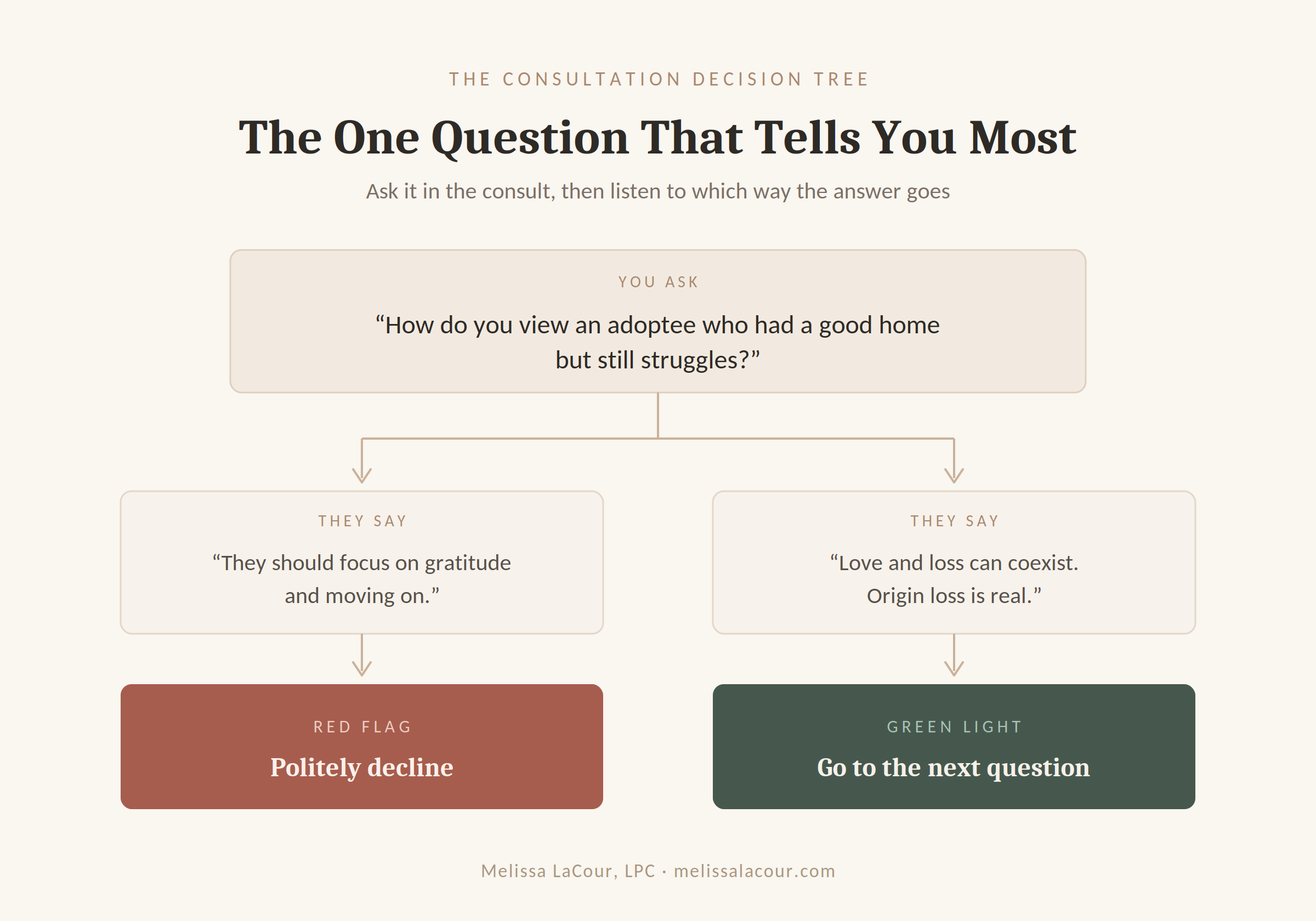
"How do you conceptualize an adoptee who had a great childhood but still struggles?" (Listen for whether they can hold love and loss simultaneously.)
"What is your clinical perspective on search and reunion?" (Avoid therapists who view reunion purely as a fairy-tale ending or discourage searching.)
"How do you approach pre-verbal or early relational trauma?" (Check for comfort with somatic and nervous system regulation techniques.)
"What does progress look like in adoption therapy?" (Be cautious of answers that emphasize 'closure' or 'getting over it.')
"Are you connected to adoption personally or through lived experience?" (You are allowed to ask; note that training and competence matter most.)
Finding Support Across State Lines
A bad therapy fit is not neutral—being told by a professional that your experience does not make sense is its own form of harm. If you cannot find a qualified specialist in your immediate town, telehealth expands your options significantly.
Clinical Background: Graduate of C.A.S.E. Training for Adoption Competency (TAC)
Lived Experience: Licensed Professional Counselor (LPC) and Adult Adoptee
Telehealth Service Footprint: Online therapy available for adult adoptees across Louisiana, Georgia, Indiana, Minnesota, and Ohio.
Schedule a Free Consultation →
Frequently Asked Questions
What does "adoption-competent therapist" mean?
An adoption-competent therapist has completed post-graduate training specific to adoption dynamics, understanding it as a lifelong journey affecting identity, attachment, and neurobiology. Because the term is unregulated, always ask about specific completed coursework and supervision.
Do I need an adoption specialist, or will a general trauma therapist work?
While general trauma therapists can be helpful, adoption involves unique dynamics—such as loyalty binds, disenfranchised grief, and reunion complexity—that general trauma training rarely covers. An adoption specialist ensures you don't spend valuable session time educating your therapist.
Should my therapist also be an adult adoptee?
It is not required. Many adoptees prefer a therapist with lived experience because it creates instant baseline understanding, while others prioritize formal clinical credentials. Specialized training and clinical fit matter more than shared identity alone.
What questions should I ask in a therapy consultation?
Ask what formal adoption training they have completed, whether they work primarily with adoptees or adoptive parents, how they handle loyalty binds, and how they approach search and reunion dynamics.
How do I find an adoption therapist if there are none near me?
Utilize telehealth options across state lines through interstate compacts (like the Counseling Compact or PSYPACT). You can also seek referrals through adoptee-led advocacy organizations or state post-adoption support programs.
Is it normal to have had negative therapy experiences as an adoptee?
Yes. Many adult adoptees report having to educate past therapists or feeling invalidated by clinicians who focus exclusively on gratitude. In most cases, the issue is a lack of specialized training rather than therapy itself being ineffective.