Why do I feel ungrateful for wanting to find my birth parents?
If you have been sitting with the thought "I want to know where I come from, but I feel awful for wanting it," I want to say something clearly before anything else:
You are not ungrateful. You are curious about yourself. Those are not the same thing, and most adoptees have never been given permission to tell them apart.
As a Licensed Professional Counselor trained in adoption competency—and as an adult adoptee myself—I have sat on both sides of this equation: in the clinician's chair and in the feeling of wondering whether wanting answers made me a bad daughter. The guilt you feel is common, but it is learned, not earned.
What Is the Adoption "Loyalty Bind"?
A loyalty bind occurs when an adoptee internalizes the belief that loving their adoptive family requires them to suppress all curiosity about their biological origins. It creates a false dichotomy: you can be a good adoptee, or you can be a person with questions—but you cannot be both.
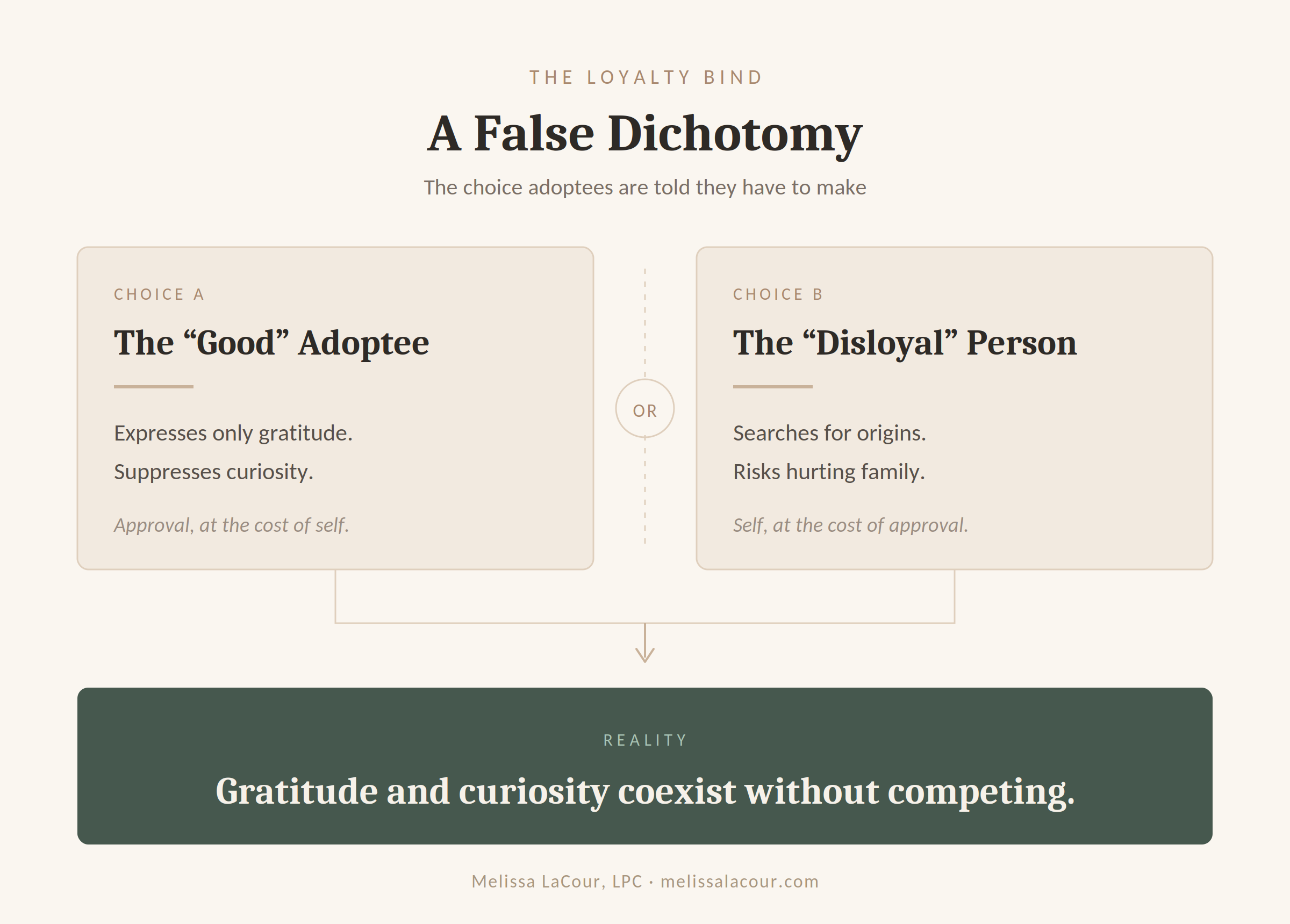
Adoptees rarely absorb this message through direct conflict. Instead, it accumulates through subtle, lifelong environmental cues:
Conditional Praise: Being praised for being "well-adjusted," which teaches you that asking questions carries a relational cost.
Societal Pressure: Being repeatedly reminded of "how lucky you are," creating an expectation that your only acceptable emotion is gratitude.
Parental Vulnerability: Noticing an adoptive parent’s facial expression shift or body language stiffen whenever birth family is mentioned.
The "Finished Event" Narrative: Hearing adoption spoken of as a single past transaction rather than a lifelong identity journey.
When a child learns that only gratitude is safe to express, they do not stop feeling grief, curiosity, or wonder. They simply learn to process those feelings privately. Decades later, that secret processing hardens into adult guilt.
Ingratitude vs. Curiosity: How They Differ
Gratitude is an emotion directed toward your adoptive family. Curiosity is an existential question about your own identity. They do not compete for the same emotional space.
Seeking your biological origins is a standard human developmental task. Non-adopted individuals answer identity questions casually at the dinner table or by looking at family photo albums. Adoptees must search on purpose. The search is more visible, so society misinterprets it as a statement of rejection. It is not a statement; it is the same human question with a harder path to the answer.
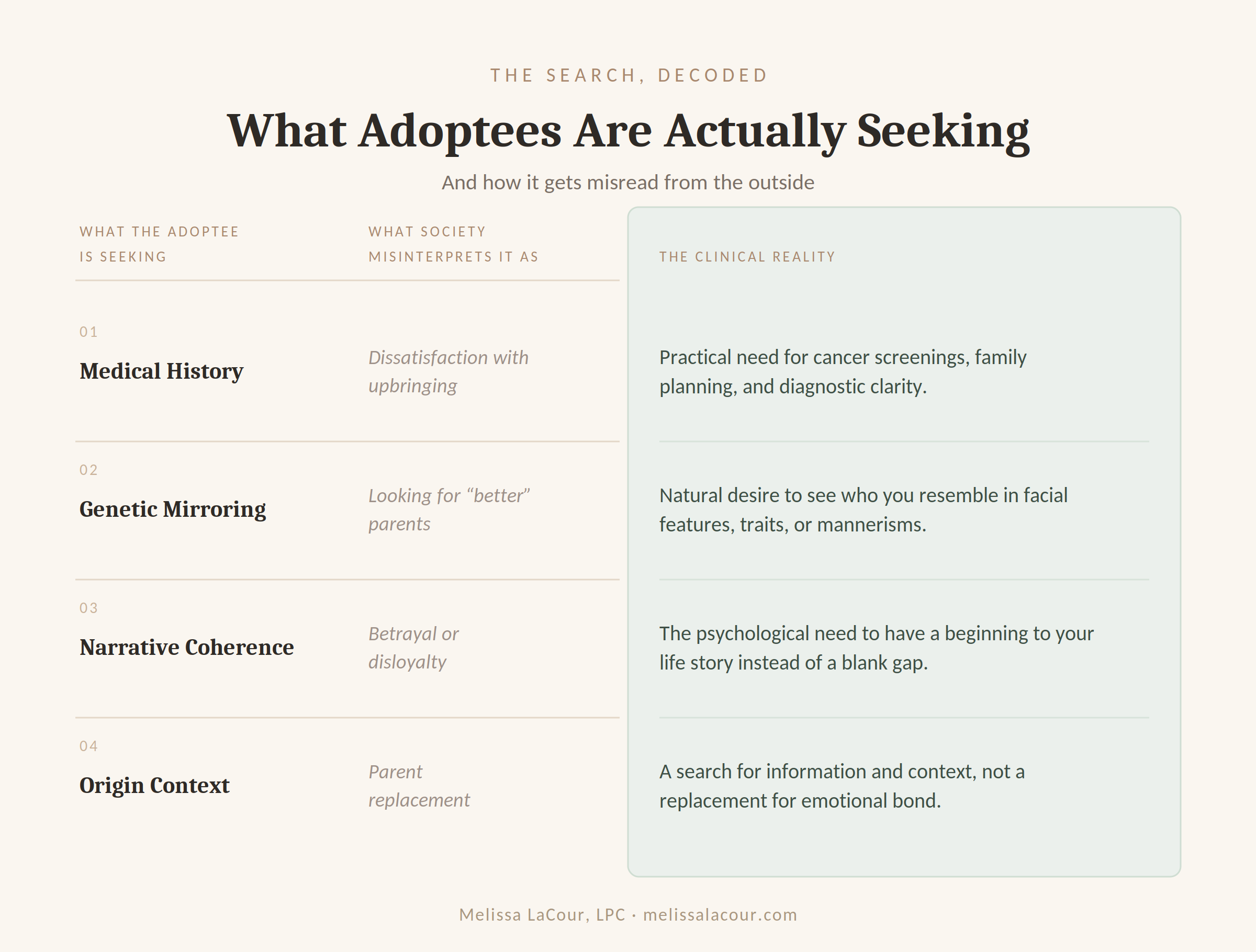
Life Milestones That Trigger Search Curiosity
It is extremely common for search curiosity to switch on suddenly during major adult transitions. Questions you managed to compartmentalize for decades often resurface during:
Pregnancy & Parenthood: Looking into your infant's eyes and seeing a biological relative for the first time.
Medical Diagnostics: Being unable to answer critical family history questions at a doctor's office.
Milestone Ages: Reaching the age your biological parents were when you were relinquished.
Loss of an Adoptive Parent: Processing grief while feeling newly unblocked to ask questions.
How to Navigate the Fear of Hurting Your Adoptive Parents
The primary obstacle for most adult adoptees is not DNA kits, registries, or court records—it is the fear of hurting their adoptive parents. That fear comes from a place of love, but it often carries more weight than it clinically should.
Strategies for Managing the Conversation
Separate Their Feelings From Your Responsibility: Your adoptive parents may experience complex feelings when you search. Those feelings are real, but they are theirs to process—ideally with professional support. You are not required to erase your identity to manage your parents' emotional regulation.
Clarify Your Intentions First: Decide what you are looking for before initiating a conversation with your parents (e.g., medical records only, a one-time letter, or ongoing contact).
Inform Rather Than Ask Permission: Shift your phrasing from permission-seeking ("Would it be okay if I looked?") to boundary-setting ("I love you, and I want you to hear from me that I’ve started looking for my medical and origin history.").
Name the Bind Out Loud: Use direct validation scripts: "My search is not about something missing in our relationship. It is about filling in gaps in my own history."
Honor Your Need for Privacy: You are an adult managing your own personal history. Searching privately before sharing with family is a valid choice, not a deceptive one.
What If My Adoptive Parents React Badly?
If an adoptive parent responds with hurt, withdrawal, or defensive statements like "After everything we did for you," understand that their reaction stems from unhealed fear—fear of abandonment, insecurity about their role, or unresolved grief surrounding infertility.
Their emotional reaction is understandable, but it is not proof that you did something wrong. Give the relationship time to absorb the news, keep your conversations focused on your need for self-knowledge, and consider engaging an adoption-competent family therapist if the communication stalls.
Frequently Asked Questions
Is it normal to feel guilty about searching for birth parents?
Yes. Guilt is one of the most universally reported emotions among adult adoptees considering search or reunion. It stems from a learned loyalty bind rather than any actual wrongdoing or disloyalty.
Does wanting to find my birth parents mean I don't love my adoptive family?
No. Curiosity about biological origins is a drive toward personal identity integration. Adoptees can love their adoptive parents deeply while still needing complete information about their genetic origins and medical history.
Should I tell my adoptive parents before I start my search?
That decision depends entirely on your personal safety and family dynamics. Some adoptees prefer openness to avoid feelings of secrecy, while others require private space to process their search before involving family. Both approaches are clinically valid.
At what age do adult adoptees usually start searching?
There is no single timeline. Search interest frequently intensifies during identity milestones such as turning 18, graduating college, getting married, becoming a parent, or navigating the death of an adoptive parent.
Can therapy help with adoption search guilt?
Yes. Working with an adoption-competent therapist allows you to untangle loyalty binds, process complex search outcomes, build boundary scripts, and navigate reunion dynamics without having to educate your clinician on adoption terminology.
Specialized Therapy for Adult Adoptees
Understanding the root of your guilt is the first step toward releasing it. If you are navigating adoption complexity, search anxiety, or reunion dynamics, specialized support can help you move forward with clarity.
Clinical Specialization: C.A.S.E. Training for Adoption Competency (TAC)
Lived Experience: Adult Adoptee & Licensed Professional Counselor (LPC)
Telehealth Service Areas: Providing specialized online adoption therapy across Louisiana, Georgia, Indiana, Minnesota, and Ohio.
Schedule a Free Consultation →
Not ready to book a session? Download The Adoptee's Permission Slip, a free guide designed for the questions you haven't said out loud yet. Get the Free Download →