If you are an adult adoptee, you might have a track record of relationships that feel inexplicably exhausting.
Maybe you have a string of romantic partnerships that end right around the time things get serious. Maybe you have a circle of close friends who think they know you, while you secretly feel like you are standing behind a pane of glass. Or maybe you find yourself exhausted from constantly scanning the room—tracking everyone’s mood, apologizing before anyone is upset, and making sure you are never too much of a burden.
When relationships feel this hard, it is easy to assume that you are simply bad at being close to people.
As a Licensed Professional Counselor specializing in adoption-competent care—and as an adult adoptee myself—I want to tell you plainly: You are not bad at relationships. Your nervous system is running a survival program written before you had words.
The Core Blueprint: Connection and Loss Arrived Together
Every relationship you enter as an adult is filtered through your foundational attachment blueprint. For non-adopted individuals, the earliest neurological baseline is continuity: I cried, someone stayed, and the bond held.
For adoptees—regardless of how loving, stable, or supportive the adoptive home was—the very first relational experience involved a rupture. A biological bond that existed in utero ended, and a transition to new caregivers occurred.
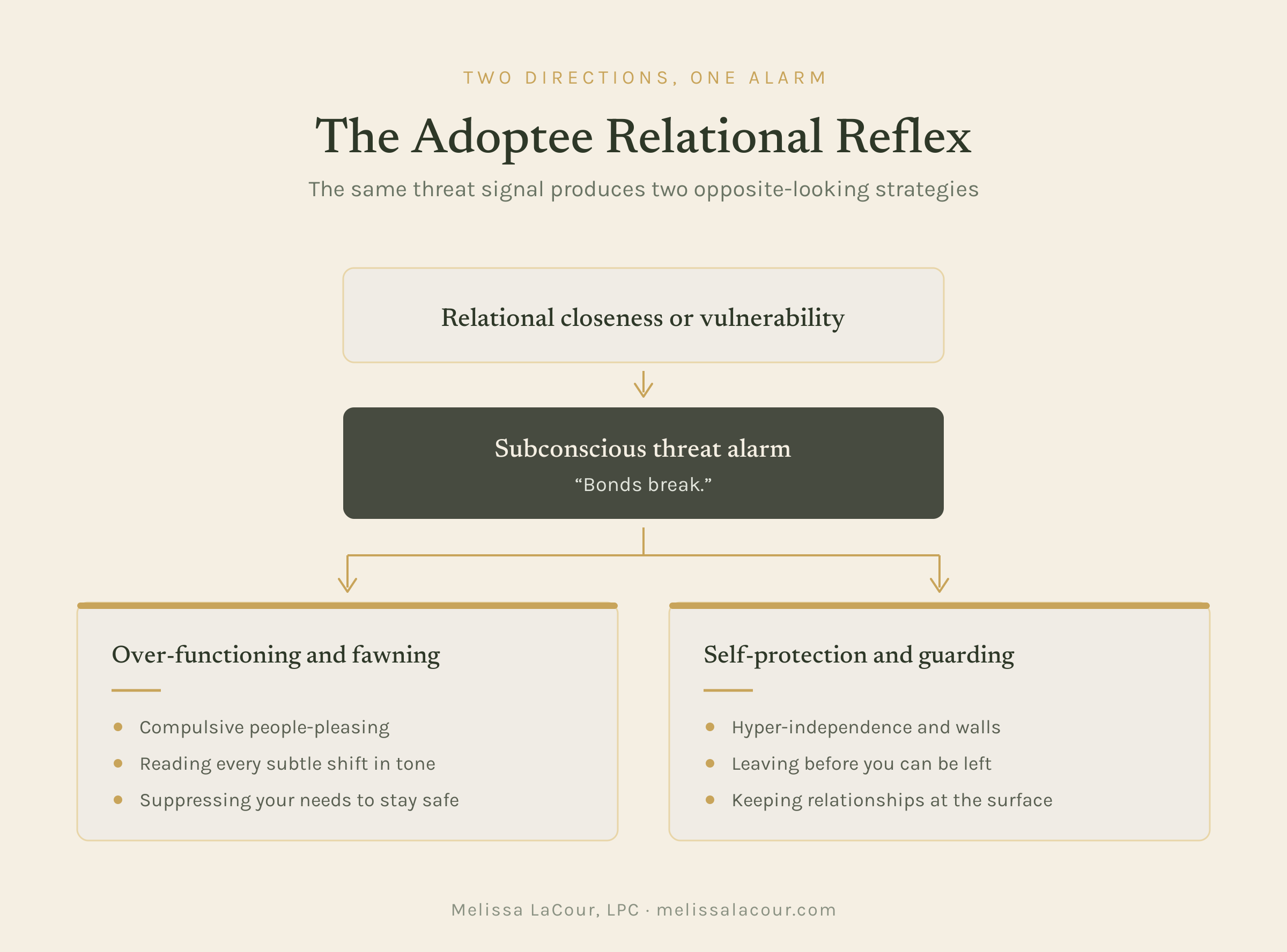
Your infant brain could not record a conscious story about that transition, so your body recorded it as a somatic reflex: attachment is temporary, and belonging must be earned.
While intimacy struggles in adoptees often center on deep romantic vulnerability, broader relationship struggles show up everywhere—in how you handle conflict with a spouse, how you navigate boundaries with coworkers, and how safe you feel in everyday friendships.
5 Specific Ways Adoption Shapes Adult Relationships
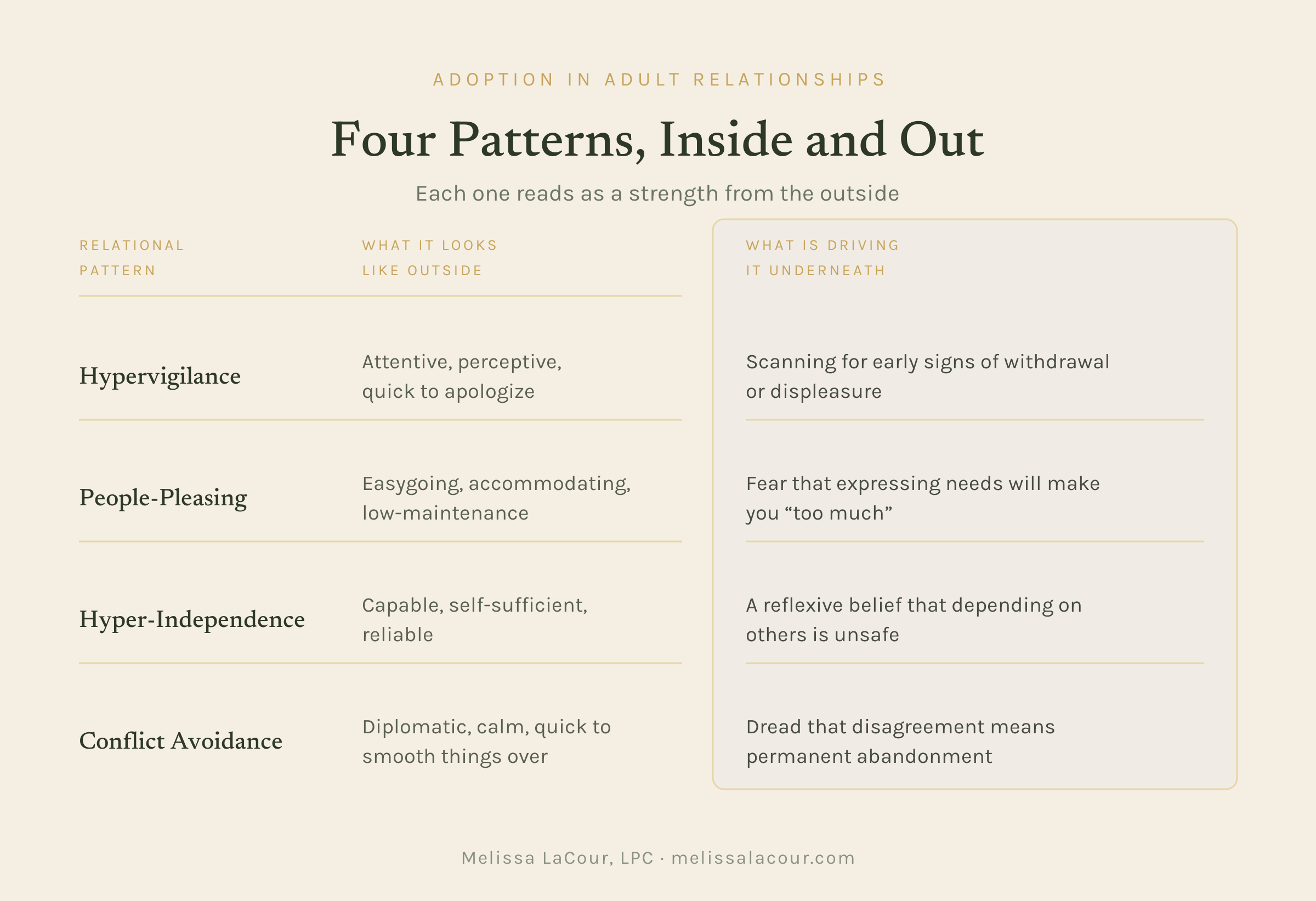
1. Rejection Sensitivity and Hypervigilance
Adoptees often possess an uncanny, exhausting radar for shifts in other people’s moods. A delayed text message, a slightly flat tone of voice, or a partner needing a quiet evening alone can register in your nervous system as an imminent abandonment threat. You aren't overreacting; your body is reacting to an ancient, pre-verbal alarm.
2. Compulsory People-Pleasing (The "Chameleon" Effect)
Many adoptees survive childhood by becoming exceptionally adaptable—learning to read the room and become whoever is easiest to love. In adult relationships, this turns into compulsory people-pleasing. You say yes when you mean no, absorb everyone else's emotional weight, and hide your genuine preferences out of an unspoken fear that having needs makes you replaceable.
3. Conflict Avoidance (Equating Disagreement With Abandonment)
In a secure relationship, conflict is simply a disagreement between two connected people. For an adoptee whose earliest blueprint associates rupture with permanent separation, conflict can feel existential. Many adoptees either completely shut down during disagreements or rush to apologize just to make the tension stop, sacrificing their own voice to preserve the bond.
4. Hyper-Independence and Difficulty Receiving
You may be the friend everyone relies on in a crisis, the partner who handles every logistical detail, and the colleague who never misses a deadline—while secretly feeling completely unable to ask for help when you are struggling. Relying on someone else requires trusting that they will show up, which feels deeply risky when your foundational experience involved early disruption.
5. Loneliness Inside Connection ("Behind Glass")
Even when surrounded by people who genuinely care about you, you may experience a persistent sense of isolation. When you spend years curating a low-maintenance, well-adjusted version of yourself to keep people close, nobody ever gets to love the real, messy, unedited version of you.
Why Romantic Partnerships Feel Like the Highest-Stakes Arena
Romantic relationships carry a unique emotional charge for adoptees because they echo the core question at the center of adoption: Will you choose me, and will you stay?
When you enter a committed partnership, you are not just navigating everyday adult life—chores, finances, communication styles. Your nervous system is also testing whether this bond will hold when things get imperfect. Small misunderstandings can trigger disproportionate waves of panic, anger, or sudden withdrawal because your body is processing both the present moment and the original loss at the exact same time.
What Actually Helps: Updating Your Relational Blueprint
The relational patterns you developed to survive early loss are deeply ingrained, but they are not permanent. Earned secure attachment is built by learning how to recognize your nervous system's reflexes and intentionally practicing new responses.
Map Your Specific Patterns: Start noticing your default relational reflexes without judging them. Do you lean toward anxious pursuit, avoidant withdrawal, or compulsive people-pleasing when you feel insecure? (If you want a structured, self-paced way to identify and untangle these exact reflexes, my mini-course, Why Adoptees Do What They Do, walks you step-by-step through how early attachment shapes your current relationships.)
Create a Pause Between Trigger and Reaction: When a partner pulls back or a friend cancels plans, notice the physical surge of panic or numbness in your body before acting on it. Naming the feeling—"My abandonment alarm is going off right now"—creates space for a grounded choice.
Practice Low-Stakes Authenticity: You do not have to dismantle every wall overnight. Start by expressing a small, honest preference—choosing where to eat, admitting you are tired, or declining an invitation—and allow your nervous system to observe that the relationship survives your honesty.
Work With an Adoption-Competent Therapist: Because these patterns are rooted in pre-verbal experience, insight alone rarely shifts them. Working with a clinician who understands adoption allows you to safely practice vulnerability and boundary-setting inside the therapeutic relationship itself.
You Don't Have to Keep Repeating the Same Cycle
If you are tired of feeling exhausted by the very connections you crave most, please hear this: nothing about you is unlovable. Your nervous system learned early on how to protect you from loss, and it has been working overtime ever since. With the right support, you can teach your body that closeness is safe—and that you do not have to earn your place in the people who love you.
Clinical Specialization: C.A.S.E. Training for Adoption Competency (TAC)
Dual Lens: Licensed Professional Counselor (LPC) and Adult Adoptee
In-Person Office: 143 Ridgeway Drive, Suite 219, Lafayette, LA 70503
Telehealth Coverage: Online adoption-competent therapy across Louisiana, Georgia, Indiana, Minnesota, and Ohio.
Schedule a Free 15-Minute Consultation →
Want to start exploring these dynamics on your own timeline? Explore my self-paced mini-course, Why Adoptees Do What They Do.
Frequently Asked Questions
Why do adoptees struggle with relationships even if they had a good childhood?
Early separation from biological parents creates an implicit, pre-verbal attachment disruption before a child develops language. Even in a warm, loving adoptive home, the nervous system often records a baseline association between closeness and loss, which resurfaces in adulthood as fear of abandonment, hyper-independence, or people-pleasing.
How does adoption affect friendships as well as romantic relationships?
In friendships, adoption-related attachment patterns often show up as surface-level connection ("feeling behind glass"), chronic over-giving without letting friends support you, intense anxiety when a friend is busy or distant, and avoiding honest conflict out of fear of being replaced.
Why do adult adoptees push people away when relationships get close?
Pushing partners or friends away is a protective nervous system defense. When intimacy deepens, vulnerability increases—and to a brain conditioned by early separation, vulnerability feels dangerous. Pulling away preemptively is an unconscious attempt to control the outcome and avoid being left first.
Can an adult adoptee build secure relationships?
Yes. Attachment styles are adaptable throughout adulthood. Through adoption-competent therapy, nervous system regulation, and intentional pattern recognition, adult adoptees can develop earned secure attachment and build deeply connected, reciprocal relationships.