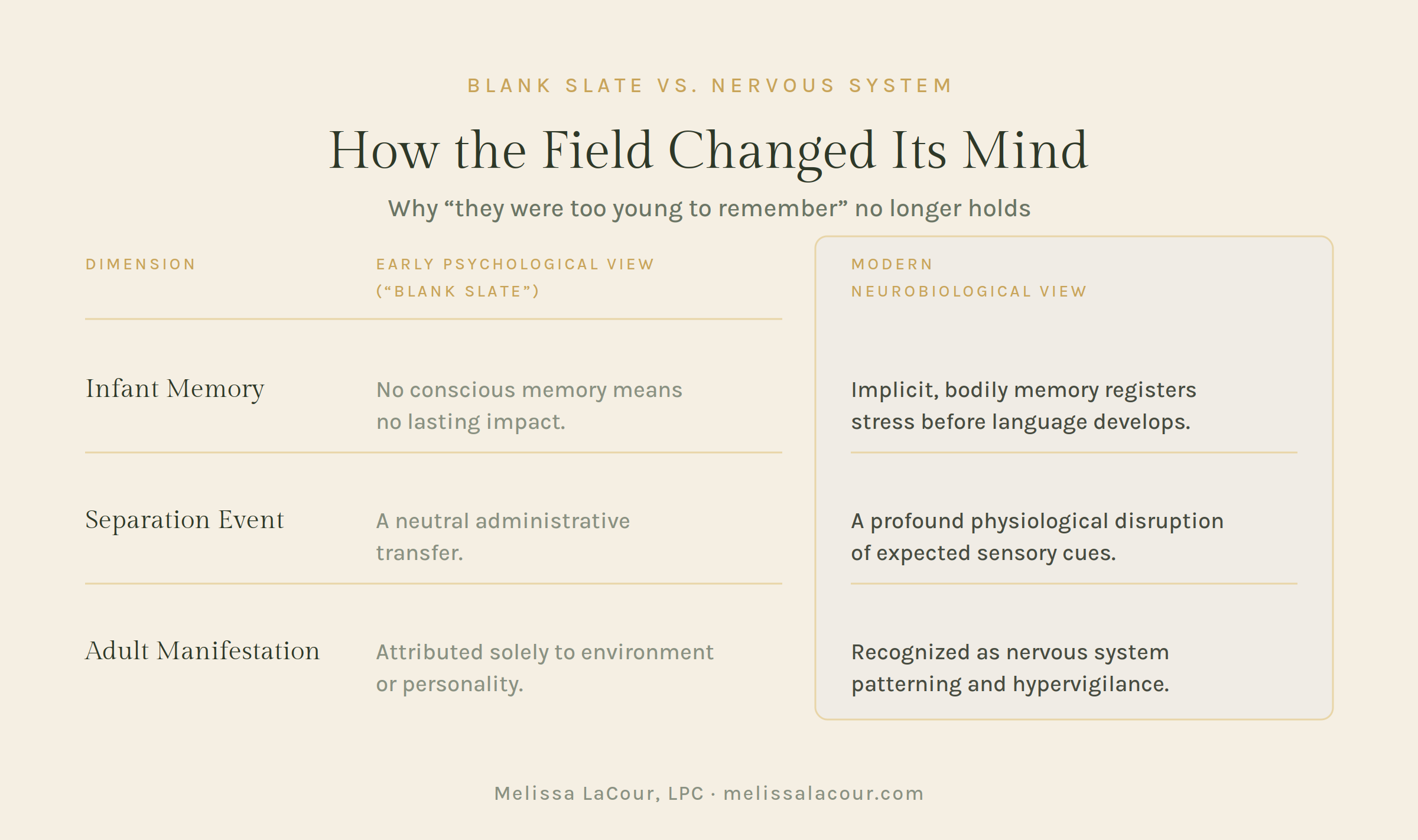
For decades, society viewed newborn adoption as a "blank slate." The assumption was simple: if a child is adopted at birth and placed in a loving, capable home, they will grow up unaffected by the separation because they have no conscious memory of it.
Yet, many adult adoptees report carrying a lifelong, unexplained feeling of abandonment, hypervigilance, or relational anxiety. In 1993, clinical psychologist and adoptive mother Nancy Verrier gave this experience a name in her landmark book: The Primal Wound.
Understanding how early biological separation impacts the developing nervous system provides essential validation for adoptees seeking to make sense of implicit, pre-verbal patterns.
What Is the Primal Wound Theory?
Verrier’s core premise is that the mother-child bond begins long before birth. During gestation, an infant becomes bio-behaviorally attuned to the birth mother’s specific physiological ecosystem:
The unique sound and rhythm of her heartbeat
The cadence of her voice and speech patterns
Her unique chemical profile and amniotic taste
Her movement rhythms and nervous system state
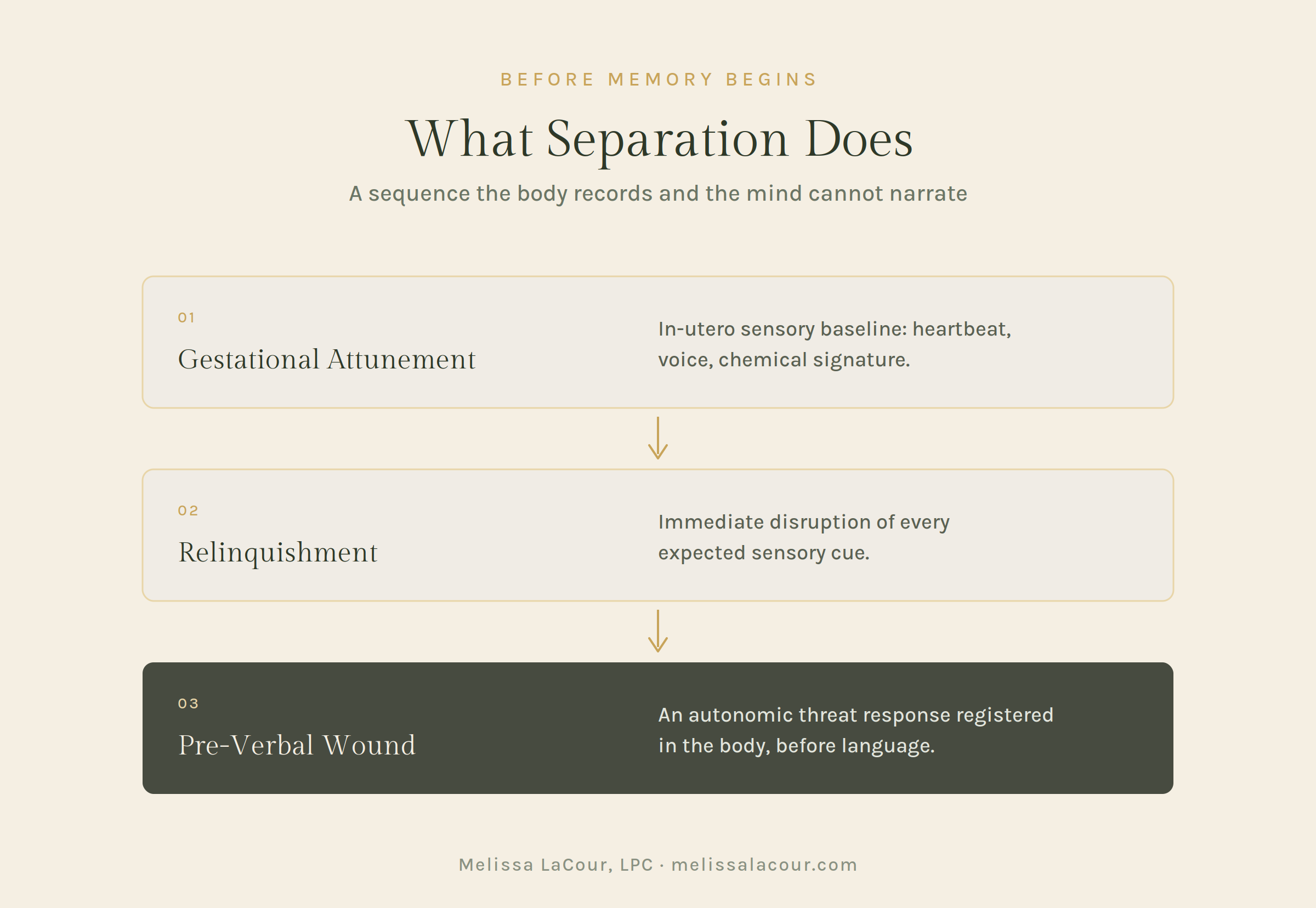
When an infant is separated from their birth mother after delivery, the infant's brain experiences a sudden disruption of expected sensory inputs. Even when immediately placed into the loving arms of adoptive parents, the infant's nervous system detects a fundamental mismatch in biological cues.
What Does Modern Neuroscience Say? Is It Scientifically Valid?
While early critics dismissed Verrier's work as overly dramatic or non-empirical, modern neuroscience and developmental psychology strongly support the underlying neurobiology of pre-verbal relinquishment trauma.
1. Implicit Memory vs. Explicit Memory
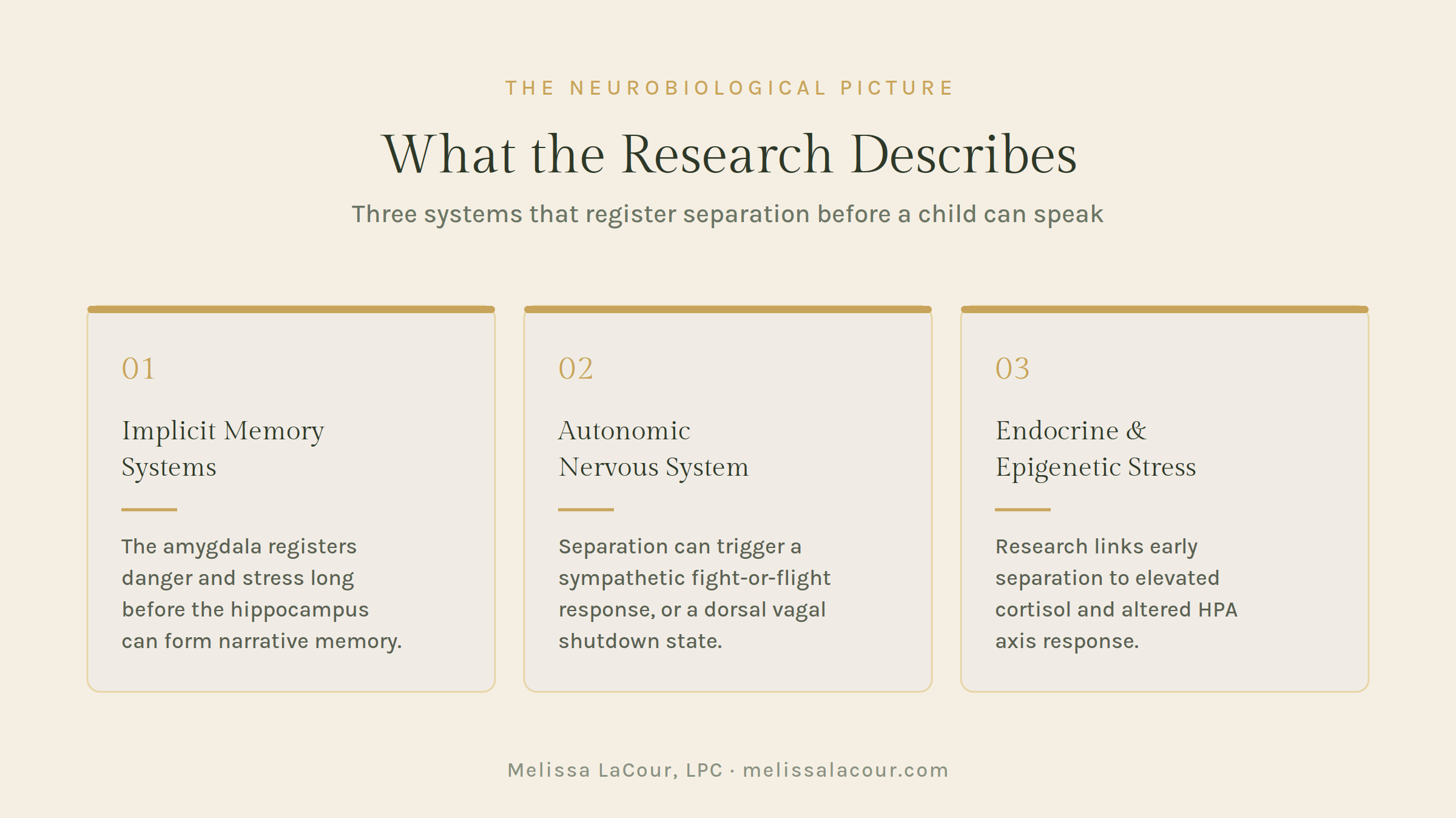
The human hippocampus (responsible for narrative, explicit memory—the "story" of what happened) is not fully developed in infants. However, the amygdala (responsible for emotional recording and threat detection) functions from birth. Early separation is stored as implicit, somatic memory—a physical baseline of stress without words or visual scenes.
2. Polyvagal Theory & Autonomic Regulation
Stephen Porges' polyvagal theory proposes that infants depend on co-regulation with a caregiver to stabilize their own autonomic nervous system, because they cannot yet do it alone. An infant also arrives already tuned to a particular set of cues: the voice, smell, and heartbeat learned in utero. When those cues disappear, the theory describes a rapid "neuroception" of danger, operating below conscious thought. That can appear as sympathetic mobilization, meaning fight or flight, or as a dorsal vagal shutdown, the flat and unresponsive state usually described as freeze.
A new caregiver can and does provide co-regulation. What cannot be replicated is the familiarity of the original cues.
Porges' model is widely used in trauma treatment and also debated, but the underlying observation is far less contested, which is that infant stress regulation develops in relationship and disruption of that relationship registers physiologically.
3. HPA Axis and Endocrine Stress Response
Studies in developmental psychobiology confirm that maternal separation in primates and humans alters the Hypothalamic-Pituitary-Adrenal (HPA) axis, elevating cortisol levels and establishing a higher baseline threshold for stress reactivity later in life.
How the Primal Wound Shows Up in Adult Adoptees
Because the initial disruption occurs before language exists, the primal wound manifests in adulthood as automatic, somatic reactions rather than conscious thoughts:
Relational Hypervigilance: Scanning romantic partners for subtle shifts in mood or withdrawal, perceiving normal space as imminent abandonment.
Chronic Rejection Sensitivity: Experiencing overwhelming panic or Rejection Sensitivity Dysphoria (RSD) in response to minor criticism or boundary setting.
Hyper-Independence: An automatic reflex that depending on others is unsafe, leading to extreme self-reliance and difficulty accepting care.
Somatic Anxiety: Unexplained physiological symptoms, such as jaw clenching, digestive distress, sleep disruption, or a persistent feeling that something is wrong.
Healing Pre-Verbal Trauma in Therapy
Because pre-verbal trauma lives in the subcortical brain and body, traditional talk therapy alone often hits a ceiling. Effective treatment addresses both the mind and the nervous system:
Somatic Experiencing & Nervous System Regulation: Learning how to track bodily cues and down-regulate the autonomic threat response.
EMDR (Eye Movement Desensitization and Reprocessing): Processing implicit trauma memories and somatic feeling states without needing explicit verbal narratives.
Attachment-Focused Therapy: Building earned secure attachment by untangling past relinquishment fears from present relationships.
Validating the Loss: Releasing the guilt of feeling wounded inside a loving, supportive adoptive family.
Work With an Adoption-Competent Therapist
You don't have to explain the reality of pre-verbal loss to a therapist who doesn't understand adoption dynamics.
Specialized Credentials: C.A.S.E. Training for Adoption Competency (TAC)
Dual Lens: Licensed Professional Counselor (LPC) & Adult Adoptee
In-Person Office: 143 Ridgeway Drive, Lafayette, LA 70503
Telehealth Service Footprint: Serving adult adoptees across Louisiana, Georgia, Indiana, Minnesota, and Ohio.
Schedule a Free Consultation →
Frequently Asked Questions
What is the "Primal Wound" in adoption?
The Primal Wound is a concept developed by Nancy Verrier proposing that the initial biological separation of an infant from their mother creates an enduring pre-verbal trauma that impacts emotional and attachment development.
Is the Primal Wound scientifically proven?
While "primal wound" is a clinical metaphor rather than a formal DSM diagnosis, modern neuroscience, polyvagal theory, and implicit memory research validate that biological separation causes significant neurobiological stress and sensory disruption in infants.
Can an infant experience trauma if they were adopted immediately at birth?
Yes. Infant brain development relies on maternal co-regulation, voice recognition, and sensory continuity. Separation at birth registers at a physiological level through implicit memory systems and autonomic stress responses, regardless of how quickly or lovingly the infant is placed with adoptive parents.
How does pre-verbal adoption trauma affect adult relationships?
It frequently manifests as anxious or avoidant attachment patterns, intense fear of rejection, hyper-independence, relational hypervigilance, and difficulty fully trusting romantic partners.