
Every November, social media feeds, community centers, and news outlets flood with stories celebrating National Adoption Awareness Month (NAAM). The prevailing imagery is familiar: finalized courthouse photos, courtroom tears of joy, and celebratory slogans framing adoption as an uncomplicated rescue story.
If you are an adult adoptee, watching this annual campaign can feel less like a celebration and more like an emotional endurance test.
You might feel a heavy mix of irritation, exhaustion, sadness, or a sudden urge to log off the internet entirely. You might also feel a wave of guilt for feeling that way at all.
As a Licensed Professional Counselor with adoption competency training (and as an adult adoptee myself), I want to offer a different message as November begins: Your discomfort during National Adoption Month makes complete sense. You are not cynical, ungrateful, or broken for finding this month difficult.
The Monolithic Celebration vs. The Lived Experience
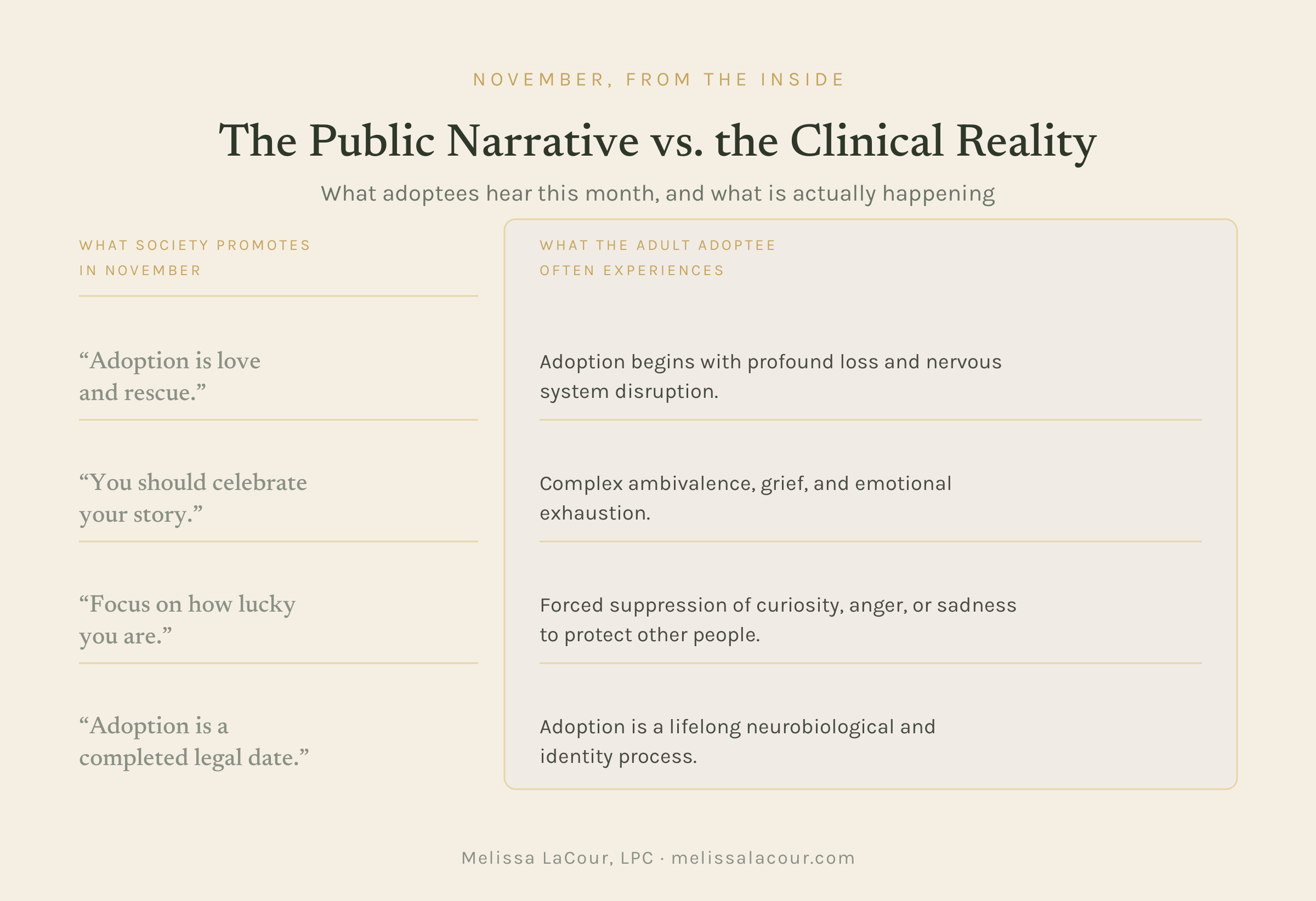
The primary reason National Adoption Month feels exhausting to adult adoptees is the stark disconnect between public narrative and internal reality.
Society generally treats adoption as a single, purely joyful event: a child needed a home, a family provided one, and everyone lived happily ever after. But for the person who was actually adopted, adoption is a lifelong developmental reality rooted in an initial, foundational loss.
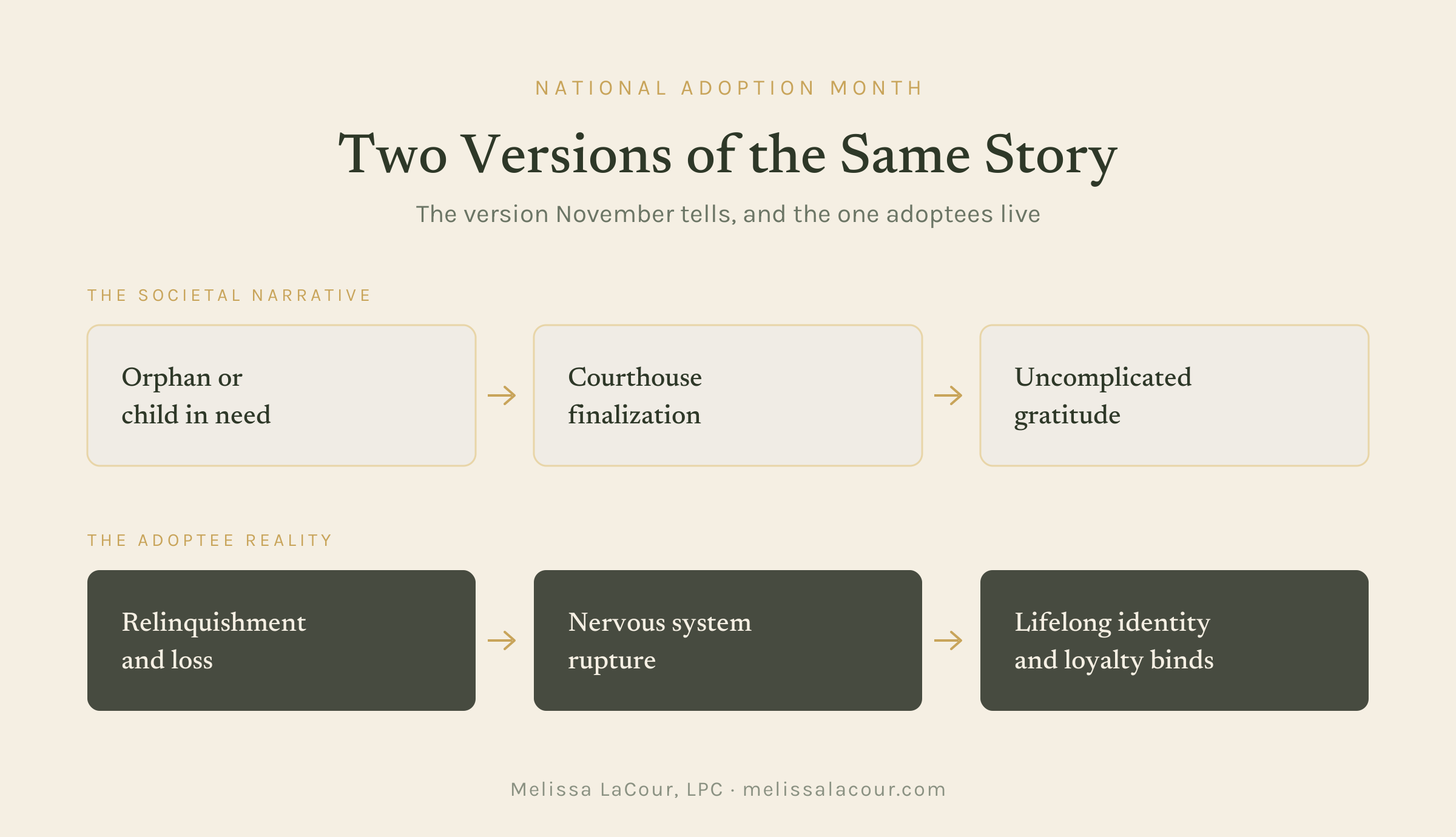
For an adoption to occur, a child first had to lose their biological family, ancestral line, genetic mirroring, medical history, and original identity. Society eagerly celebrates the second chapter of the book—the formation of the adoptive family—while demanding that the adoptee act as though the first chapter was never written.
4 Reasons November Triggers Adult Adoptees
Disenfranchised Grief Is Pushed to the Surface
Disenfranchised grief refers to a loss that is not openly acknowledged, socially validated, or publicly mourned. When the culture spends thirty days declaring adoption to be an unmitigated blessing, an adoptee’s grief over their original separation has nowhere to go. Suppressed grief often turns inward, presenting as irritability, depressive episodes, or somatic fatigue.
The Compulsory Gratitude Script
Adoptees grow up under a pervasive societal rule: be grateful. In November, this expectation is amplified. You may encounter well-meaning friends, colleagues, or adoptive family members who tag you in posts, send texts congratulating you on your adoption, or ask you to share your "inspirational story." Being expected to perform gratitude on command while privately feeling conflicted creates immense cognitive dissonance.
Erasure of the Adult Perspective
National Adoption Month campaigns focus almost exclusively on babies, young children, and prospective adoptive parents. Adult adoptees—the only people in the adoption constellation who have lived the entire experience through to adulthood—are frequently excluded from the conversation, spoken over, or dismissed when they articulate the realities of adoption trauma.
Compounded Holiday Triggers
November is not just National Adoption Month; it is also the kickoff to the major holiday season. Family-centric holidays like Thanksgiving bring immediate, practical triggers:
Sitting at a table with relatives you do not genetically resemble.
Managing delicate loyalty binds between adoptive families, birth families, or secret search desires.
Fielding awkward questions from extended family about your origins or background.
How to Protect Your Mental Health This November
You do not have to perform for anyone during National Adoption Month. Here are practical strategies to maintain your boundaries:
Curate Your Digital Environment: You have full permission to mute hashtags like #NationalAdoptionMonth, #AdoptionAwareness, or #GotchaDay on social platforms. Taking a thirty-day sabbatical from social media is a valid coping mechanism.
Decline the Invitation to Perform: If people ask for your thoughts, an inspirational quote, or your adoption story, a simple boundary script works: "Adoption is a deeply personal, lifelong experience for me, and I prefer not to discuss it publicly."
Seek Out Adoptee-Only Spaces: When surrounded by dominant cultural narratives, spending time in peer-led adoptee spaces or listening to adoptee voices reminds you that you are not the only one feeling this way.
Separate Grief from Ingratitude: You can appreciate the people who raised you and still mourn the biological continuity you lost. Both truths exist together.
Move Through November With Adoption-Competent Support
If the cultural noise of November is bringing up old loyalty binds, unresolved grief, or identity struggles, you do not have to navigate it alone—or spend session time explaining your feelings to a therapist who doesn't understand adoption.
Clinical Specialization: C.A.S.E. Training for Adoption Competency (TAC)
Dual Lens: Licensed Professional Counselor (LPC) & Adult Adoptee
In-Person Office: 143 Ridgeway Drive, Lafayette, LA 70503
Telehealth Coverage: Providing online therapy across Louisiana, Georgia, Indiana, Minnesota, and Ohio.
Schedule a Free Telehealth Consultation →
Frequently Asked Questions
Why is National Adoption Month hard for adult adoptees?
National Adoption Month often centers purely celebratory and savior narratives while ignoring the foundational grief, loss of identity, and genetic separation inherent in adoption. This can make adoptees feel unseen, pressured to express forced gratitude, or isolated.
What is disenfranchised grief in adoption?
Disenfranchised grief is grief that is not recognized, validated, or allowed by society. Because society views adoption as an unambiguous positive, an adoptee’s genuine grief over the loss of their biological family, origins, and genetic mirroring is often dismissed or silenced.
How can I support an adult adoptee during National Adoption Month?
Avoid assuming they want to celebrate. Do not congratulate them on being adopted or tell them how lucky they are. Instead, listen without defensiveness, acknowledge the complexity of their experience, and give them permission to feel ambivalent or frustrated.
Can therapy help with adoption-related triggers in November?
Yes. Working with an adoption-competent therapist provides a safe, validating container where you can process complex feelings, untangle loyalty binds, and build protective boundaries without having to justify why the month is difficult.