
One of the most persistent, guilt-inducing experiences reported by adult adoptees is feeling like a guest or alien in their own family. You might look at a room full of adoptive relatives at a holiday dinner—people who raised you, supported you, and love you deeply—and feel an unexplainable sense of distance.
Adoptees often internalize this disconnect as personal brokenness or ungratefulness. However, clinically speaking, feeling disconnected from your adoptive family culture is a natural identity response, not a failure of love.
What Is Genetic Mirroring?
In non-adoptive families, identity development relies heavily on genetic mirroring. From infancy through adolescence, non-adopted children receive constant biological feedback:
"You have your grandmother's eyes."
"You laugh just like your uncle."
"Your father was hyper-focused and artistic at your age, too."
This constant visual and physiological feedback tells the child's nervous system: I belong to this gene pool. My traits are recognized, expected, and understood.
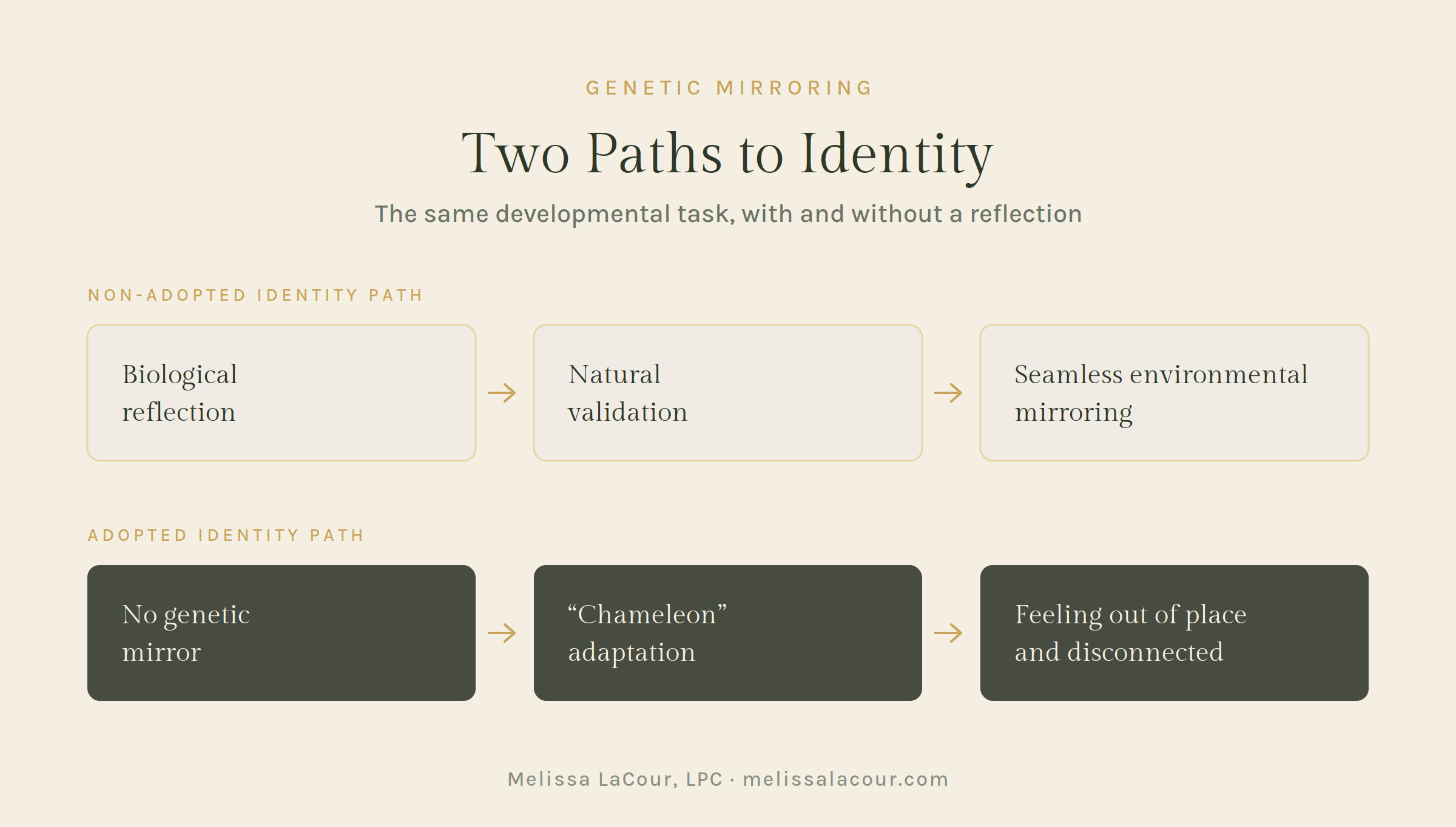
When an adoptee grows up without genetic mirroring, they lack this subconscious validation. Even in a warm adoptive home, you may have different sensory processing levels, learning styles, physical features, or emotional temperaments than everyone else in the house.
Environmental Attachment vs. Genetic Mirroring
To understand why you can feel loved yet fundamentally disconnected, it helps to separate environmental attachment from genetic alignment:
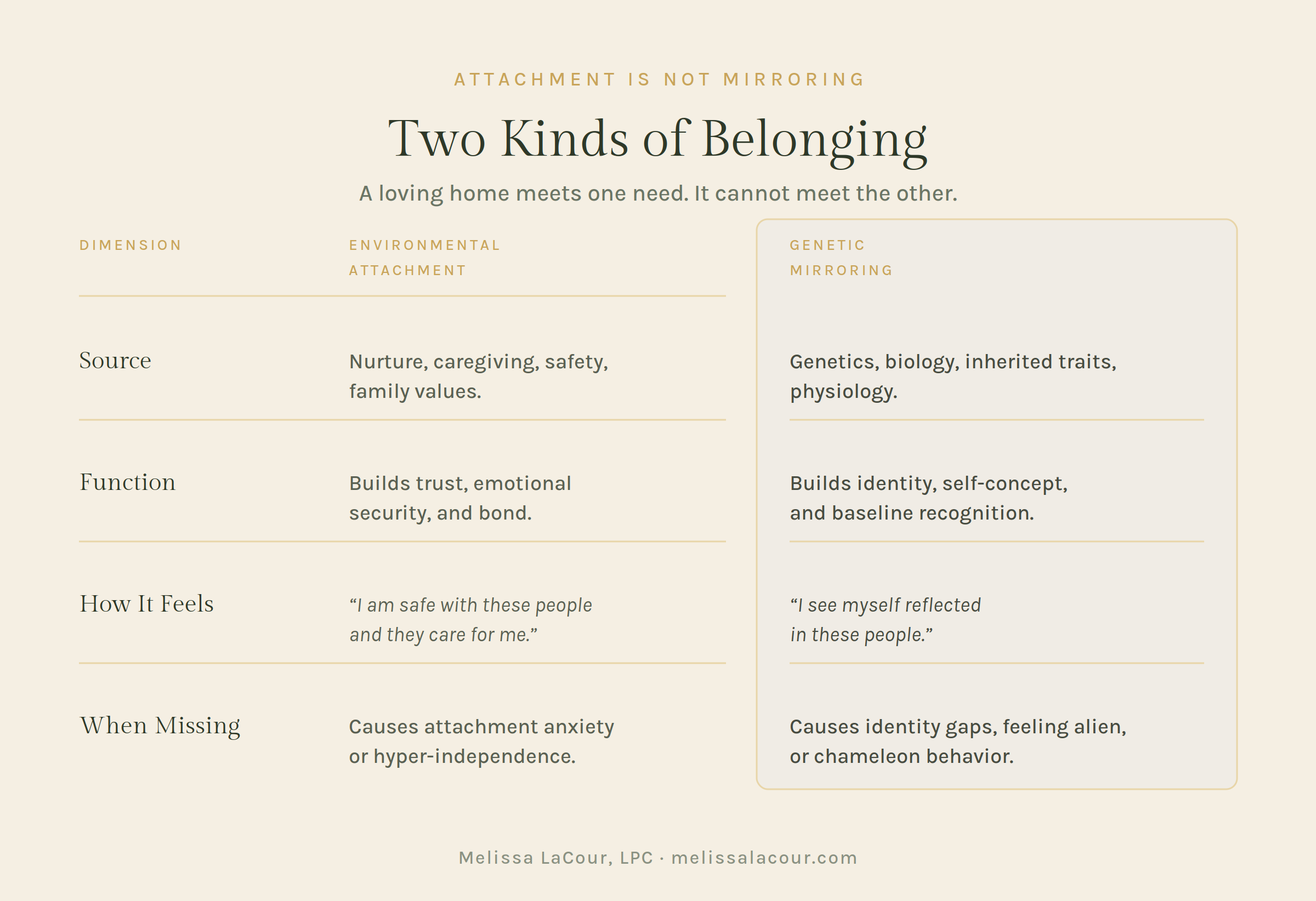
You can have a secure environmental attachment with your adoptive parents while simultaneously experiencing a total absence of genetic mirroring. One does not erase the other.
The "Chameleon Effect" in Adult Adoptees
When children lack genetic mirroring, their survival instinct is often to adapt by becoming a chameleon.
To maintain safety and belonging, you may have unconsciously mirrored your adoptive family's mannerisms, political views, hobbies, or emotional style. As an adult, maintaining this chameleon state requires immense energy, leading to chronic exhaustion during family gatherings.
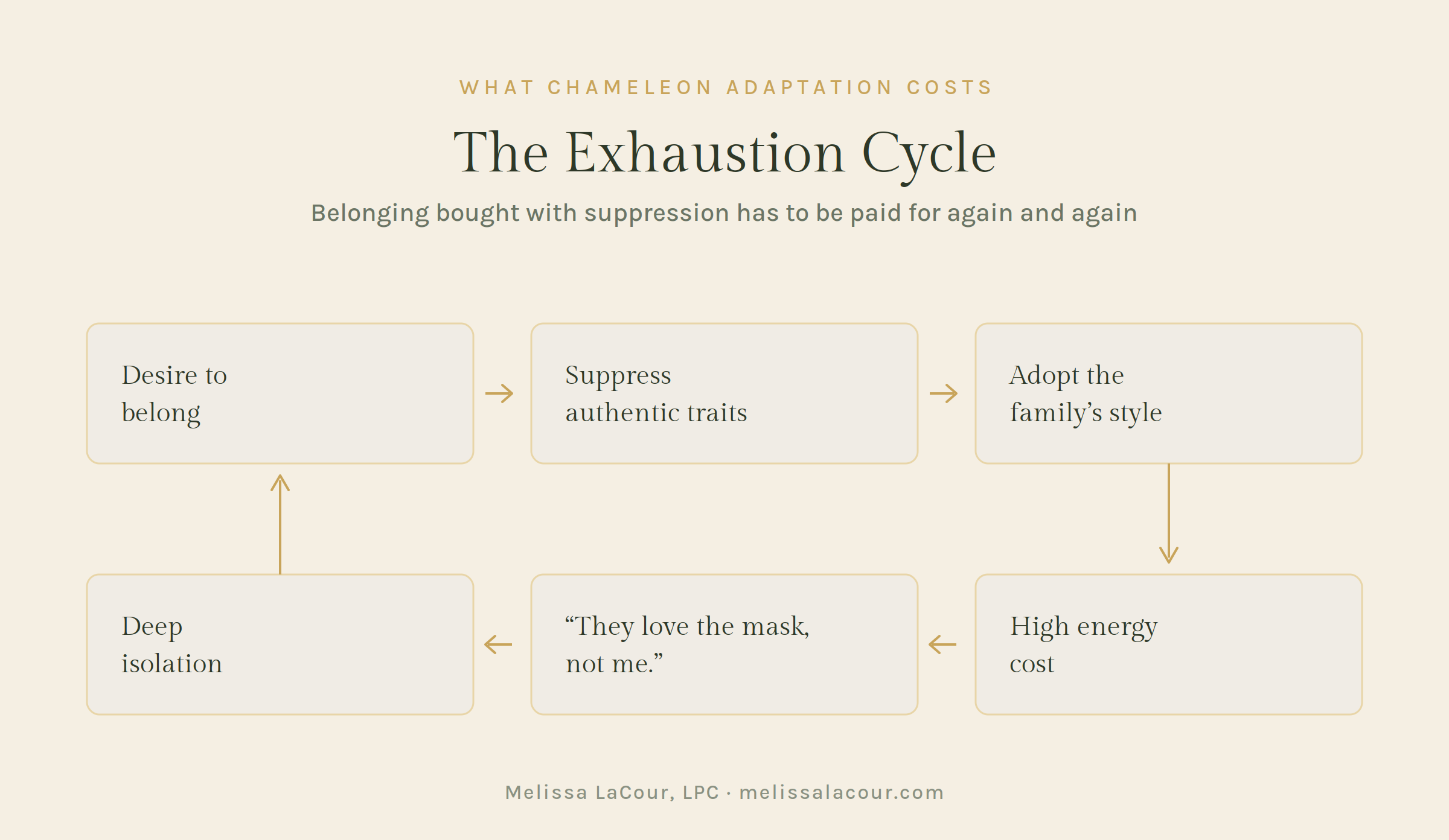
The moment you relax the chameleon mask and express your authentic temperament, the contrast between you and your adoptive family becomes stark—leaving you feeling out of place once again.
4 Ways to Navigate Adoptive Family Disconnect
Uncouple Gratitude from Identity: Remind yourself that desiring genetic alignment is a basic human need, not an insult to the family that raised you.
Name the Lack of Mirroring: Acknowledge that feeling different is a biological reality, not a personality flaw.
Seek Out Biological Mirrors: Engaging in search, finding biological relatives, or connecting with adult adoptee peer groups can provide the missing reflection you've been seeking.
Drop the Chameleon Mask: Practice showing up as your authentic self in small, manageable ways, allowing your family to know the real you rather than the adapted version.
Specialized Therapy for Adult Adoptees
Navigating identity gaps, family dynamics, and the loneliness of feeling out of place doesn't have to be done alone.
Clinical Specialization: C.A.S.E. Training for Adoption Competency (TAC)
Dual Perspective: Licensed Professional Counselor (LPC) & Adult Adoptee
In-Person Office: 143 Ridgeway Drive, Lafayette, LA 70503
Telehealth Footprint: Serving clients across Louisiana, Georgia, Indiana, Minnesota, and Ohio.
Schedule a Free Consultation →
Frequently Asked Questions
Is it normal to feel like an outsider in my adoptive family?
Yes. It is one of the most common experiences reported by adult adoptees. It typically stems from a lack of genetic mirroring rather than a lack of love or effort from your adoptive parents.
What is genetic mirroring in adoption?
Genetic mirroring is the experience of seeing your physical features, personality traits, talents, and temperament reflected in biological family members. Lacking this reflection can make identity development more challenging.
Does feeling disconnected mean I don't love my adoptive family?
No. Love (attachment) and genetic alignment (identity) are separate psychological processes. You can love your family deeply while still recognizing that you are fundamentally different from them in temperament or biology.
How can therapy help with genetic mirroring issues?
An adoption-competent therapist helps you process identity gaps, release guilt over feeling different, unlearn compulsory "chameleon" behaviors, and build authentic self-worth.