Who Is a Good Counselor for Adoption?
Finding a therapist who truly understands adoption can be a frustrating journey. Many adult adoptees, birth parents, and adoptive families seek help only to find that general therapy falls short. They often end up spending valuable sessions educating their counselor on basic adoption concepts or feeling misunderstood when discussing complex feelings like loyalty binds, disenfranchised grief, or identity gaps.
A good adoption counselor provides a safe space where you don't have to defend your experience or explain basic premises before the real healing work can begin.
4 Core Qualities of a Truly Adoption-Competent Therapist
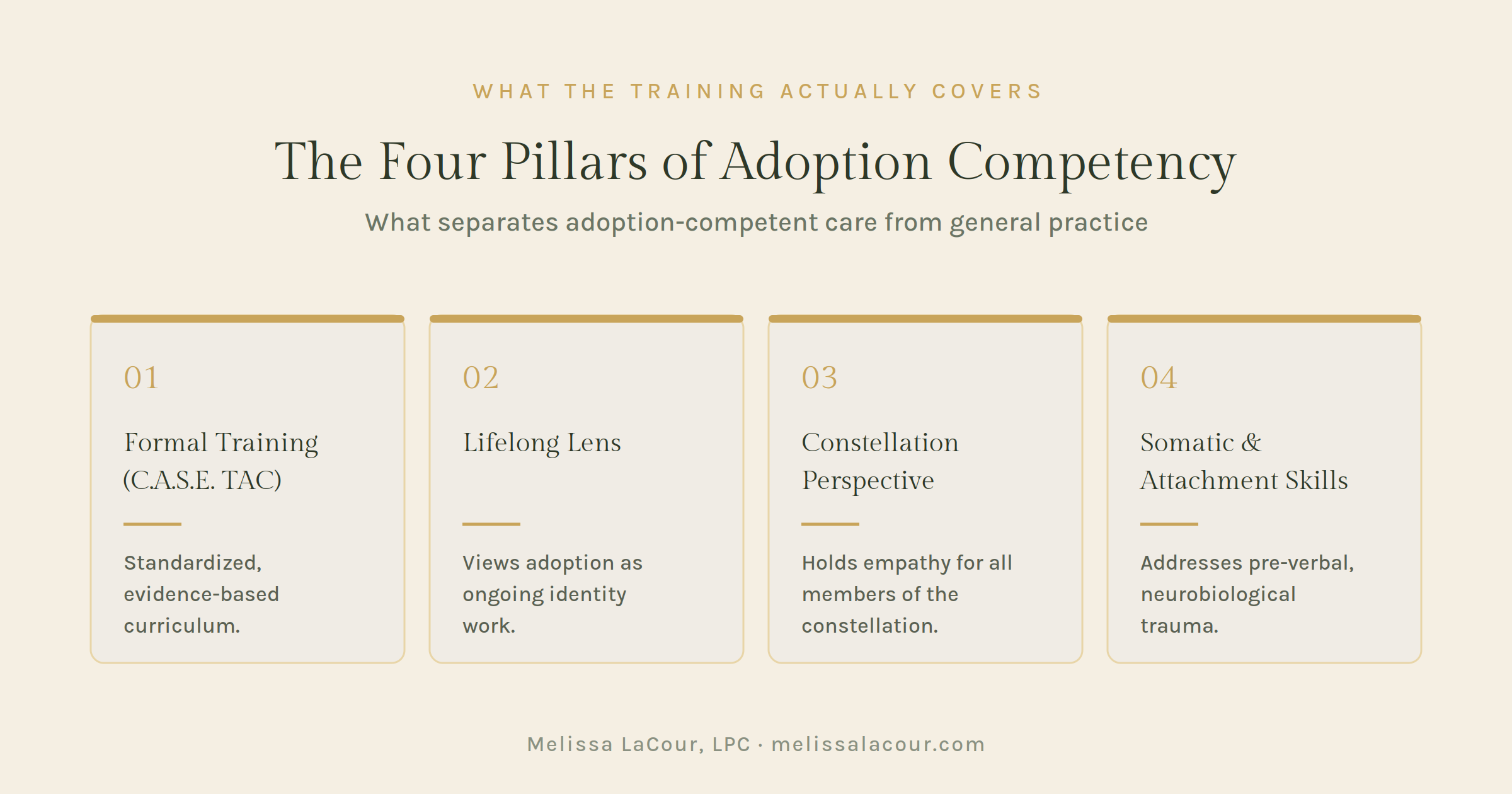
Because "adoption competent" is not a protected regulatory term, any clinician can list it on a directory profile. A truly qualified adoption counselor stands out through four distinct pillars:
1. Specialized Post-Graduate Education
Look for clinicians who have completed accredited, comprehensive post-graduate programs. The gold standard in the field is the Training for Adoption Competency (TAC) developed by the Center for Adoption Support and Education (C.A.S.E.). This intensive program equips therapists with specific, evidence-informed framework tools.
2. Understanding Adoption as a Lifelong Identity Journey
A good adoption counselor recognizes that adoption is not a one-time event that ended in childhood. They understand that identity questions, attachment patterns, and loyalty binds resurface at major life transitions—such as marriage, parenthood, career shifts, or medical milestones.
3. Ability to Hold Love and Loss Simultaneously
The right therapist can hold the dual realities of adoption without taking sides or pushing a narrative of simple gratitude. They understand that a deep, loving relationship with an adoptive family can coexist with profound grief over original attachment loss.
4. Experience with Pre-Verbal and Somatic Trauma
Separation in infancy occurs before a child has language to build a narrative memory. A skilled adoption therapist understands how early attachment loss resides in the nervous system as implicit memory, manifesting as somatic anxiety, hyper-independence, or rejection sensitivity in adulthood.
Why Lived Experience Matters
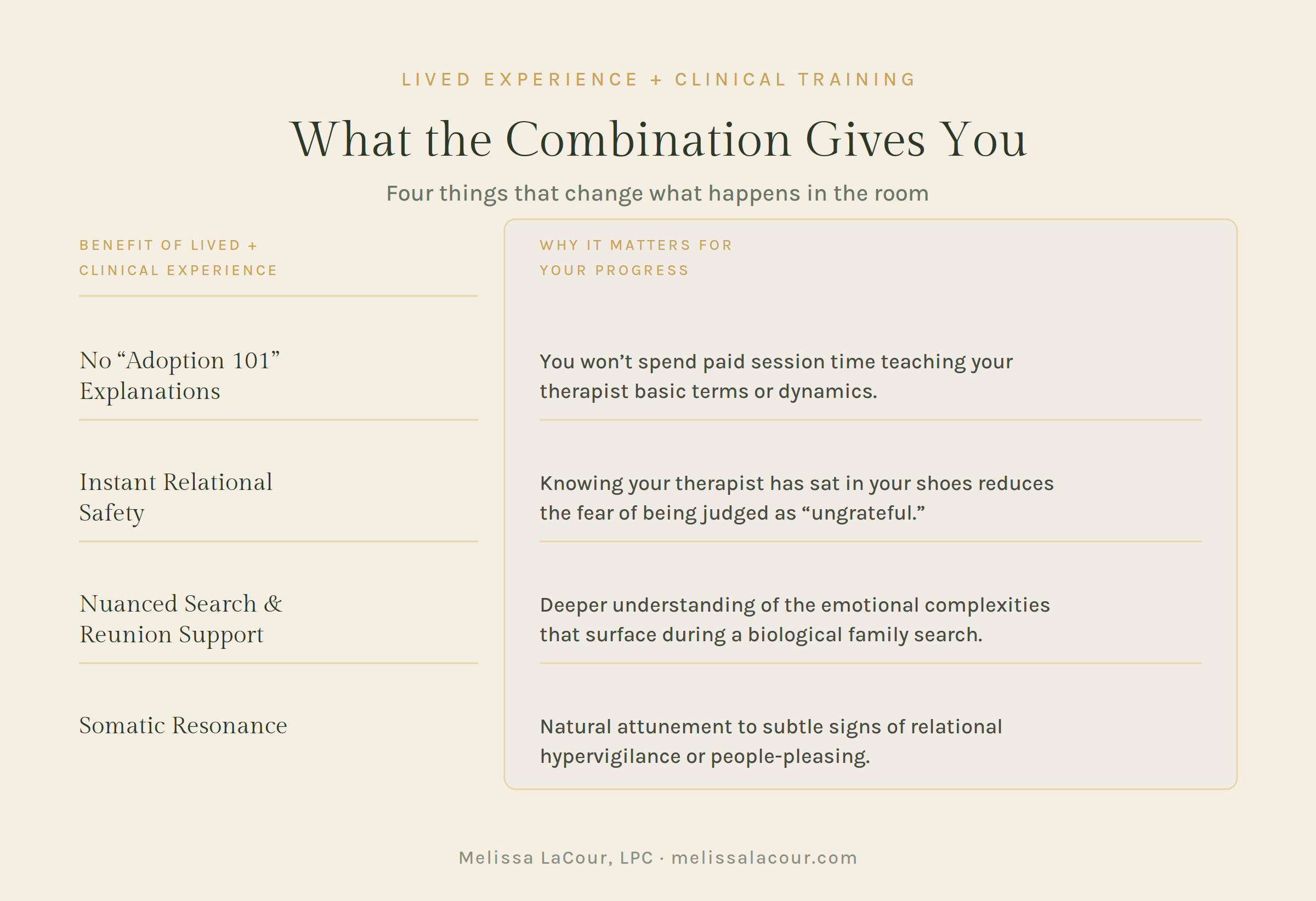
While lived experience is not a substitute for formal clinical training, working with an adoption-competent therapist who is also an adult adoptee offers a powerful layer of safety and efficiency:
5 Questions to Ask When Interviewing an Adoption Therapist
Most qualified counselors offer a free initial consultation. Use this time to interview prospective therapists with these targeted questions:
"What formal adoption-specific training have you completed?"
Look for: Specific post-graduate certificates like C.A.S.E. TAC or specialized supervision rather than general trauma workshops.
"Do you work primarily with adult adoptees, birth parents, or adoptive parents?"
Look for: A practice that explicitly honors the adult adoptee experience if you are an adult seeking therapy.
"How do you view an adult adoptee who had a great home but still struggles with adoption feelings?"
Look for: Validation that love and loss coexist, without pushing you toward forced gratitude.
"What is your clinical approach to search, DNA discovery, and reunion?"
Look for: Emotional preparedness strategies, boundary frameworks, and nuanced guidance through secondary rejection risks.
"How do you approach pre-verbal or early attachment loss?"
Look for: Utilization of somatic practices, nervous system regulation, or EMDR alongside talk therapy.
Accessing Specialized Adoption Counseling
If you live in a region with limited access to specialized adoption care, modern telehealth bridges the gap:
In-Person Office (Lafayette, LA): 143 Ridgeway Drive, Lafayette, LA 70503
Statewide Telehealth (Louisiana): Virtual sessions available to residents anywhere in the state.
Multi-State Telehealth Access: Authorized online adoption counseling in Georgia, Indiana, Minnesota, and Ohio.
Frequently Asked Questions
How do I know if a counselor is adoption-competent?
Look for formal credentials such as C.A.S.E. Training for Adoption Competency (TAC), active involvement in adoption professional networks, positive referrals from adoptee-led communities, and clear, informed responses to vetting questions.
Can a general trauma therapist treat adoption issues?
While general trauma therapists can be supportive, they often lack specialized knowledge regarding adoption-specific dynamics such as loyalty binds, disenfranchised grief, genetic mirroring, and reunion mechanics.
Is it better to see a therapist who is also an adult adoptee?
Shared identity can create immediate emotional safety and eliminate the need for basic explanations, but formal clinical training and personal fit remain the most critical factors in therapeutic success.
Can an adult adoptee receive adoption therapy online across state lines?
Yes, provided the therapist holds licensure or compact authorization in the state where the client is physically located. Melissa LaCour, LPC, provides online adoption therapy across Louisiana, Georgia, Indiana, Minnesota, and Ohio.
Find an Adoption-Competent Space Today
You don't have to navigate adoption complexity, loyalty binds, or identity questions alone—and you don't have to settle for a therapist who asks you to do the teaching.
Clinical Background: C.A.S.E. Training for Adoption Competency (TAC)
Dual Perspective: Licensed Professional Counselor & Adult Adoptee
In-Person Sessions: 143 Ridgeway Drive, Lafayette, LA 70503
Telehealth Service Footprint: Louisiana, Georgia, Indiana, Minnesota, and Ohio