
You spent nine months planning, preparing, and quietly imagining what it would feel like to finally look into the face of someone who shares your DNA. People told you that the second the baby arrived, a tidal wave of unconditional love would wash over you.
Instead, the baby was placed on your chest, and the room went strangely flat.
You care for your child. You feed them, change them, rock them, and check their breathing obsessively. But the overwhelming, cinematic wave of attachment isn't there. Instead, you feel distant, robotic, or terrifyingly numb.
And then comes the thought that makes your stomach drop:
What is wrong with me? Am I repeating the abandonment? Am I incapable of bonding?
As a Licensed Professional Counselor with specialized adoption competency training—and as an adult adoptee myself—I need you to hear this with absolute clarity: You are not broken, you are not a bad parent, and you are not repeating history. Your nervous system is trying to protect you.
Why Bonding Feels Dangerous to an Adoptee’s Nervous System
Society teaches us that bonding is a simple, automatic reflex. In reality, bonding requires profound vulnerability.
To deeply bond with an infant, your nervous system must open itself to total attachment. But for an adult adoptee, the earliest neurobiological lesson ever recorded was this: the person I attached to completely disappeared.
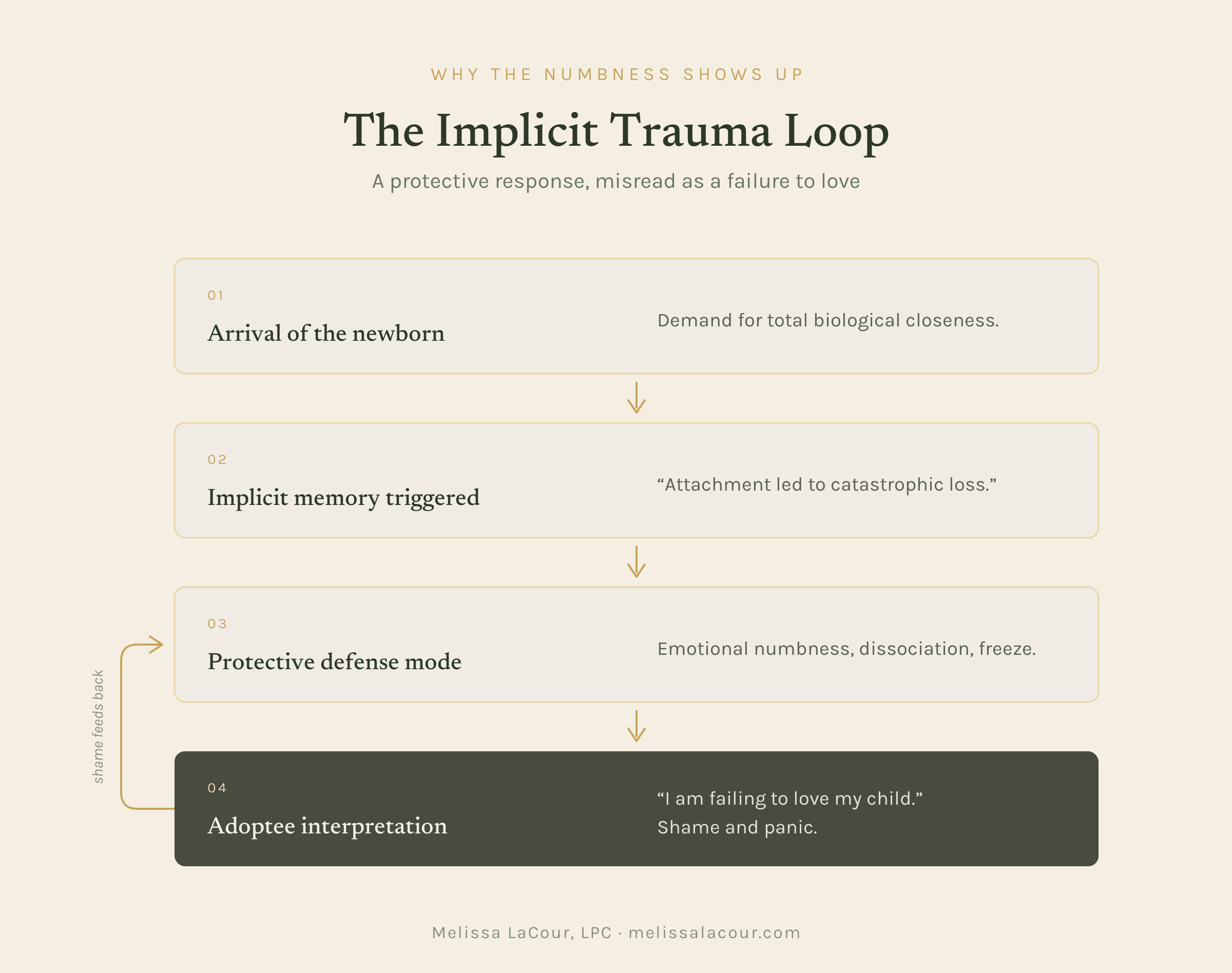
Infants do not have narrative memory, but the body remembers somatic disruption. When you hold your own biological child, your nervous system is thrust back into the landscape of early attachment. If your body registers deep closeness as an existential vulnerability, its default survival mechanism is dorsal vagal shutdown (the freeze response).
The numbness you feel is not a lack of love. It is an internal emotional circuit breaker designed to keep you from feeling overwhelmed.
The Difference Between Detachment and Caregiving
When adoptee parents panic about delayed bonding, they often mistake a temporary lack of feeling for a lack of commitment.
Notice the vital clinical distinction between detachment and functional caregiving under trauma stress:
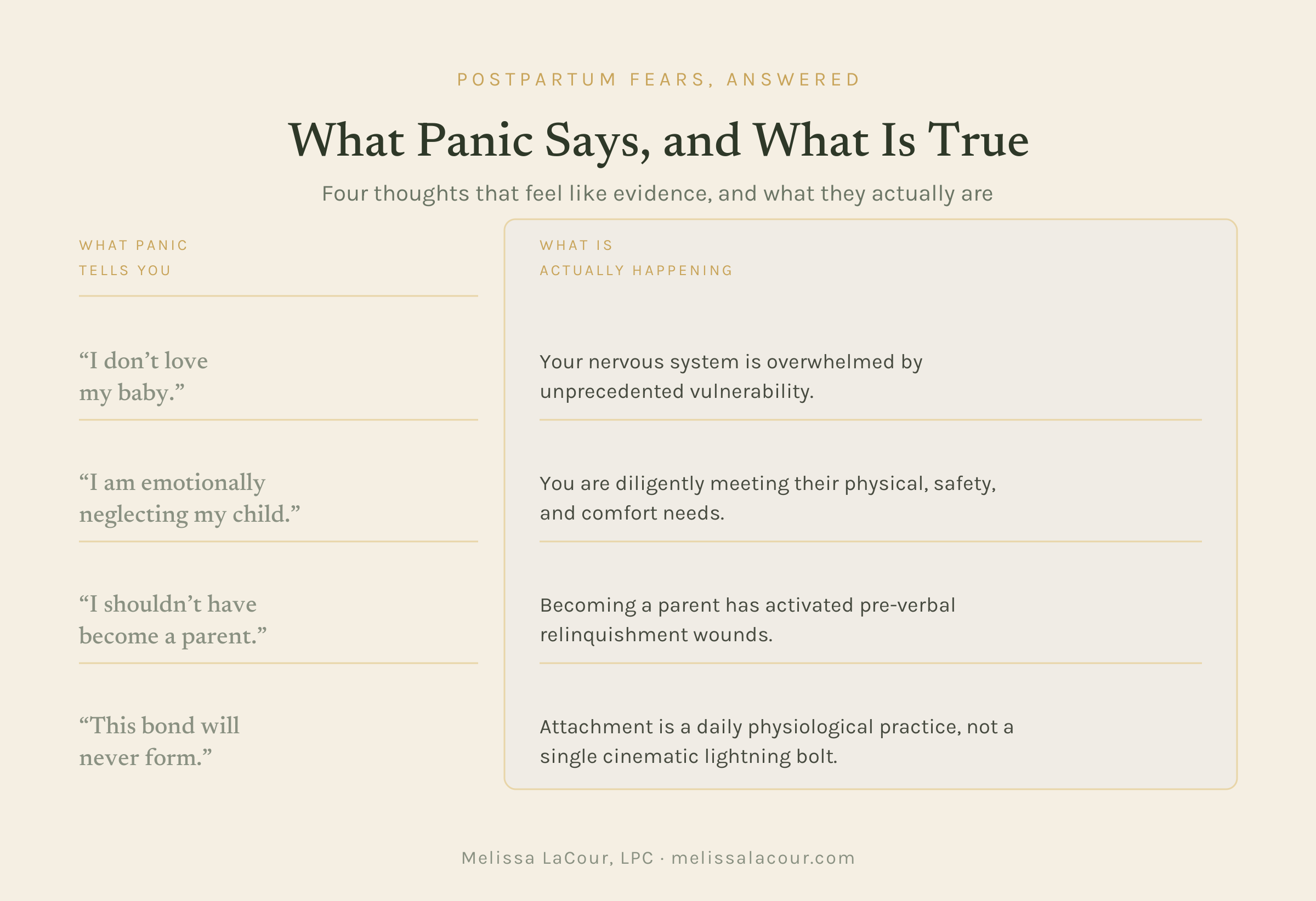
Bonding is not a light switch flipped in the delivery room; it is a slow neurobiological attunement built through daily, repetitive interactions. Your baby does not know whether you feel fireworks in your chest; your baby registers your warm skin, your rhythmic breathing, your voice, and your consistent response to their cries.
4 Common Triggers That Cause Bonding Delays in Adoptees
The Shock of the First Genetic Mirror
For most adult adoptees, their child is the very first biological relative they have ever seen. Looking at an infant who shares your eyes, hands, or nose can trigger profound cognitive and emotional disorientation. It highlights the vastness of the genetic continuity you were denied, unlocking delayed grief alongside new parenthood.
Grieving Your Own Infant Self
Holding a tiny, fragile newborn frequently brings up intense, unspoken grief for what happened to you as an infant. Seeing how utterly vulnerable a baby is makes the reality of your own early separation palpable. Your mind might wonder: How could anyone have let me go? That unprocessed grief can temporarily crowd out joyful feelings.
Hypervigilance Masquerading as Distance
Adoptee parents often channel their anxiety into hyper-vigilant care: checking the monitor fifty times an hour, tracking ounces with extreme perfectionism, or refusing to let anyone else help. This hyper-arousal exhausts the adrenal system, leaving you with zero emotional energy left for soft, relaxed connection.
Fear of Rejection by the Infant
If your baby cries incessantly, struggles with latching, or arches away during a fussy period, an adoptee's implicit memory may misinterpret normal infant dysregulation as personal rejection ("Even my own baby doesn't want me"). This can trigger an instinctive urge to pull back emotionally to protect yourself from pain.
How to Build Attachment When You Feel Numb
Attachment does not require you to force feelings you do not currently have. Instead, focus on small, somatic invitations that signal safety to both your baby’s nervous system and your own:
Prioritize Skin-to-Skin Contact: Rest your baby directly on your bare chest without the pressure to "feel" anything specific. Skin-to-skin contact stimulates natural oxytocin release, regulates the infant’s autonomic system, and physically co-regulates your nervous system.
Practice Gentle Narration: Talk out loud to your baby about ordinary things: "We're folding your laundry now," or "I'm pouring some water." Hearing your voice provides auditory regulation for your infant while anchoring your mind in the present physical room.
Release the "Magical Moment" Myth: Let go of the expectation that bonding happens in a single euphoric realization. View attachment like watering a plant: quiet, daily, and cumulative.
Name the Numbness Without Shame: Say internally: "My body is feeling numb because it thinks closeness is dangerous. I am safe, my baby is safe, and we have time to learn each other."
When to Seek Adoption-Competent Perinatal Support
If emotional numbness, severe anxiety, or intrusive catastrophic fears persist beyond the early weeks, professional support can help you untangle your early adoption wounds from your present parenthood.
Working with an adoption-competent clinician ensures you will not be misdiagnosed or judged. You won't have to defend your love for your child while exploring the genuine trauma of early attachment disruption.
Clinical Specialization: Graduate of C.A.S.E. Training for Adoption Competency (TAC)
Lived Experience: Licensed Professional Counselor (LPC) and Adult Adoptee
In-Person Office: 143 Ridgeway Drive, Lafayette, LA 70503
Telehealth Service Footprint: Specialized online therapy for adoptees across Louisiana, Georgia, Indiana, Minnesota, and Ohio.
Schedule a Free Telehealth Consultation →
Frequently Asked Questions
Is it normal for an adult adoptee not to feel an instant bond with their newborn?
Yes. Many adult adoptees experience a temporary emotional freeze response after childbirth. Because early adoption involves the severing of primary attachment, stepping into the biological parent role can trigger implicit fears of vulnerability and loss, causing the nervous system to shut down feelings to maintain safety.
How does adoption trauma impact postpartum attachment?
Adoption trauma often presents as intense hypervigilance, emotional numbness, fear of losing the child, or sudden grief over one's own infant separation. These trauma responses can temporarily block the relaxed, receptive state needed for immediate emotional bonding.
Does delayed bonding mean I will never have a close relationship with my child?
No. Attachment is a developmental process built through consistent caregiving, responsiveness, and repair over time—not a single emotional event in the hospital. Children develop secure attachment through reliable physical care, attunement, and routine interactions.
How is postpartum therapy different with an adoption-competent therapist?
An adoption-competent therapist understands that postpartum struggles in adoptees are often rooted in pre-verbal trauma, disenfranchised grief, and genetic mirroring shock, rather than simple hormonal depression or parental ambivalence. They help you process the primal wound without judgment.